
The Short Answer
A 510 thread cartridge connects with an M7 x 0.5mm male thread: ten threads cut at a 0.5mm pitch, which is exactly where the name comes from. Body diameter runs 10.5mm to 12mm. A 0.5ml cartridge stands 48mm to 53mm tall and a 1.0ml cartridge stands 65mm to 75mm tall, mouthpiece included.
What the 510 Designation Actually Standardizes
The number describes the connector, nothing else. Ten threads at a 0.5mm pitch on a 7mm major diameter post. The male thread sits on the cartridge base, the female receptacle sits inside the battery, and a spring-loaded center pin protrudes roughly 0.5mm to 1mm past the thread face to carry the positive contact. Thread engagement on production hardware lands between 4mm and 5mm.
Everything above that thread is unregulated. Two cartridges that screw onto the same battery can differ by 2mm in body diameter, 10mm in overall height, and 4mm at the mouthpiece. That is the fact that governs vape packaging: 510 compatibility guarantees electrical fit and says nothing about carton fit. Brands that spec a tuck box from a battery-compatibility assumption end up with cartridges that rattle in transit or cartons that will not close over the mouthpiece.
Standard 510 Cartridge Dimensions by Tank Volume
Measure overall height from the tip of the mouthpiece to the base of the threads. That number, not the tank volume on the invoice, is what your carton cavity must clear.
| Tank volume | Body diameter | Overall height | Mouthpiece width | Typical use |
|---|---|---|---|---|
| 0.3 ml | 10.0 - 10.5 mm | 42 - 46 mm | 9 - 11 mm | Microdose and low-potency SKUs |
| 0.5 ml | 10.5 - 11.5 mm | 48 - 53 mm | 9 - 12 mm | Entry price point, multi-packs |
| 1.0 ml | 10.5 - 12.0 mm | 65 - 75 mm | 9 - 13 mm | Flagship US regulated SKU |
| 2.0 ml | 12.0 - 14.0 mm | 78 - 86 mm | 10 - 14 mm | International nicotine hardware |
Why the Table Is a Starting Point, Not a Dieline
The 1.0ml format is the volume most state-licensed cannabis operators build their flagship SKU around. The 0.3ml format shows up in microdose and low-potency lines. The 2.0ml tank is common in international nicotine hardware because the EU Tobacco Products Directive caps refillable tank capacity at 2ml, and it is rare in US regulated cannabis, where per-package THC caps push brands toward smaller tanks and multi-cart cartons instead.
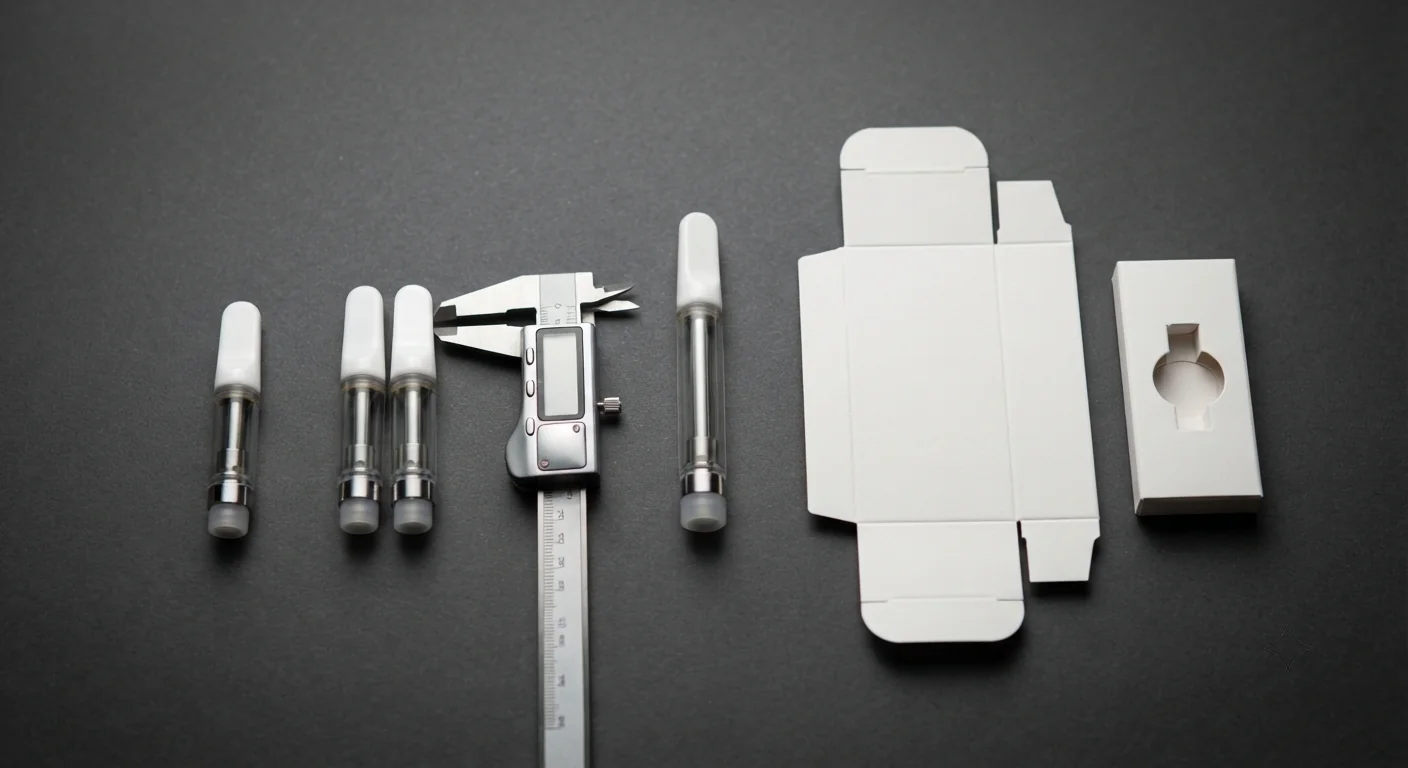
Hardware tolerance is the trap inside that table. Injection-moulded and glass-blown components carry batch variance of roughly 0.3mm on diameter and 0.5mm on height, and that variance moves per production lot, not per supplier. Measure five units from the lot you are packing, take the largest reading on each axis, and build the dieline from that figure rather than the supplier spec sheet.
How Ceramic Core Architecture Shifts the Numbers
Ceramic core cartridges sit at the upper end of every dimensional range. A porous ceramic heating element wraps a center post that displaces internal tank volume, so a ceramic 1.0ml cart runs roughly 3mm to 5mm taller than a cotton-wick cart of the same stated capacity and the same body diameter. Glass tank walls add another 1.0mm to 1.5mm per side before you reach the oil.
Oil intake holes are the other spec that separates hardware families. Production carts ship with 0.8mm, 1.2mm, 1.6mm, or 2.0mm intake ports, matched to viscosity: sub-1.0mm ports for thin distillate, 1.6mm and 2.0mm for live resin and rosin. Coil resistance sits between 1.0 and 1.8 ohms across most ceramic cores, with an operating window of 2.8V to 3.6V. None of these 510 cartridge specs change your dieline directly. They change which hardware a brand commits to, and the hardware sets the box.
The Mouthpiece Is the Widest Point on the Cartridge
Insert cavities fail at the mouthpiece, never at the tank. The mouthpiece column above spans every profile; the figures below are typical per profile. Four profiles cover almost all current hardware. Round ceramic tips measure approximately 11.5mm in diameter and add 8mm to 10mm of height above the tank shoulder. Flat ceramic tips, the duck-bill profile, run 12mm to 13mm across the wide axis and 7mm to 8mm across the narrow axis. Tapered polycarbonate tips are the slimmest at 8.5mm to 9.5mm. Wood and metal hybrid tips exceed 12mm and add mass that changes how the cart settles into a foam cavity.
Cut the insert cavity to the widest measured point plus clearance, then check the narrow axis separately. An oval flat tip dropped into a round cavity rotates freely, and a cartridge that rotates inside a window carton presents the back of the label to the customer at shelf. A rectangular cavity keyed to the flat tip solves it without adding a millimetre to the outer carton.
Proprietary Pod Formats That Are Not 510
Magnetic and friction-fit pods abandoned the threaded connector entirely. The typical rectangular pod envelope measures 40mm to 46mm tall, 19mm to 22mm wide, and 9mm to 12mm deep. All-in-one disposables run wider and longer still: 15mm to 22mm across and 90mm to 115mm tall with the battery integrated, with the low battery mass tipping tall narrow cartons forward on a shelf.
Pod geometry rewards a different structure. A flat pod face is a label surface, which is why pod brands frequently move to a shallow two-piece rigid box where the pod lies flat and reads like a product rather than standing upright like a pen. Pod contacts sit exposed on the base, so specify a barrier liner in any carton shipping through humid distribution lanes.
Turning Cannabis Cartridge Dimensions Into a Carton Dieline
Three clearance rules cover the vast majority of vape cartridge box dimensions and decide whether your vape boxes hold the cart still or let it slide.
| Insert type | Clearance per side | Total per axis | Notes |
|---|---|---|---|
| Paperboard platform | +1.5 mm | +3.0 mm | Most common for single-cart retail cartons |
| Foam or EVA cavity | +3.0 mm | +6.0 mm | Required for glass tanks at 1.0 ml and above |
| Friction-fit sleeve | +0.5 mm | +1.0 mm | No insert, relies on board memory |
The Clearance Math, Worked
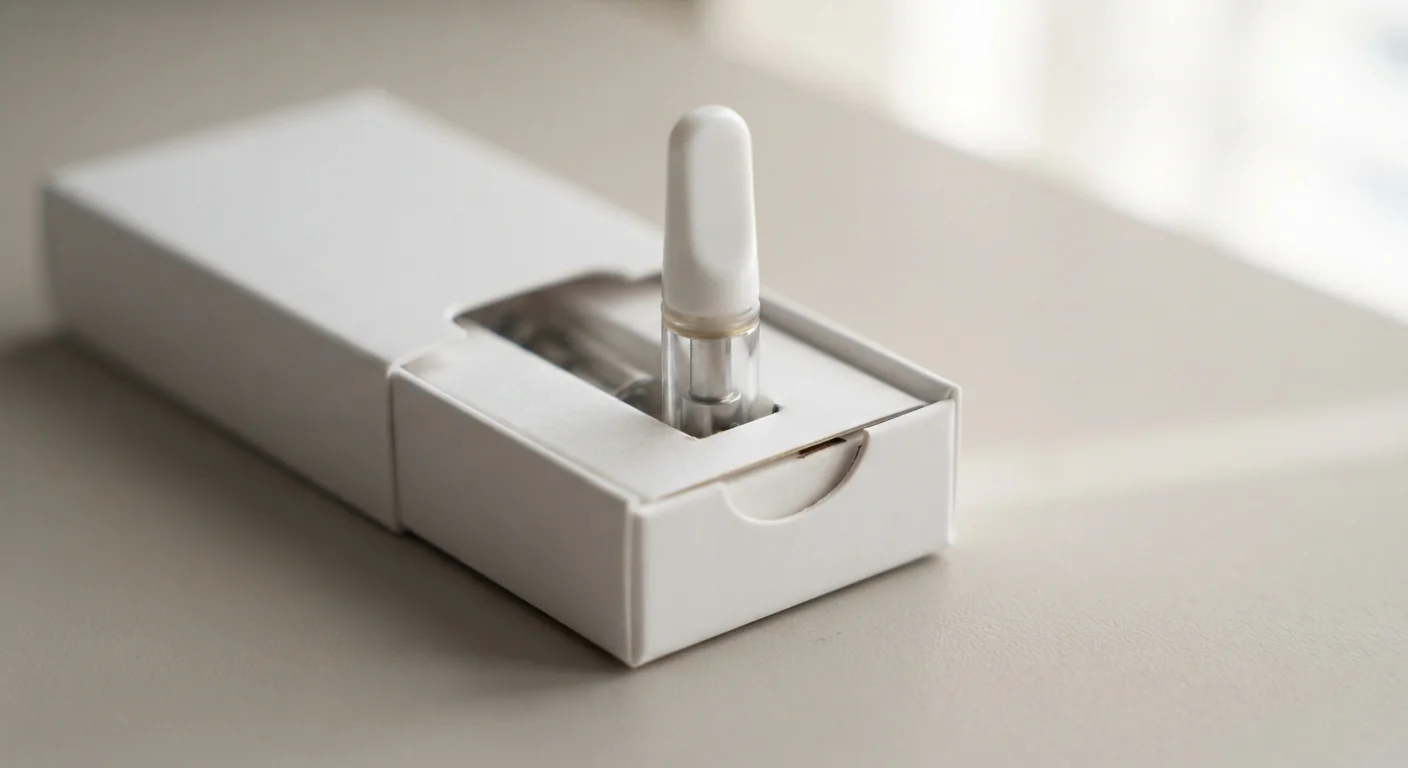
Read those figures per side, then double them. Worked example: a ceramic 1.0ml cart measuring 11.5mm at the mouthpiece and 70mm overall, packed on a paperboard platform. Width is 11.5 + 1.5 + 1.5, which is 14.5mm. Height is 70 + 1.5 + 1.5, which is 73mm. Internal carton is 14.5mm x 14.5mm x 73mm. Round up to the next half-millimetre and never round down into the clearance. Board thickness sits outside that figure: 350gsm SBS runs approximately 0.45mm caliper, so external lands under 1mm above internal per axis.
For material, 350gsm SBS C1S is the working minimum for 510-thread vape cartridge boxes in this category. Move to 400gsm, roughly 20pt caliper, for retail shelf presence, and to 24pt, approximately 480gsm, for any carton carrying a magnetic closure. Multi-cart cartons in 2, 4, and 5-count configurations need a scored platform or a 1.5mm greyboard divider, because loose cartridges knocking together crack glass tanks in distribution. Window patches should be 30 micron PET, die-cut smaller than the tank face so the patch edge never sits on a score line.
Compliance Dimensions That Change the Box
Child-resistant performance is classified under ASTM D3475 and tested under the CPSC protocol at 16 CFR 1700.20, which uses a panel of children aged 42 to 51 months and adults aged 50 to 70. Push-tab tucks, slide-lock sleeves, and locking-tab custom tuck boxes each add 2mm to 4mm of internal depth on the locking wall. Specify the child-resistant mechanism before the dieline is cut, not after the first proof comes back.
Warning panel real estate is the second constraint. State cannabis programs commonly mandate a universal symbol at a 0.5 inch minimum dimension alongside government warning text at a 6pt minimum. On the 14.5 x 14.5 x 73mm carton above, the largest available panel measures roughly 14.5mm by 73mm, about 1.6 square inches. A half-inch symbol consumes a meaningful share of that face before a single brand element is placed. Operators solve it by upsizing the carton 3mm to 5mm per axis or by adding a fold-out leaflet panel that carries the regulated copy off the primary display face.
That trade-off, regulated copy against brand surface, is the real design constraint in this category.
Frequently Asked Questions
Our Packaging Products
Elevate Your Brand With Custom Packaging
Get packaging designed for your brand. Free shipping. No minimums.
Start TodayAuthor
Trevor Lang
Trevor Lang writes on cannabis and vape packaging compliance, with a focus on child-resistant carton qualification and 510 hardware sourcing for licensed brands. His work covers the point where hardware tolerances meet state packaging rules.