The Standard Cake Box Sizing Rule
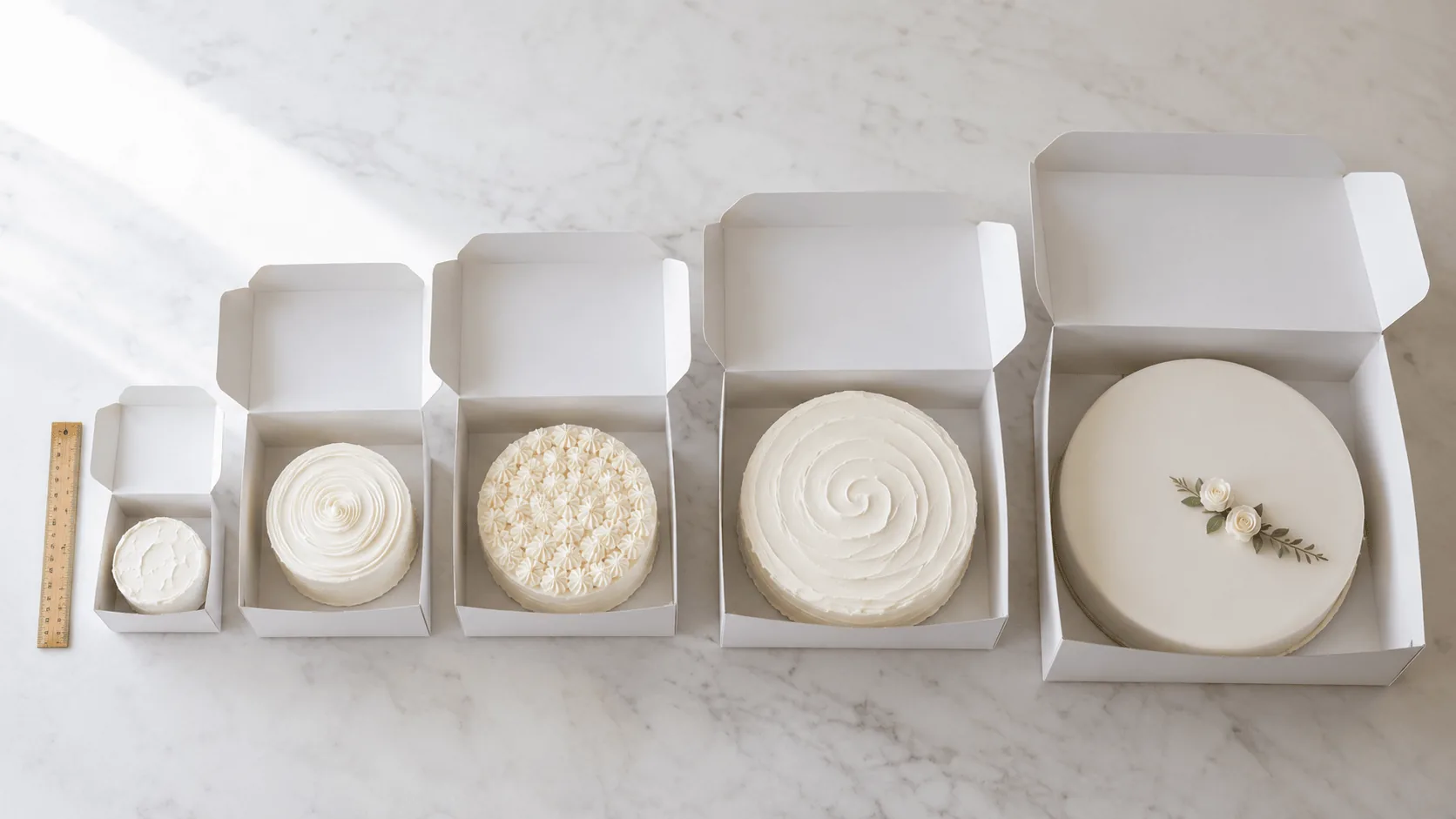
Every commercial bakery follows the same dimensional rule: cake diameter plus 2 inches equals box width. The extra inch on each side prevents the frosting from contacting the corrugated wall during transport, which is the single most common cause of cake damage between counter and customer. The same rule applies to depth: total cake height plus 1 inch of headroom equals minimum box height.
This rule is not aesthetic. Frosting transfers heat differently than baked crumb, and any wall contact during a 70°F to 35°F refrigerator transition creates a smear point that telegraphs through buttercream within 4 to 6 hours. A 1-inch buffer eliminates the contact entirely.
Cake Box Dimensions by Cake Size
The table below covers the five most-ordered cake diameters across U.S. retail bakeries. Weight estimates assume a filled buttercream cake with one layer of fruit or ganache filling, calculated at approximately 0.8 lb per square inch of base area.
| Cake Diameter | Recommended Box (L × W) | Standard Depth Options | Typical Cake Weight (Filled) | Best Use Case |
|---|---|---|---|---|
| 6 inch | 7″ × 7″ | 4″, 5″, 6″ | 2–3 lb | Single-tier, 8–10 servings |
| 8 inch | 9″ × 9″ | 5″, 6″, 8″ | 4–5 lb | Standard birthday, 12–18 servings |
| 10 inch | 11″ × 11″ | 5″, 6″, 8″ | 6–8 lb | Two-tier base, 20–30 servings |
| 12 inch | 13″ × 13″ | 6″, 8″, 10″ | 10–14 lb | Tiered base, 40–50 servings |
| 14 inch | 15″ × 15″ | 6″, 8″, 10″, 12″ | 16–22 lb | Wedding base, 60–75 servings |
Choosing Box Depth: 4, 5, 6, 8, 10, or 12 Inch
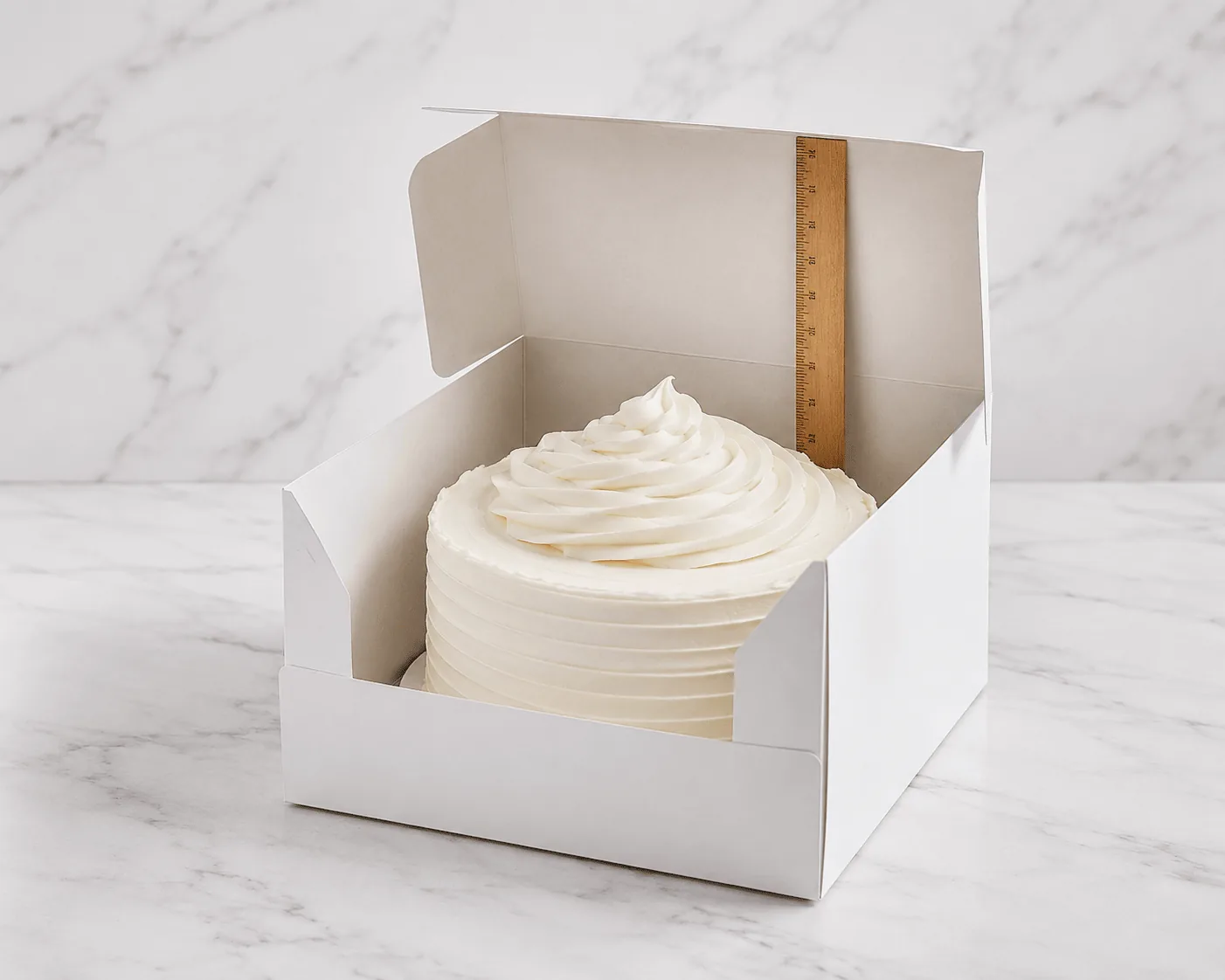
Depth selection follows the finished cake height, not the cake diameter. A 6-inch round baked in two 2-inch pans with filling and a buttercream crown reaches roughly 4.5 to 5 inches tall. The same 6-inch round built as a three-layer construction with a fondant topper can reach 7 inches. The box depth must accommodate the tallest version a bakery actually produces.
Standard depth selection by build type: • 4-inch depth: single-layer sheet-style rounds, drip cakes under 4 inches finished • 5-inch depth: standard two-layer cakes with a ½-inch buttercream crown • 6-inch depth: three-layer cakes, ganache drip cakes, semi-tall buttercream builds • 8-inch depth: extended-layer cakes (4–5 layers), short two-tier bases • 10-inch depth: full two-tier configurations or single-tier cakes with tall toppers • 12-inch depth: three-tier wedding bases and any cake exceeding 10 inches of finished height
Tiered Cake Box Sizes for Two-Tier, Three-Tier, and Wedding Stacks
Tiered cakes are sized by the bottom tier, not the average. A 6″ + 8″ two-tier sits on an 8-inch base, so the box width follows the 8-inch dimensional rule: 9″ × 9″. The height calculation is where most bakers undersize: each tier averages 3.5 inches of finished height, plus dowel rod clearance of 0.25″ between tiers, plus 1″ of clearance above the top icing for the lid.
| Tier Configuration | Recommended Base Box | Minimum Box Height |
|---|---|---|
| 6″ + 8″ | 9″ × 9″ × 8″ deep | 8″ (allows 1″ clearance above icing) |
| 6″ + 8″ + 10″ | 11″ × 11″ × 12″ deep | 12″ (each tier ~3.5″ + dowel clearance) |
| 8″ + 10″ + 12″ | 13″ × 13″ × 14″ deep | 14″ (taller tiers, decorative topper room) |
| 10″ + 12″ + 14″ (wedding) | 15″ × 15″ × 16″ deep | 16″ minimum; transport in separate boxes for taller stacks |
Explore Our Packaging
Four-Tier and Taller Wedding Stacks
Wedding stacks above three tiers should ship disassembled. A four-tier construction with 6″, 8″, 10″, and 12″ rounds reaches 14 to 16 inches of finished height, which exceeds the safe transport ceiling for a single corrugated box on standard refrigerator shelving. The professional approach: ship the three lower tiers in separate same-size boxes, deliver the top tier inside the base box, and stack on-site after refrigerated transport.
Cake Board Sizing Inside the Box
The cake board sits between the cake base and the box floor. Board size follows the cake diameter plus 2 inches, matching the box footprint within ¼-inch tolerance so the board does not shift during transport. A 10-inch cake uses a 12-inch board inside the 11″ × 11″ box footprint, which forces a board trim from the standard 12-inch round to roughly 10.75 inches square or round. Most bakeries buy 0.090-inch grease-resistant cake boards in 8″, 10″, 12″, 14″, and 16″ sizes and trim down on the bench rather than stock a 50-size range.
For tiered cakes, the bottom-tier board becomes the structural floor of the stack. Wedding-cake stacks above 12 lb total weight require either a 0.125-inch board or two layered 0.090-inch boards adhered with food-safe spray.
Material and Construction Specs by Cake Size
Smaller cake boxes (6″ and 8″) perform well in 18-point clay-coated white SBS paperboard, which is the dominant material in U.S. retail bakery boxes. Cakes over 10 inches require corrugated cardboard construction (E-flute or B-flute) to prevent the box base from flexing under a filled cake exceeding 6 lb. A 14-inch wedding-base cake at 18 lb requires B-flute corrugated minimum, with a separate 0.090-inch greaseproof cake board placed inside the box to distribute weight across the corrugation.
Window panels add roughly 8 to 12 percent to unit cost. Most operators reserve windowed boxes for retail-display cakes under 10 inches, where the box does double duty as merchandising on the bakery counter.
Custom Print ROI on Cake Boxes
Custom-printed cake boxes pay back at roughly 200 units per month in steady reorder volume. A bakery boxing 200 cakes monthly absorbs the plate setup cost (typically $180 to $260 one-time) across 8 to 12 weeks of inventory, after which printed boxes cost within 6 to 9 cents of plain stock per unit. Below 200 units monthly, custom-printed sleeves wrapped around plain boxes deliver the same branded effect with no plate fee.
Volume math works in favor of the operator above 500 monthly units. At that pace, offset-printed boxes drop to roughly 4 to 6 cents above plain stock per unit, the plate fee amortizes in under three weeks, and reorder cycles align with a 4-to-6-week inventory float. Bakeries seasonal-spike around three windows: Valentine's (mid-January reorder), Mother's Day (mid-April reorder), and the November–December wedding catering surge.
Frequently Asked Questions
Our Packaging Products
Elevate Your Brand With Custom Packaging
Get packaging designed for your brand. Free shipping. No minimums.
Start TodayAuthor
Racheal Summers
Racheal ran a wedding-cake studio in Portland for nine years before moving into packaging consulting, where she now helps bakeries match box specs to actual cake builds. She has personally boxed more than 4,000 tiered cakes and writes about the dimensional details bakers learn the hard way.