The Short Answer
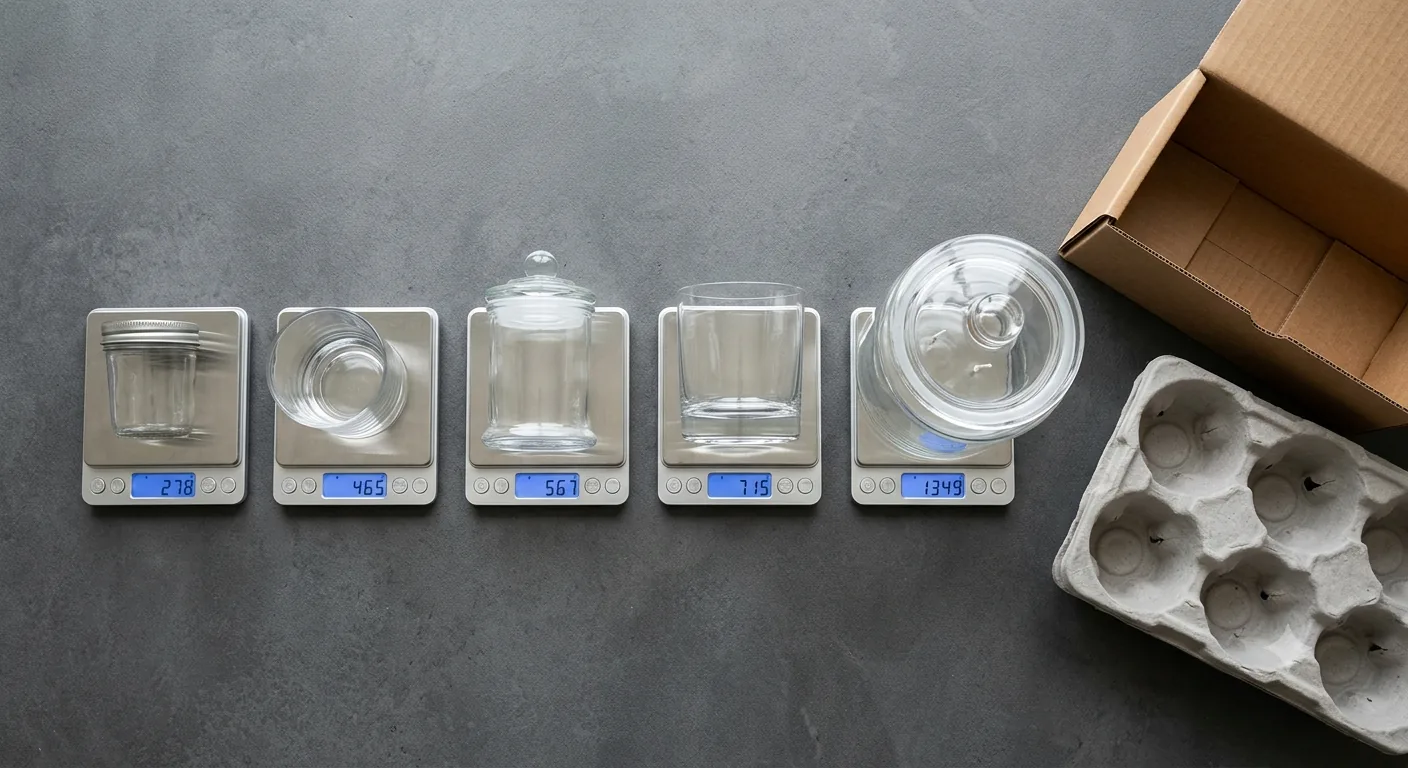
A standard glass candle vessel weighs 5.8 oz to 1.6 lb empty and 9.8 oz to 3.1 lb filled. A 4 oz straight-sided jelly jar averages 165 g empty and 278 g filled. A 22 oz three-wick apothecary jar averages 725 g empty and 1,349 g filled. Glass carries more of that total than wax does.
Glass Candle Vessel Weight Chart: Empty vs Filled
Weights below cover common domestic formats from Libbey, Anchor Hocking, and CandleScience, filled with soy wax at 0.90 g/mL.
| Vessel size | Vessel style | Empty glass | Wax fill | Filled weight |
|---|---|---|---|---|
| 4 oz | Straight-sided jelly | 165 g / 5.8 oz | 113 g / 4 oz | 278 g / 9.8 oz |
| 8 oz | Straight-sided tumbler | 238 g / 8.4 oz | 227 g / 8 oz | 465 g / 16.4 oz |
| 9 oz | Apothecary status jar | 312 g / 11 oz | 255 g / 9 oz | 567 g / 1.25 lb |
| 12 oz | Heavy-base tumbler | 375 g / 13.2 oz | 340 g / 12 oz | 715 g / 1.58 lb |
| 16 oz | Apothecary | 520 g / 1.15 lb | 454 g / 16 oz | 974 g / 2.15 lb |
| 22 oz | Three-wick apothecary | 725 g / 1.6 lb | 624 g / 22 oz | 1,349 g / 2.97 lb |
Why an 8 oz Candle Is Not 8 oz on the Scale
Across the range, glass accounts for roughly half to three-fifths of filled vessel weight. Trimming an ounce of wax barely moves your shipping bill; changing vessel style moves it substantially.
Two different measurements share the same abbreviation. A vessel marketed as an 8 oz jar holds 8 fluid ounces of water, which is 237 mL of volume. A candle marketed as an 8 oz candle contains 8 ounces of wax by weight.
Soy container wax has a density of approximately 0.90 g/mL at 20 C. Paraffin sits at the same 0.90. Coconut-soy blends run 0.92, and beeswax reaches 0.96. Fill a 237 mL jar to the standard 90 percent line and you have 213 mL of soy, which weighs 192 g, or 6.8 oz. The 8 oz candle weight quoted on most product pages describes the jar format rather than the actual wax poured.
The full answer to how much does a candle weigh is therefore three numbers, not one: wax weight, filled vessel weight, and packed shipping weight. Carriers only care about the third.
Wax Density Math: Calculating Fill Weight for Any Vessel
The formula works for glass, ceramic, tin, and concrete alike:
Fill weight in grams = vessel volume in mL x fill ratio x wax density
Take a 10 fl oz ceramic tumbler at a 0.88 fill ratio using a coconut-soy blend. That is 296 mL x 0.88 x 0.92, which equals 240 g of fill. Add a 6 percent fragrance load and the wax portion drops to 226 g while fragrance oil supplies the remaining 14 g.
Assembly hardware sits outside the formula. A cotton or wood wick weighs 1 to 3 g, a tabbed clip adds 1 g, and a wick sticker adds under 0.5 g. Round hardware to 4 g per unit.
For an unlisted vessel, tare it on a 0.1 g scale, fill to your pour line with water, and multiply the grams by wax density.
Vessel Style Moves the Number More Than Capacity Does
Two vessels holding identical wax volumes can differ by 200 g of glass. Base thickness drives the gap.
Straight-sided jelly jars use 3 mm sidewalls and a 4 mm base. They are the lightest glass format per fluid ounce, which is why 4 oz and 8 oz samplers ship cheaply.
Apothecary and status jars use a 6 mm to 9 mm base puck for the weighted feel buyers associate with department store fragrance. That puck adds 80 g to 150 g with zero gain in wax capacity.
Seamless steel tins weigh far less: a 6 oz tin is near 38 g empty, one fifth of a comparable glass jar. Stoneware and concrete run the other direction. An 8 oz stoneware vessel weighs 340 g to 420 g empty. An 8 oz concrete vessel reaches 450 g to 600 g. Switching an 8 oz glass line to stoneware adds roughly 75 kg of outbound freight per month at 500 units.
What Packaging Adds Before the Carrier Weighs It
Empty candle jar weight and fill weight only get you to the product. The carrier weighs the whole parcel.
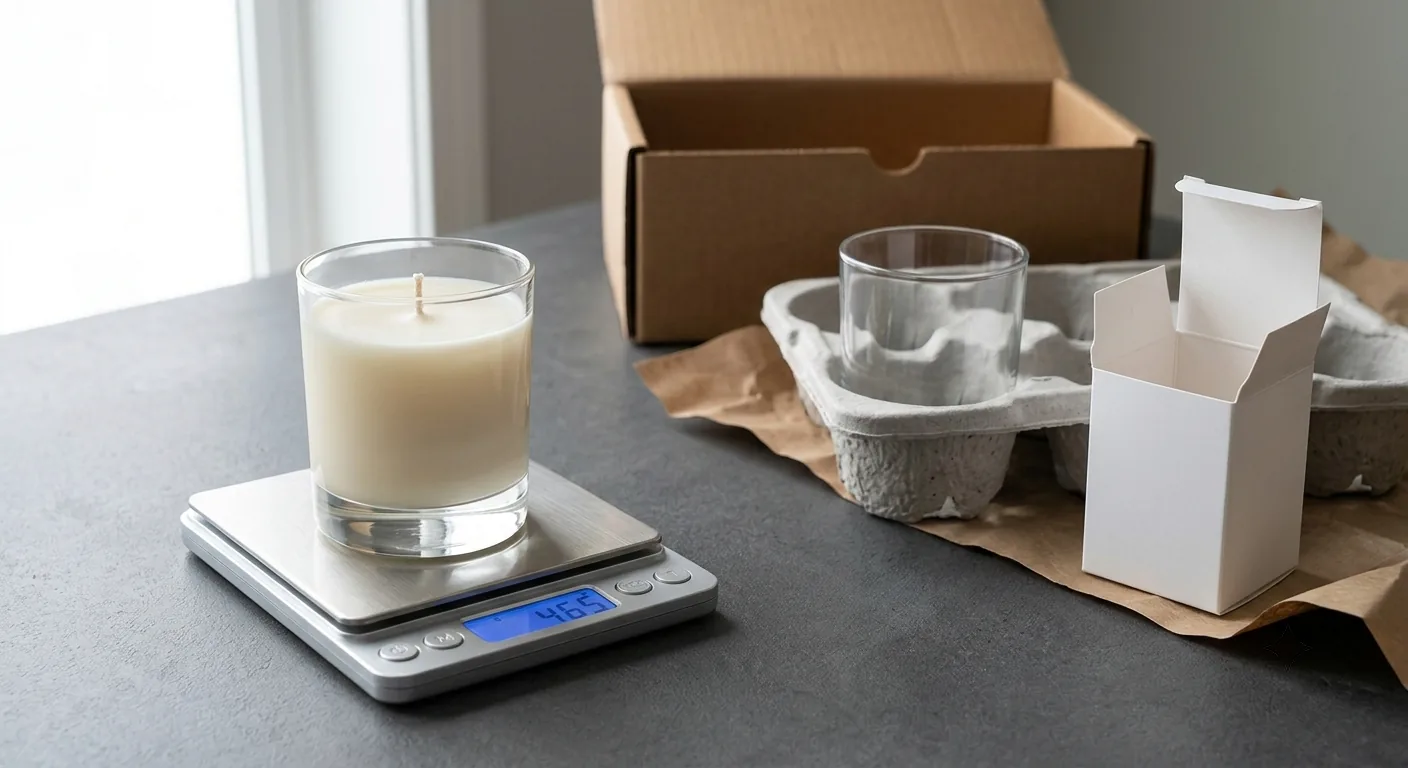
A single 8 oz candle shipped direct to consumer builds up like this. An 18 pt SBS vessel carton at 3 x 3 x 4.5 in weighs 21 g. A B-flute mailer at 6 x 6 x 5 in made from 32 ECT corrugated cardboard weighs 95 g. A molded pulp vessel insert weighs 35 g to 45 g. Two sheets of kraft void fill add 24 g. Shipping label and tape add 6 g.
That totals roughly 185 g, or 6.5 oz, of packaging around a 465 g candle. Packed candle shipping weight lands near 650 g, which is 1.43 lb. Folding cartons and mailer boxes account for about 18 percent of what the carrier weighs, so a lighter board grade on the outer box saves real money at volume.
Where Weight Turns Into Money
Carriers bill the greater of actual weight and dimensional weight, then round up to the next whole pound. UPS and FedEx apply a domestic dimensional divisor of 139. USPS Ground Advantage uses 166 and only applies dimensional pricing above 1 cubic foot.
A 6 x 6 x 5 in mailer measures 180 cubic inches, or 1.30 lb dimensional. The packed 8 oz candle at 1.43 lb actual is higher, so the parcel bills at 2 lb.
Below roughly 8 oz of wax, dimensional weight usually governs and the fix is a tighter box. At 12 oz and above, actual weight governs and the fix is lighter packaging or a thinner-based vessel.
Rounding creates the sharpest cost cliffs. A single packed 4 oz candle sits at 0.87 lb and bills as 1 lb. Add a second 4 oz candle at 0.62 lb and the parcel reaches 1.49 lb, billing as 2 lb. The second candle doubles the postage while adding 71 percent of the weight. Building two-candle and four-candle sets around those thresholds rather than aesthetics is where custom packaging decisions pay for themselves.
Weight Thresholds That Change Your Box Spec
Board grade should follow packed weight, not vessel count.
1. Under 2 lb, single-wall 32 ECT B-flute handles a single vessel with a fitted insert.
2. From 2 lb to 5 lb, covering 16 oz and 22 oz singles plus two-candle sets, 44 ECT single-wall prevents the corner crush that cracks heavy apothecary bases.
3. From 5 lb to 12 lb, typical of four-candle gift sets, double-wall 48 ECT is the minimum.
4. Above 12 lb, reached by six-packs of 22 oz vessels, specify 275 lb test double-wall with corner posts.
Size the mailer to vessel diameter plus 2 inches and height plus 1.5 inches, which leaves room for a molded pulp insert. Usually one size below the default most makers reach for.
| Vessel | Recommended mailer (inches) |
|---|---|
| 4 oz single | 4.25 x 4.25 x 5 |
| 8 oz single | 5 x 5 x 5.5 |
| 12 oz single | 5.5 x 5.5 x 5.5 |
| 16 to 22 oz single | 6 x 6 x 6.5 |
| Two 8 oz candles | 9.5 x 5 x 5.5 |
| Four 8 oz candles | 9.5 x 9.5 x 5.5 |
Three Mistakes That Wreck a Shipping Estimate
Custom mailer boxes cut to the exact vessel footprint remove dimensional weight penalties, and candle shipping boxes with vessel inserts eliminate the internal movement that turns a 30 inch drop into a broken jar, which is the core discipline of e-commerce packaging for fragile glass. Three estimating errors undo all of it.
1. Treating a capacity label as a weight. An 8 oz straight-sided tumbler, an 8 oz apothecary jar, and an 8 oz stoneware vessel share a label and nothing else. Weigh the exact SKU before quoting shipping.
2. Leaving the lid out. A 4 oz metal screw lid weighs 14 g, an 8 oz lid 22 g, a 12 oz wood lid 33 g, and a 22 oz three-wick metal lid 71 g, heavier than a full B-flute mailer panel.
3. Estimating from wax weight. A candle sold as 8 oz reaches the carrier near 1.43 lb once glass, lid, carton, insert, and mailer are counted.
Frequently Asked Questions
Our Packaging Products
Elevate Your Brand With Custom Packaging
Get packaging designed for your brand. Free shipping. No minimums.
Start TodayAuthor
Noah Fischer
Noah Fischer spent six years pouring coconut-soy candles for a Portland home fragrance label before moving into its operations seat, where he rebuilt the shipping program around vessel weight rather than vessel count. He keeps a calibrated 0.1 g bench scale on his desk and has weighed every jar format sold by Libbey and Anchor Hocking at least twice. He now advises small candle brands on packing specs and carrier billing.