
The Short Answer
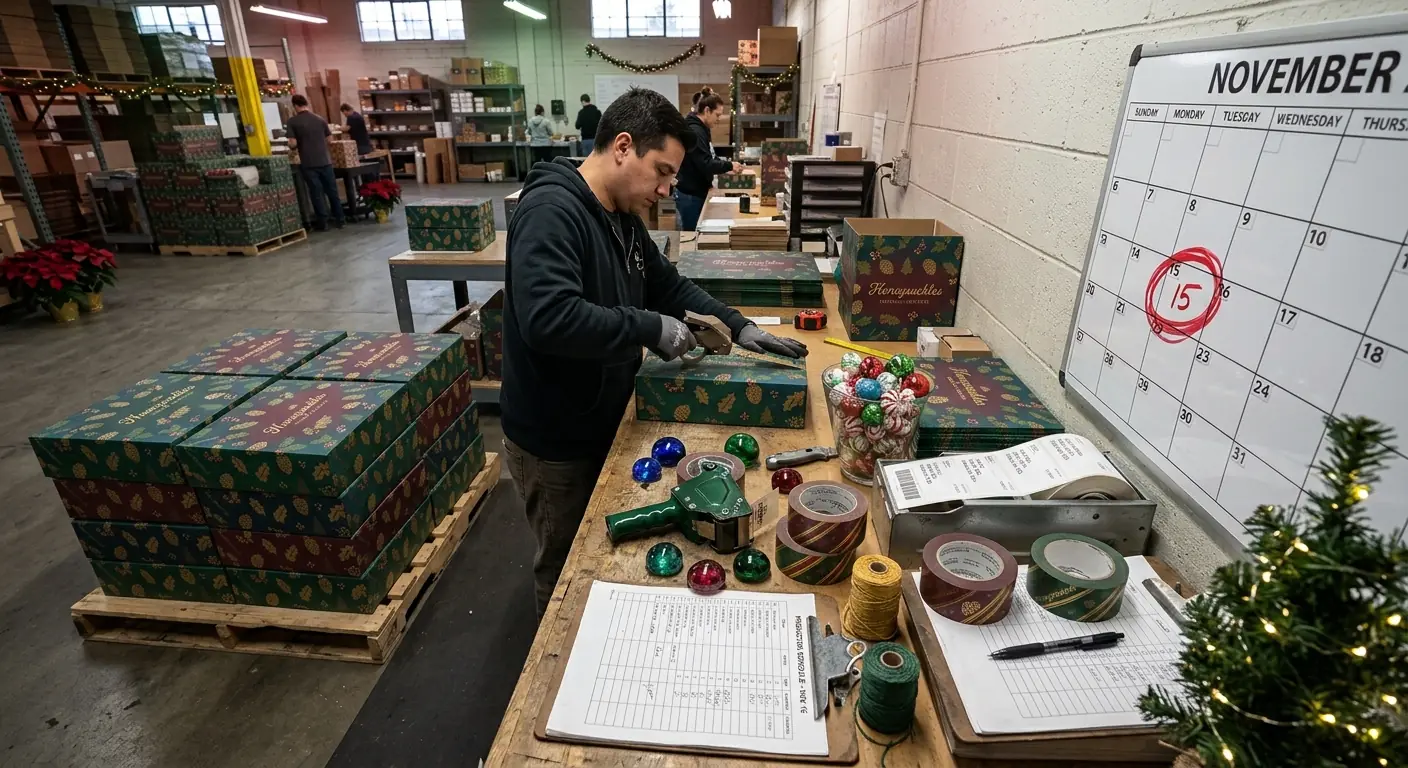
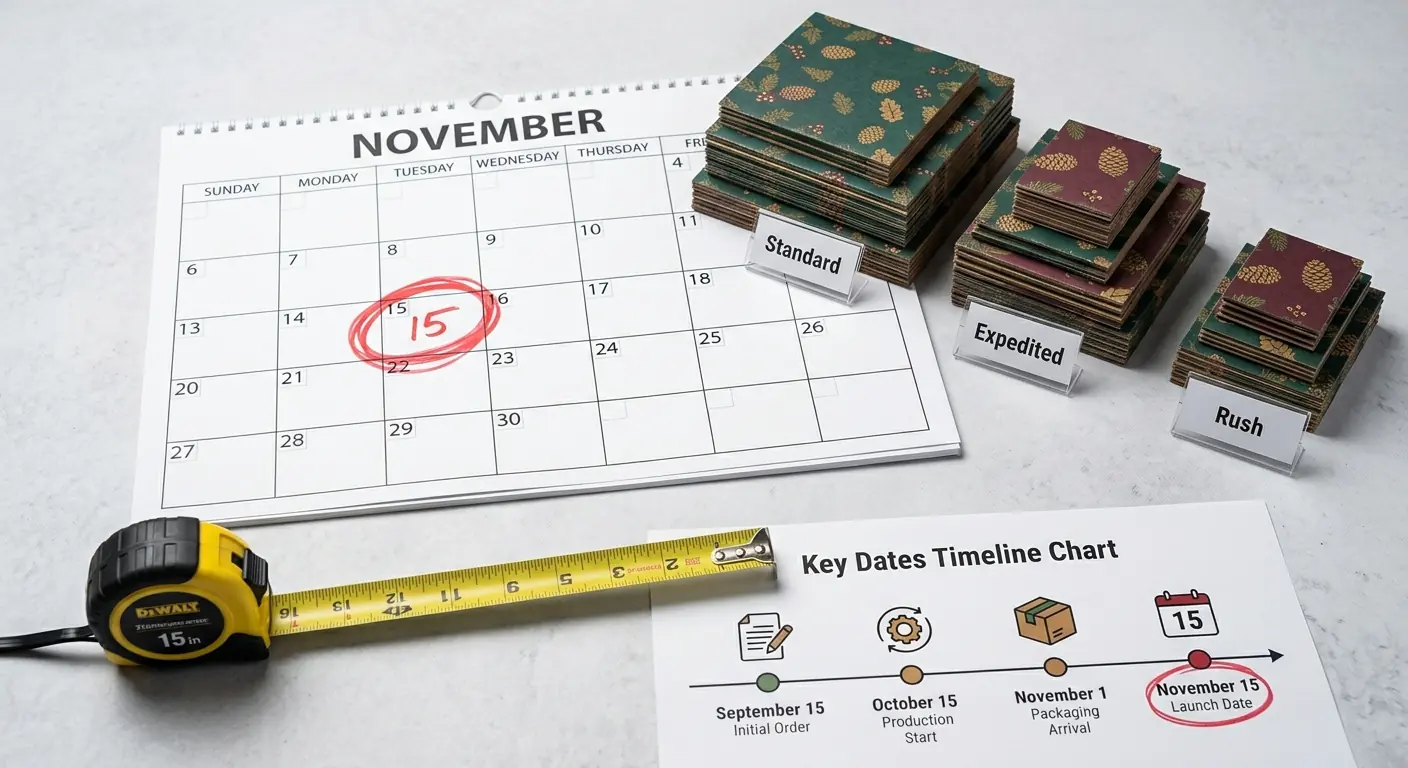
Submit print-ready artwork by September 15 to have custom Christmas packaging on the packing bench by November 15. Standard production runs 10 to 15 business days after proof approval, plus 6 to 10 business days of freight. October 15 is the expedited cutoff, November 1 the last date for custom boxes, November 20 for stock boxes.
Your Real Deadline Is Black Friday, Not December 25
December 25 is the consumer deadline. Yours sits five weeks earlier. Gift orders start moving the Tuesday before Thanksgiving, peak across Cyber Weekend, and stay heavy until the last ground cutoff in mid-December. That is a 25 to 30 day selling window, and every box shipped inside it, whether Christmas mailer boxes going out to customers or gift sets going into retail, is already folded flat in your warehouse when it opens.
Set November 15 as your in-hand date, ten days before Black Friday. Brands targeting the Monday of Thanksgiving week have no buffer, and a two-day freight delay costs them the highest-revenue 96 hours of their year.
Working Backward From December 25: The Critical Path
Christmas packaging deadlines are built from business days: 15 business days is three full weeks, and the last week of November loses two to Thanksgiving. Every date below is a completion deadline on the critical path, and all assume a Monday to Friday production week.
The physical white sample is a parallel track, not a rung on the ladder below. Off an approved dieline it takes 5 to 7 business days plus 3 days transit, and it moves your delivery date only if you hold the press for it, which adds about two weeks. Skip it on a dieline you have run before. The buffer is the rung nobody deletes: spend it to justify a late order and you pay next-day air on a pallet of empty boxes.
| Stage | Days needed | Complete by |
|---|---|---|
| Print-ready artwork and dieline submitted | 5 to 10 business days of prep | September 15 |
| Digital proof approved, two revision rounds | 4 to 6 business days | September 24 |
| Print, die-cut, glue, and finishing | 10 to 15 business days | October 15 |
| LTL freight to your warehouse | 6 to 10 business days | October 29 |
| Receiving, count, and reprint buffer | 10 business days | November 12 |
| Boxes flat on the packing bench | In-hand | November 15 |
Carrier Cutoffs Set Your Selling Window
Carriers publish holiday cutoffs in early November, and the dates shift a day or two each season. The pattern holds. Ground is a transit map, not a fixed date: Texas to Oregon needs five transit days, Texas to Louisiana two. Your effective cutoff is a range across your customer base, and around December 16 the cheap tier closes.
| Service | Typical last ship date for December 25 arrival |
|---|---|
| USPS Ground Advantage | Around December 17 |
| USPS Priority Mail | Around December 19 |
| USPS Priority Mail Express | Around December 21 |
| UPS Ground and FedEx Ground | Around December 16, transit dependent |
| UPS 3 Day Select | Around December 19 |
| UPS 2nd Day Air and FedEx 2Day | Around December 22 |
| Next Day Air and Standard Overnight | Around December 23 |
Why December Compounds Every Delay
Delay in December multiplies rather than adds, because congestion hits inbound freight and outbound parcels in the same six weeks. Peak-season surcharges run from roughly early October through mid-January, stacked on residential, oversize, and additional-handling fees. Retail rate parcels bill on a DIM divisor of 139, so a 12 x 10 x 4 inch mailer bills at 4 pounds regardless of contents, and one oversized inch in every direction lifts billed weight by roughly half.
Inbound freight is the part operators forget. The trucks carrying your flat-packed boxes compete with retail inventory freight from mid-October onward, and LTL transit that runs six business days in August commonly runs eight to ten in late October. That is why a September artwork deadline serves a November in-hand date.
Standard vs Rush Production Windows
Holiday packaging lead time is not one number. It is four windows with four price tags, and the spread between the first and the last is your seasonal margin.
Holiday rush order packaging works, inside constraints. Digital printing carries no plate charge, so a four-color job on 500 units skips the two to three days plate making adds to offset and flexo. Rush also caps finishes: soft-touch lamination, foil stamping, and spot UV each add two to four business days a rush window does not have. Quantity is not the constraint, since Packify sets no minimum order quantity: a 250-unit December run is a press-scheduling question, never an eligibility one.
| Window | Artwork deadline | Production | Freight | Cost vs standard |
|---|---|---|---|---|
| Standard | September 15 | 10 to 15 business days | Ground, 6 to 10 days | Baseline |
| Expedited | October 15 | 7 to 9 business days | Ground, 6 to 10 days | Roughly 15 to 25 percent more |
| Rush | November 1 | 4 to 6 business days | Air, 2 to 3 days | Roughly 40 to 70 percent more, plus air freight at three times ground |
| Salvage | November 20 | Ships in 48 hours | Ground or air | Stock corrugated, branded with labels and tape |
Order-By Dates by Box Type
When to order Christmas boxes changes by structure, because production time tracks converting steps rather than box size. The holiday packaging range splits along one line: flat-converted structures that come off the press finished, and structures that need hand assembly after printing.
Read the bottom two rows of the table below against today’s date. Past mid-August, rigid boxes, magnetic closure boxes, and advent structures are next-season decisions, not rush candidates: a 20 business day build plus freight lands after Black Friday, and no fee compresses hand assembly the way it compresses press time. Domestic mailers and folding cartons stay live: Christmas mailer boxes and Christmas candy boxes both convert inside a 15 business day window, and Christmas cookie boxes on food-safe coated board run alongside them. Luxury packaging with foil and magnets, which covers Christmas gift boxes and Christmas stacking boxes, locks six weeks earlier than a comparable mailer.
| Structure | Common spec | Production time | Artwork deadline |
|---|---|---|---|
| Custom mailer boxes | 32 ECT B-flute corrugated cardboard | 10 to 12 business days | September 15 |
| Folding cartons | 350 to 400 GSM SBS board | 12 to 15 business days | September 10 |
| Custom rigid boxes with magnetic closure | 1.5 to 2 mm greyboard, wrapped | 15 to 20 business days | August 20 |
| Advent and multi-compartment structures | Rigid plus die-cut inserts | 20 to 25 business days | July 30 |
Domestic vs Overseas Converting
Every date above assumes domestic converting. Much of the world’s rigid and magnetic closure production sits in Asia, and that covers most Christmas candle boxes and wrapped two-piece gift structures. The arithmetic changes there: 15 to 20 business days of production, 25 to 40 days of ocean transit, then 5 to 10 days for customs clearance and drayage. That is a 10 to 14 week total, putting the artwork deadline in early July for a November in-hand date. Air freight cuts transit to 5 to 8 days at six to ten times the ocean rate per kilogram, erasing the unit-price advantage that sent the order overseas. Ask where the boxes convert before trusting a quoted lead time.
What Most Operators Get Wrong
The proofing mistake is the expensive one. A dieline error caught on a sample costs seven days; caught on a delivered pallet, it costs the season. The rest of the list below is where the calendar quietly leaks days.
| Mistake | What it costs | The fix |
|---|---|---|
| Counting calendar days, not business days | 15 business days reads as two weeks, arrives as three | Add 40 percent to every quoted production number |
| Waiting on final artwork before locking the dieline | Two to three weeks of dead time | Approve structure in August, drop art in September |
| Holding production for a physical sample | About two weeks on the critical path | Run it in parallel, or skip it on a repeat dieline |
| Ordering exactly the forecast quantity | Running out mid-Cyber-Weekend at 4x cost | Order 10 to 15 percent over forecast |
| Booking inbound freight last | Two to four added transit days in late October | Book the LTL slot when production starts |
If You Have Already Missed the Window
There is a real path to a branded season in November, and it skips custom structures. Print branded custom packaging elements instead: 72 mm printed tape on stock kraft mailers, full-color labels sized to the panel, printed tissue with a seal. A stock white mailer with a wrap-around sleeve delivers a real unboxing experience and ships in days, and Christmas treat boxes for party favors and corporate drops assemble flat-to-formed and take a printed label cleanly. Single-color flexo on stock corrugated boxes runs five to seven business days.
Get pricing in writing first. Request a quote with your dieline, quantity, and in-hand date in one message, and see how to place an order so proofing is not the step that surprises you. E-commerce packaging decisions in November protect the ship date, not the panel.
Frequently Asked Questions
Our Packaging Products
Elevate Your Brand With Custom Packaging
Get packaging designed for your brand. Free shipping. No minimums.
Start TodayAuthor
Elena Vasquez
Elena Vasquez spent eleven years scheduling seasonal print runs at corrugated and rigid converters and now builds Q4 production calendars for DTC brands. She once approved a rigid box proof on October 12 without re-checking magnet placement; the reprint delivered 4,000 gift boxes two days after Black Friday, and the brand shipped its best weekend of the year in plain kraft mailers. Every timeline she writes now starts at the in-hand date and works backward.