
The Short Answer
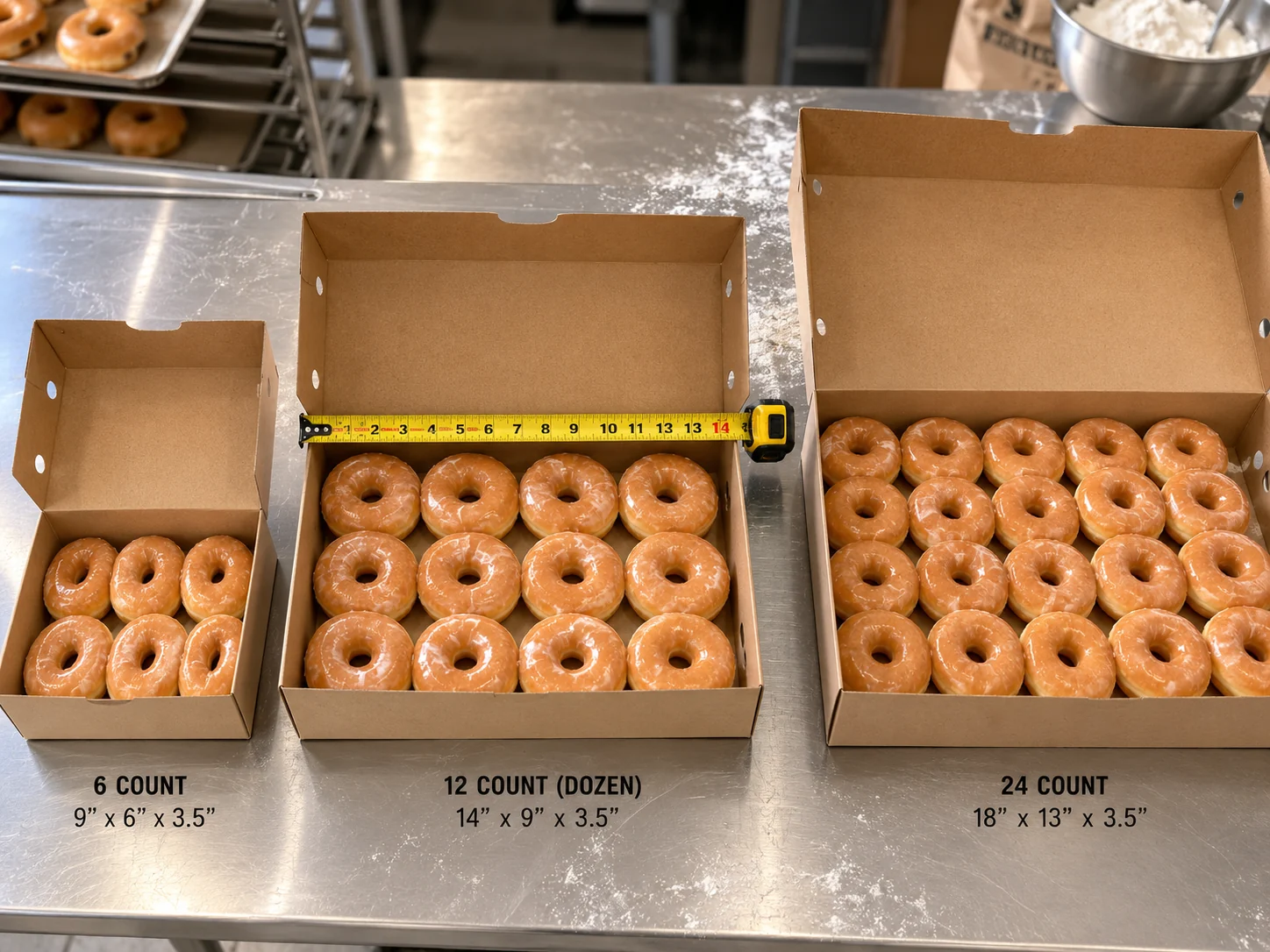
Standard donut box sizes come in three counts. A 6-count box measures 9 x 6 x 3.5 inches. A dozen box measures 14 x 9 x 3.5 inches. A 24-count box measures 18 x 13 x 3.5 inches. Every one of those numbers assumes a 3.5-inch raised ring donut with roughly a quarter inch of clearance per side.
Standard Donut Box Dimensions by Count
These are the outside dimensions most US converters run as stock tooling. Interior space is roughly 0.125 inches smaller on each axis after board thickness and score allowance. The 6-count and 12-count carry the vast majority of retail volume in American donut shops. The 24-count exists almost entirely for office catering and corporate standing orders.
| Count | Layout | External L x W x D | Typical Board | Empty Weight |
|---|---|---|---|---|
| 6-count | 3 x 2 | 9 x 6 x 3.5 in | 18pt SBS | 2.1 oz |
| 12-count (dozen) | 4 x 3 | 14 x 9 x 3.5 in | 18pt SBS | 3.4 oz |
| 24-count | 6 x 4 | 18 x 13 x 3.5 in | 24pt SBS / E-flute | 6.9 oz |
Why 3.5 Inches Is the Number That Controls Everything
Donut box dimensions are reverse-engineered from one measurement: the finished diameter of a proofed and fried raised ring donut, which lands at 3.5 inches for shops running a standard 2.5-inch cutter with a 1-inch center. Add 0.25 inches between donuts so glaze does not weld two pieces together, plus 0.25 inches of wall clearance per side, and the math produces the stock sizes exactly.
Six donuts in a 3 x 2 grid: (3 x 3.5) minus tight nesting brings the width to 9 inches, which is why the 6-count runs 9 x 6. Twelve donuts in a 4 x 3 grid: 4 x 3.5 = 14 inches across, with gaps absorbed by the quarter-inch settle every donut takes once placed. That is the origin of the 14 x 9 dozen donut box size.
Cake donuts change the math. A standard cake donut finishes at 3 inches. Filled donuts and bismarcks run 4 to 4.5 inches long by 2.5 inches wide, which is why filled product never fits a 4 x 3 grid cleanly.
Count Layouts: 3x2, 4x3, and 6x4
The grid determines the box, and geometry fixes the grid.
3 x 2 (six count). Two rows of three. The most stable layout for transport, because no donut sits more than one position from a wall.
4 x 3 (twelve count). Four columns, three rows. The two center donuts in the middle row are the only pieces with no wall contact, which is why glaze transfer complaints almost always trace back to those two positions.
6 x 4 (twenty-four count). Six columns, four rows. Six positions sit interior with no wall support. A 24 count donut box needs heavier board or a center partition to stop the lid bowing under its own span, the failure mode most operators discover on their first catering run.
Explore Our Packaging
How Big Is a 12 Donut Box, Exactly?
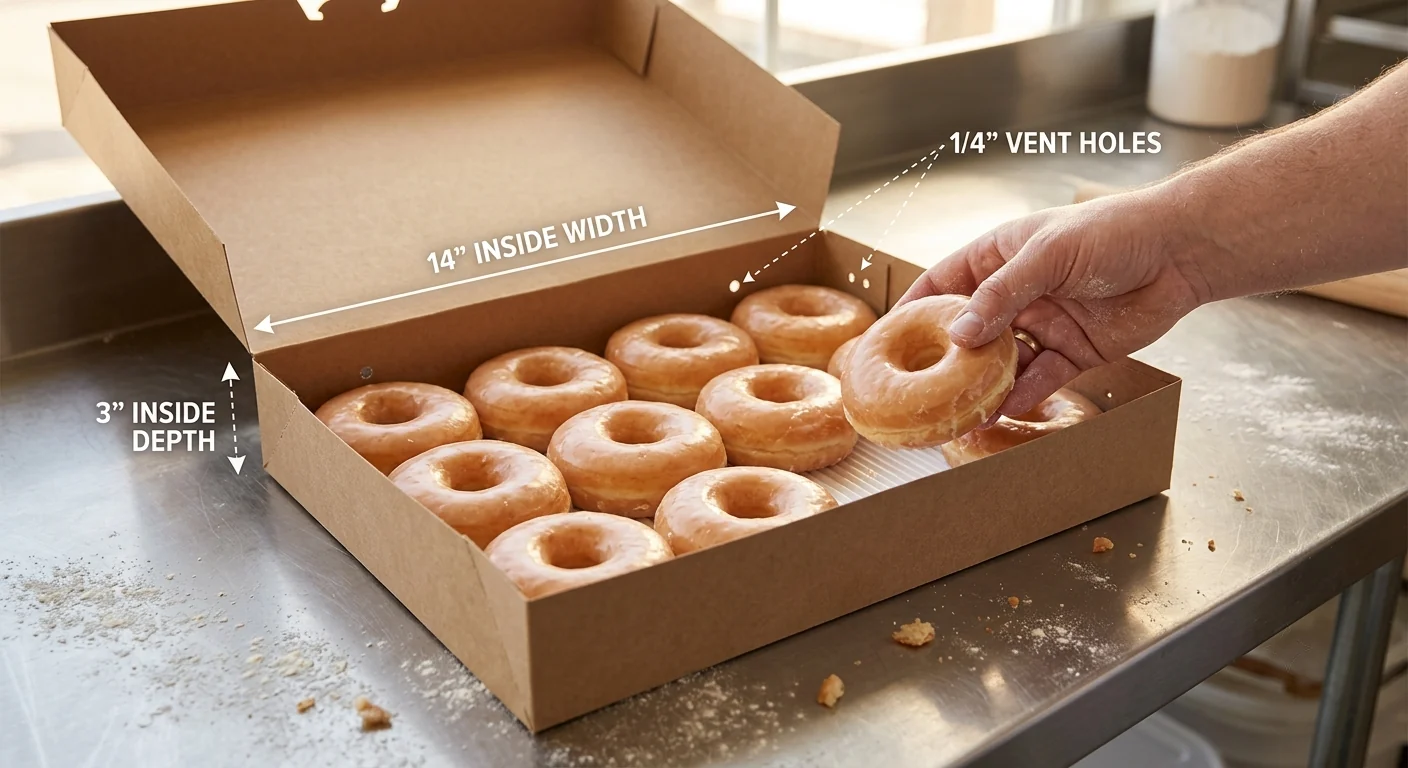
A standard 12 donut box is 14 inches long, 9 inches wide, and 3.5 inches deep, external. Interior clear space is approximately 13.75 x 8.75 x 3.25 inches. Empty weight on 18pt SBS runs around 3.4 ounces. Loaded with twelve glazed raised donuts at roughly 1.8 ounces each, the full box weighs approximately 1.75 pounds.
Depth matters more than most operators expect. A glazed raised donut stands 1.5 to 1.75 inches tall; a filled bismarck stands 2 to 2.25 inches. Drop to a 2.5-inch box for filled product and the lid presses every crown flat, smearing filling into the board.
Depth Selection by Product Type
The 3.5-inch stock depth is a compromise that clears most single-layer product. Match the interior depth to the tallest donut you actually box, and add roughly half an inch of headroom so the lid never touches a crown or a glaze peak.
| Donut Style | Standing Height | Min. Interior Depth | Recommended Box Depth |
|---|---|---|---|
| Cake donut | 1.25 in | 2 in | 2.5 in |
| Glazed raised ring | 1.5 to 1.75 in | 2.25 in | 3 in |
| Filled bismarck | 2 to 2.25 in | 2.75 in | 3.5 in |
| Two stacked layers | 3.5 in | 4.25 in | 5 in |
Vent Hole Spacing: The Detail That Decides Whether Glaze Survives
A sealed donut box traps steam. That steam condenses on the lid, drips back onto the glaze, and turns a crisp shell into a sticky film within about twelve minutes of closing. Donut box vent holes solve this, and their placement follows a consistent pattern across well-designed bakery boxes.
Standard specification: 0.25-inch diameter circular perforations, spaced 2 inches on center, positioned in the lid panel and along the upper third of the two long side walls. A dozen box carries eight to ten vents: six across the lid, two per long wall. A 24-count carries fourteen to sixteen. The 6-count needs four to six, since its sealed air volume keeps condensation below saturation.
Vents belong in the upper third of side walls, never the lower third. Low vents sit level with the glaze pool on the bottom board and leak sugar syrup onto a customer’s car seat. Keep vents at least 0.75 inches from any score line, since perforating a fold weakens it and the panel tears when a driver grabs the box by one edge. Never vent the bottom panel: grease migration through a bottom perforation is the most common cause of blowout on a stacked delivery order.
Board Grade and Grease Resistance
Board selection determines whether a box looks clean at the twenty-minute mark or shows translucent oil spots. 18pt SBS with a clay coat on the print side handles 6-count and 12-count boxes. It holds a crisp fold, prints cleanly at 300 lpi, and resists grease strike-through for the two to four hour window that covers retail and most delivery routes. 24pt SBS or E-flute corrugated cardboard is the correct call for 24-count boxes, where the 18-inch lid span needs the additional caliper or flute structure, otherwise the lid sags into the top row of donuts.
Grease-resistant treatment should be a PFAS-free barrier coating. California, New York, Washington, Minnesota, and Colorado have all restricted intentionally added PFAS in food packaging, and those rules cover donut boxes exactly as they cover fry cartons. Ask for documentation before the first order, not after the first inspection. Standard folding cartons in an auto-lock bottom style assemble in under three seconds each, which matters when open requires forty boxes built ahead.
Ghost Kitchen and Delivery Considerations
Delivery changes the requirements in three specific ways.
Stacking strength becomes the binding constraint. An 18pt SBS dozen box supports approximately 8 to 10 pounds of top load before the lid deflects into the product. Four stacked full boxes weigh about 7 pounds, leaving almost no margin. Ghost kitchens running high delivery volume should specify 20pt board or an E-flute variant.
Tamper evidence is now a platform requirement, not an option. A perforated tuck flap or a printed seal label satisfies DoorDash and Uber Eats tamper policies without adding a separate sealing step to the pack line.
Interior legibility replaces the counter conversation. In delivery, the box is the only communication. A printed interior grid with position numbers, or a checkbox list inside the lid flap, resolves the most common delivery complaint: a customer believing an item was missing when it was simply unrecognizable.
A printed lid travels to an office break room and sits in front of thirty people for four hours, which is why print pays back faster on donut boxes than on almost any other bakery box. Eco-friendly packaging in uncoated kraft with a single-color flexo print captures most of that return at the lowest per-unit cost. For shops moving off stock white, the practical starting point is one dozen size in custom packaging, leaving the 6-count and 24-count plain until volume justifies a second plate.
Frequently Asked Questions
Our Packaging Products
Elevate Your Brand With Custom Packaging
Get packaging designed for your brand. Free shipping. No minimums.
Start TodayAuthor
Marcus Delgado
Marcus Delgado ran a three-location donut shop in San Antonio for nine years before moving into ghost kitchen operations, where he now oversees packaging spec and pack-line throughput for a group of delivery-only bakery brands. He has personally rebuilt box specs after losing a 400-box catering order to lid sag, and he still measures every sample with calipers before approving a print run.