
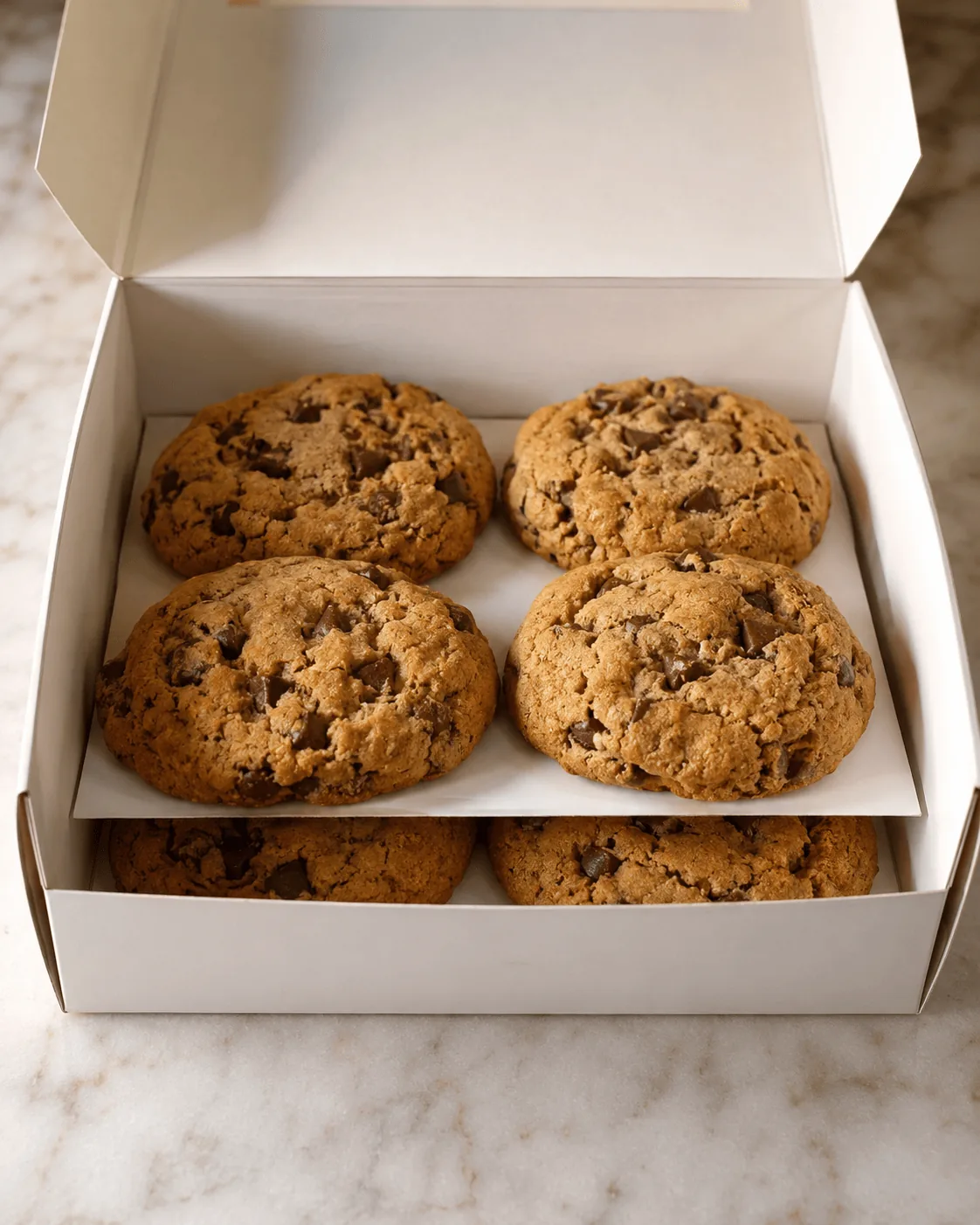
Start With Cookie Diameter, Not Box Size
Baked cookie diameter is the number that drives everything, and most bakers underestimate it. A 1.5-ounce dough ball spreads to roughly 3 inches once baked. The four diameters that cover almost every retail cookie are 2 inches (bite-size and thumbprints), 2.5 inches (the standard drop cookie), 3 inches (a generous chocolate chip or oatmeal cookie), and 4 inches (bakery-style and stuffed cookies).
Measure your own cookies after baking, not before. Dough spread varies with butter ratio, oven temperature, and rest time. A cookie chilled before baking spreads less than one baked from room-temperature dough. Bake a test batch, let it cool fully, and measure the widest point with a ruler. That single measurement determines which box you need.
Round up when you measure. A cookie that lands at 2.7 inches should be treated as a 3-inch cookie for packing purposes. The half-inch of error you build in becomes the clearance that stops cookies from cracking against each other in transit.
The Spacing Rule That Prevents Breakage
Cookies need clearance. Pack them edge-to-edge and they crack, chip, and fuse together when warm cookies release residual steam. The working standard is 0.25 inches of clearance between each cookie and 0.25 inches between the outer cookies and the box wall. That quarter-inch buffer absorbs vibration during shipping and leaves room for cookies that spread slightly larger than the test batch.
Here is the formula. For a single row, box interior length equals the number of cookies, times the cookie diameter, plus 0.25 inches of spacing for every gap between cookies and for each of the two walls. Four 2.5-inch cookies in a row need 10 inches of cookie plus five quarter-inch spaces, which lands at 11.25 inches of interior length. Apply the same math to width, and you have your single-layer footprint.
The 0.25-inch rule loosens for soft or decorated cookies. Royal-icing sugar cookies and cookies topped with chocolate drizzle need 0.375 to 0.5 inches of clearance so the decoration never touches a neighbor. Crisp shortbread tolerates the tighter quarter-inch. Match the buffer to the fragility of what you are packing.
Cookie Box Capacity by Count
This cookie box size chart gives the box dimensions that hold each standard count in a single layer, calculated with the 0.25-inch spacing rule and a 2.5-inch standard cookie. The dozen cookie box size is the one bakers ask about most, so it anchors the table. Character cutters change the math, and halloween cookie box sizes works the same counts from a bounding box instead of a diameter.
| Count | Box Dimensions (L×W×H) | Layout (2.5″ cookies) | Configuration |
|---|---|---|---|
| 6 | 8 × 6 × 2.5 in | 3 × 2 single layer | Single layer, no divider |
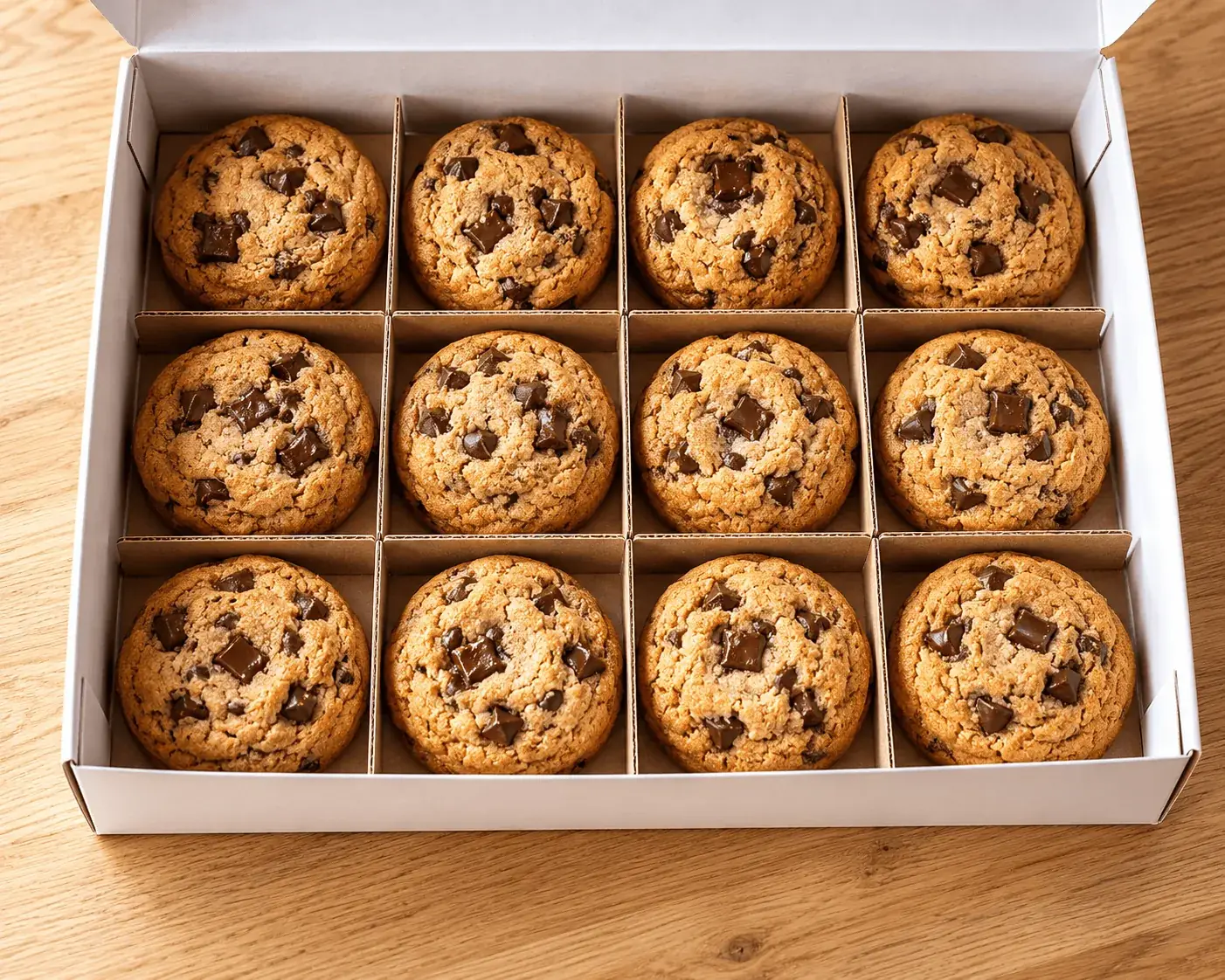
| 12 | 12 × 8 × 2.5 in | 4 × 3 single layer | Single layer, optional cell grid |
| 24 | 12 × 8 × 3 in | 4 × 3, two layers | Two layers + 1 separator |
| 48 | 12 × 8 × 4 in | 4 × 3, four layers | Four layers + 3 separators |
Explore Our Packaging
How Dividers Change the Count
Dividers are the difference between a box that holds 12 cookies and the same footprint holding 24. A divider is a cardboard insert that creates individual cells or separates stacked layers. Two configurations dominate.
The first is the cell-grid insert, which slots cookies into individual compartments. A 4 x 3 grid in a 12-count box gives every cookie its own walled cell, eliminating cookie-to-cookie contact entirely. This is the configuration for premium assortments where each cookie is a different flavor and presentation matters. Cookie boxes with dividers in a cell-grid layout protect decorated cookies that would otherwise smear.
The second is the layer separator, a flat sheet that sits between stacked rows. A layer separator turns a 12-count footprint into a 24-count box by stacking two single layers with a rigid sheet between them. Critically, the footprint does not change: a 12 x 8 inch dozen, a 24-count, and a 48-count share the same base because they use the same 4 x 3 layer. Only the height grows, from 2.5 inches for one layer to 4 for four. The separator carries the weight of the top layer so the bottom cookies never bear the load.
Divider thickness matters for the final box height. Standard chipboard dividers run 0.022 to 0.024 inches thick, negligible per sheet but cumulative across four layers. Budget that thickness into box depth so the lid still closes flat.
Single Layer vs. Stacked: Which to Choose
Single-layer boxes win for gifting and retail display. Every cookie is visible the moment the box opens, which is the entire point of a window-lid bakery box on a shelf. The unboxing experience for a dozen cookies arranged in a single visible layer outperforms a stacked box where the buyer sees only the top row.
Stacked boxes win for volume and shipping economy. A 48-count single layer is unwieldy and fragile; a 48-count stacked box in a compact footprint ships in a smaller carton and costs less to mail. Commercial bakeries fulfilling corporate orders stack by default because the math on shipping and material favors it.
Cookie Box Dimensions for Specialty Shapes
Round cookies follow the grid math cleanly. Irregular shapes do not. A decorated gingerbread person, a long biscotti, or a piped spritz cookie breaks the neat row-and-column calculation, and you size the box to the longest dimension of the actual cookie.
Biscotti run 4 to 6 inches long and pack lengthwise in narrow boxes, typically 6 to 8 cookies standing on edge in a row. Gingerbread shapes need the cell-grid divider because they cannot be stacked without snapping at the thin points. Sandwich cookies like macarons add height, not width, so a macaron box is shallow in footprint but needs 1.5 to 2 inches of depth for a single row standing on edge.
When a cookie shape resists the standard grid, the cookie box dimensions follow the cookie, not a template: measure the longest axis and add the 0.25-inch buffer on every side.
Matching the Box to the Order
Good cookie packaging starts with the product, not the box. Measure your baked diameter, add the spacing buffer, choose single-layer or stacked based on whether presentation or shipping governs, and add a divider when the cookies are decorated or the count exceeds 12. A bakery box sized this way protects the product and presents it well, which is what turns a first order into a repeat customer.
For a half-dozen tasting box, a single-layer 7-inch box reads premium and shows every cookie. For a 48-count corporate gift, a stacked box with three layer separators ships safely and keeps material cost down. The formula is the same; only the inputs change.
Frequently Asked Questions
Our Packaging Products
Elevate Your Brand With Custom Packaging
Get packaging designed for your brand. Free shipping. No minimums.
Start TodayAuthor
Jamie Holloway
Jamie Holloway ran a small-batch cookie business for six years, baking and boxing 300-plus dozen a week for farmers markets, corporate gift orders, and wholesale cafe accounts. Jamie has hand-packed every count from half-dozen tasting boxes to 48-count stacked gift assortments and learned cookie spacing math the hard way, one cracked shipment at a time.