
The Short Answer
To measure for a tuck box, measure your product at its widest point, add clearance, and order the result as interior dimensions in L x W x D order. Length and width describe the opening; depth runs to the far end. For rigid items, add 1/16 inch (1.6 mm) per axis; glass, tubes and soft goods differ (see table).
Exterior dimensions are always larger, because every folded panel adds the thickness of the board. This box measurement guide covers the convention, the interior-to-exterior gap by board caliper, clearance by product type, and three worked examples.
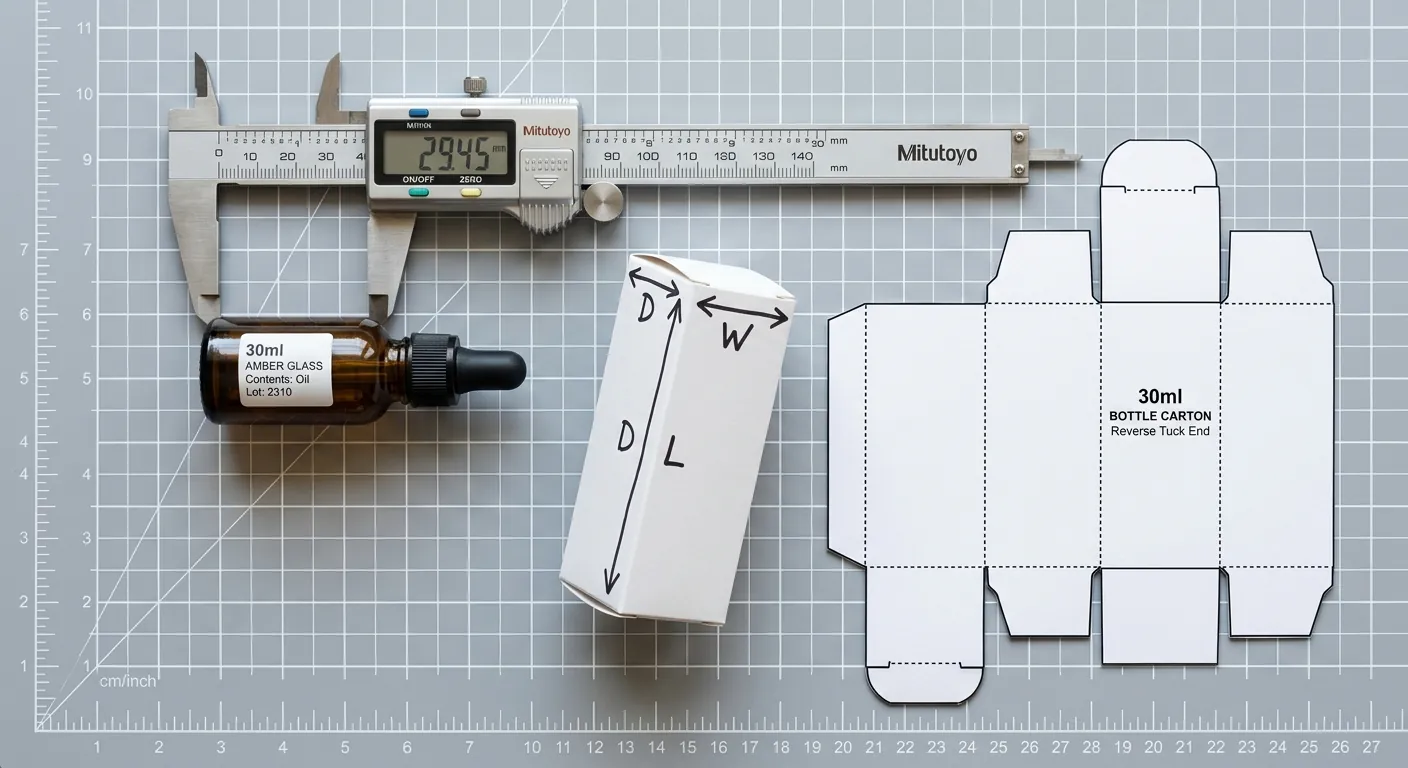
The L x W x D Convention: Which Side Is Which
Paperboard cartons are dimensioned from the opening. This is where length, width and depth specs trip up first-time buyers: corrugated mailer boxes and shipping cartons use L x W x H, where height simply means vertical. On a paperboard carton, the face with the tuck flap sets the first two numbers.
| Dimension | What it measures | Where to find it on the box |
|---|---|---|
| Length (L) | Longer side of the opening | Edge of the panel the tuck flap hinges from |
| Width (W) | Shorter side of the opening | Edge of the side panel, front to back |
| Depth (D) | Distance from the opening to the opposite end | Panel height between the top and bottom flaps |
Length is always equal to or greater than width. Depth can be larger or smaller than either. The convention applies equally to straight tuck end and reverse tuck end cartons, because both close with a flap at the end of the box.
A lipstick carton opens at the top, so its spec reads approximately 1 x 1 x 3.5 inches. Write 3.5 x 1 x 1 instead and the opening moves onto a long side: the tube slides out sideways, and the tuck flap cuts across the front artwork.
Tuck Box Interior Dimensions vs Exterior Dimensions
Interior dimensions describe the empty space your product occupies. Exterior dimensions describe the outside of the folded carton, and they exceed the interior by roughly two board thicknesses on every axis. That is why inside and outside box dimensions never match: the board wraps around a fixed space, so the outside grows while the inside stays put.
| Board | Caliper | Exterior minus interior, per axis |
|---|---|---|
| 14pt SBS | 0.014 in (0.36 mm) | approx. 0.03 in (0.7 mm) |
| 16pt SBS | 0.016 in (0.41 mm) | approx. 0.03 in (0.8 mm) |
| 18pt SBS or kraft | 0.018 in (0.46 mm) | approx. 0.04 in (0.9 mm) |
| 24pt SBS | 0.024 in (0.61 mm) | approx. 0.05 in (1.2 mm) |
| E-flute corrugated | approx. 1/16 in (1.6 mm) | approx. 1/8 in (3.2 mm) |
The per-axis figures already include the small extra the board takes as it bends at each score line. On paperboard the total gap stays under 1.3 mm, which is why printers quote cartons by interior size and let the dieline absorb the board.
Use interior dimensions for product fit and exterior dimensions for shelf depth and case packing. Six 18pt cartons with a 2.00-inch interior width sit approximately 12.22 inches wide side by side once the board is counted, not 12.00 inches, so a shipper or display tray sized from interior figures will not fit six cartons.
Explore Our Packaging
How to Measure for a Tuck Box in 6 Steps
1. Measure the product, not an old box. A previous carton carries its own manufacturing error and its own board thickness. Start from the item that ships.
2. Use digital calipers for anything under 6 inches. A 150 mm (6 in) digital caliper reads to 0.01 mm; a tape measure reads to 1/16 inch at best.
3. Measure at the widest point on each axis. Include caps, pumps, droppers, and shoulder labels. A locked pump measures roughly 6 to 10 mm shorter than an unlocked one, so record the shipping position.
4. Choose the opening face first. Decide which end the customer opens. That face defines length and width; everything perpendicular to it is depth.
5. Take three readings per axis and keep the largest. Glass and hand-poured products vary unit to unit.
6. Add tolerance and insert thickness, then label the figures "interior." The next section gives the exact allowance. A spec sheet without the word "interior" invites the supplier to guess.
For products with irregular shapes, the full measuring reference walks through cylinders, multi-item kits, and nested components.
How Much Tolerance to Add Around a Product
Tuck box tolerance is the clearance between the product and the inner wall. Too little and the panels bow or the tuck flap will not seat. Too much and the product rattles and scuffs the print.
| Product type | Add to length and width | Add to depth |
|---|---|---|
| Rigid, flat-sided items (soap bars, card decks) | 1/16 in (1.6 mm) | 1/16 in (1.6 mm) |
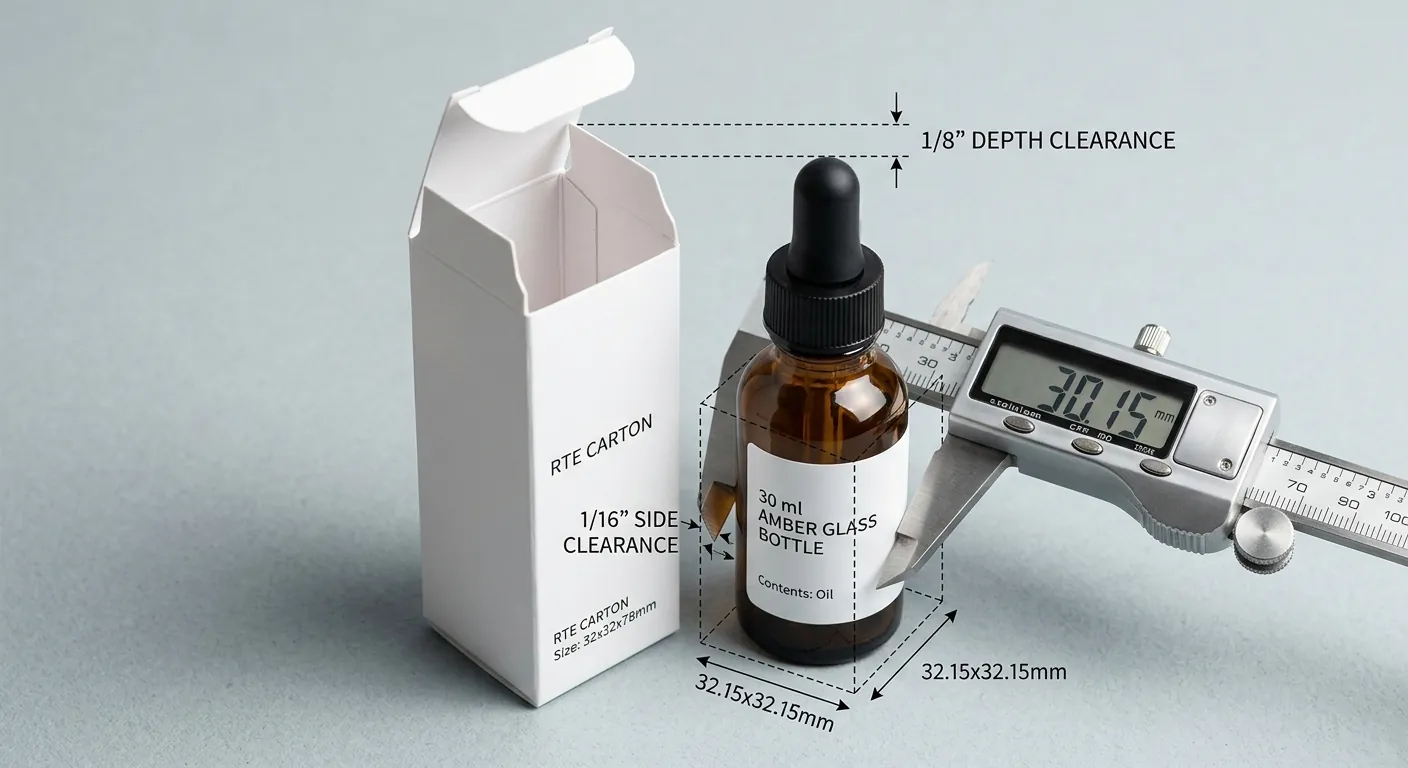
| Glass bottles and jars | 1/16 to 1/8 in (1.6 to 3.2 mm) | 1/8 in (3.2 mm) |
| Capped tubes (lipstick, lip balm, mascara) | 1/32 to 1/16 in (0.8 to 1.6 mm) | 1/8 in (3.2 mm) |
| Soft items (pouches, folded textiles) | 0 to 1/32 in (0 to 0.8 mm) | 1/16 in (1.6 mm) |
| Product in a paperboard insert | Insert wall thickness x 2, plus 1/16 in | Insert base thickness, plus 1/16 in |
Depth gets the larger allowance because the closure sits on top of the product: both dust flaps and the closure panel fold inward at their score lines, and fresh creases spring back slightly. With zero depth clearance, those panels press on the product and the closure pops open on the shelf.
The tuck tongue slides 1/2 to 3/4 inch down inside the front panel, between the product and the wall, so it consumes width, not depth. On snug products, add one board caliper to the width allowance: 0.018 inch (0.46 mm) on 18pt board.
Die-cutting and folding add approximately plus or minus 1/32 inch (0.8 mm) of variation on paperboard, which a 1/16-inch allowance absorbs. Brands ordering cosmetic boxes for glass serums use the 1/8-inch end, because glass and label stock vary between bottle suppliers.
Three Worked Examples
Poker deck, top opening
A standard poker card measures 2.5 x 3.5 inches (63.5 x 88.9 mm), and a 54-card deck on 300 gsm stock stacks to approximately 0.62 inch. With the flap on the short top edge, length is the card width, width is the deck thickness, and depth is the card height. Adding 1/16 inch to each axis, plus 0.018 inch on width for the tongue of an 18pt carton, gives 0.70 inch of width, rounded up to 23/32. The interior spec is 2 9/16 x 23/32 x 3 9/16 inches. Skip the tongue allowance and the deck jams on the first pull.
30 ml dropper bottle
A 30 ml Boston round with its dropper assembled measures approximately 32 mm across and 95 mm tall. Glass takes 1/8 inch (3.2 mm) per axis, so the interior spec rounds up to 35.5 x 35.5 x 98.5 mm. On 18pt SBS, the carton measures roughly 36.5 x 36.5 x 99.5 mm outside, the figure for planning a 12-unit shipper.
Bar soap, two valid specs
A 3.5 x 2.25 x 1 inch soap bar produces two correct answers. Open it on the large face and the spec is 3 9/16 x 2 5/16 x 1 1/16 inches, a shallow tray-style box. Open it on the short end and the spec becomes 2 5/16 x 1 1/16 x 3 9/16 inches, a slim carton that slides out of a shelf row.
Measuring Mistakes That Cost a Full Run
- Copying the outside of an old box as the new interior. Each reorder grows the carton by about 0.9 mm per axis on 18pt board. After three reorders the carton ends up nearly 3 mm oversized per axis, and the product rattles.
- Rounding down. A 2.47-inch bottle recorded as 2.4 inches will not fit, whatever tolerance is added afterward. Round up to the next 1/32 inch or 0.5 mm.
- Measuring before final components arrive. A cap from a second supplier changes bottle height by 2 to 5 mm. Measure the production component, not the sample.
Frequently Asked Questions
Our Packaging Products
Elevate Your Brand With Custom Packaging
Get packaging designed for your brand. Free shipping. No minimums.
Start TodayAuthor
Owen Pierce
Owen Pierce spent nine years as a structural designer at a paperboard converting plant, cutting sample tuck boxes on a CAD sample table before every production run was approved. He has signed off dielines for card game publishers, supplement brands, and indie skincare labels, and still checks every first article with a set of digital calipers.