
The Short Answer
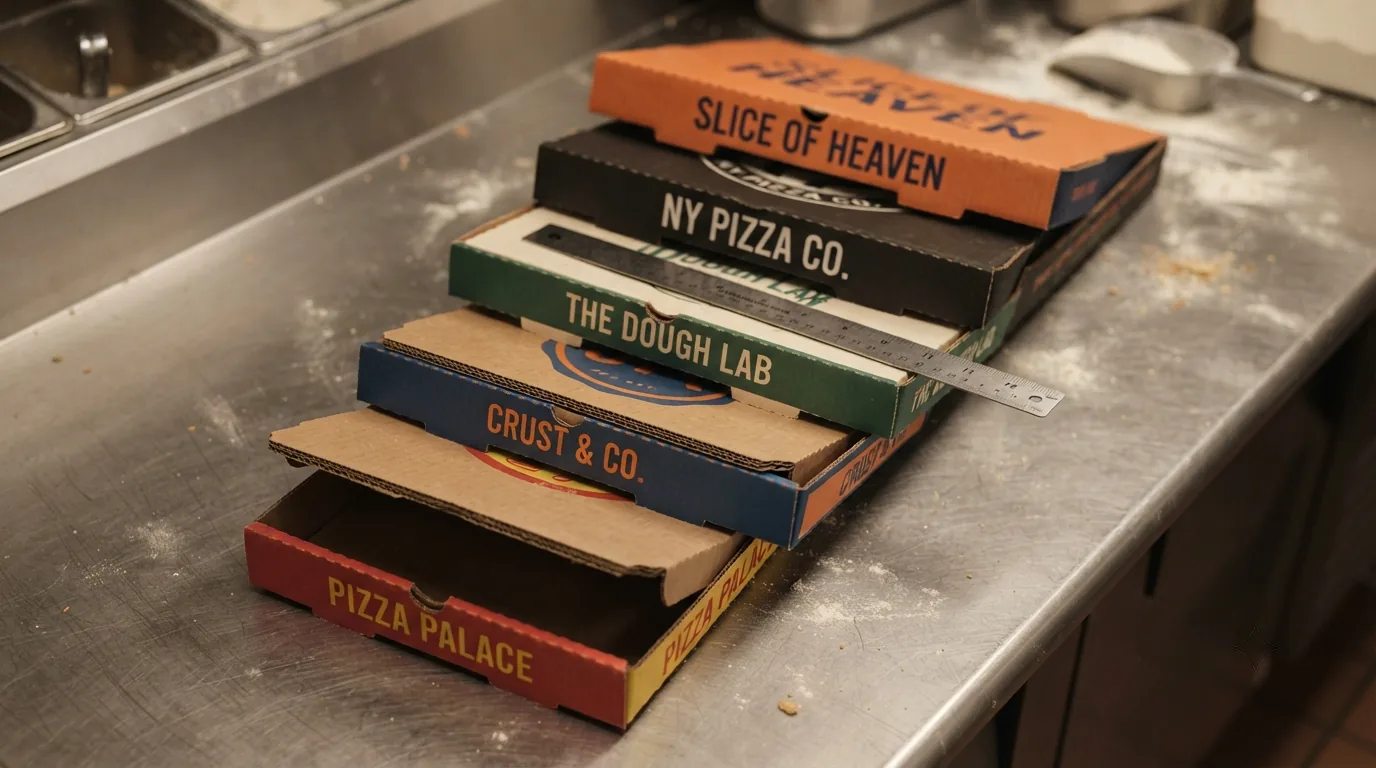
Standard pizza box sizes run 10, 12, 14, 16, and 18 inches square, matching the diameter of the pizza they carry. Depth ranges from 1.5 inches on a 10 inch box to 2 inches on 16 and 18 inch boxes. Deep dish versions add another 0.5 to 1 inch. Most US pizzerias stock 12, 14, and 16 inch.
The Standard Pizza Box Size Chart
Pizza boxes are named by their outer square dimension, never their interior. A box labeled 14 inch measures 14 inches across the outside edge of the folded flap and offers about 13.75 inches of usable interior once the flute thickness of the corrugated cardboard on both side walls is subtracted.
| Nominal size | Outer dimensions | Usable interior | Typical pizza weight | Slice count |
|---|---|---|---|---|
| 10 inch | 10 x 10 x 1.5 in | 9.75 x 9.75 in | 0.8 to 1.0 lb | 4 to 6 |
| 12 inch | 12 x 12 x 1.75 in | 11.75 x 11.75 in | 1.2 to 1.5 lb | 8 |
| 14 inch | 14 x 14 x 1.75 in | 13.75 x 13.75 in | 1.8 to 2.2 lb | 8 to 10 |
| 16 inch | 16 x 16 x 2 in | 15.75 x 15.75 in | 2.4 to 2.9 lb | 12 |
| 18 inch | 18 x 18 x 2 in | 17.75 x 17.75 in | 3.0 to 3.6 lb | 12 to 16 |
Why the Quarter Inch of Clearance Matters
That quarter inch of total clearance is deliberate. More room lets the pizza slide in transit, dragging toppings to one edge and pushing cheese onto the wall. Less forces the crust to compress into the corners and buckle the side panel. The standard pizza box dimensions above have held for decades because that tolerance is the tested balance between slide and squeeze. The 8 inch personal box and the 20 inch party box sit outside the core five. The 8 inch dominates mall food courts and airport concessions. The 20 inch demands an oven deck deep enough to fire the pie and a delivery bag almost no operator stocks.
Pizza Box Depth: The Dimension Operators Get Wrong
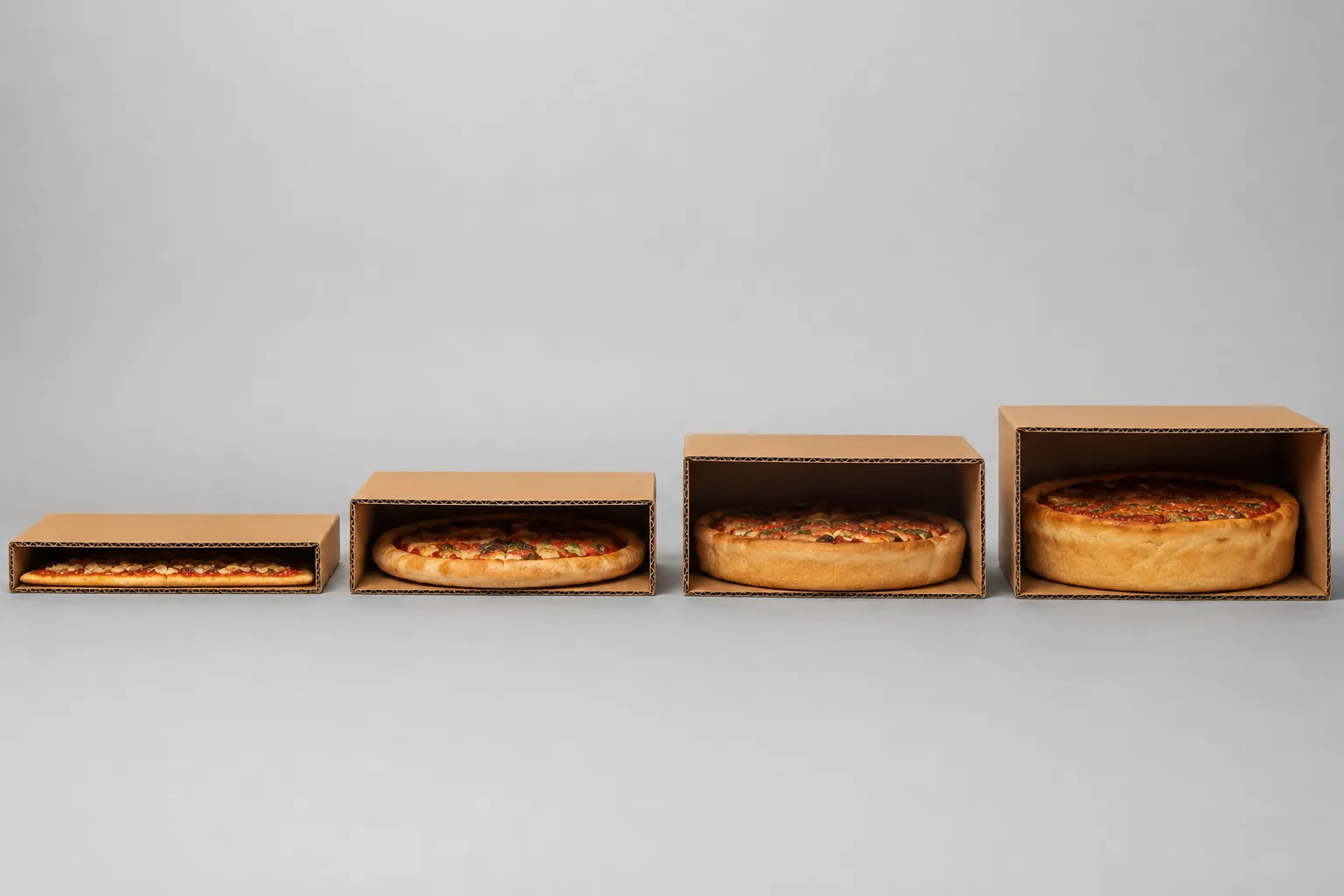
Width gets the attention. Depth decides whether the pizza survives the drive. A New York style pie sits 0.75 to 1 inch tall at the cornicione and clears a 1.75 inch box comfortably. Detroit style and pan reach 1.25 to 1.5 inches. Stuffed crust Chicago hits 2.25 inches. Load either into a 1.75 inch box and the lid presses the cheese, transferring every topping to the underside before the driver reaches the second light. Pizza box depth breaks into four tiers:
| Depth tier | Crust styles it fits | Diameters it applies to |
|---|---|---|
| 1.5 in | Thin crust and tavern cut | 10 and 12 inch only |
| 1.75 in | Hand tossed and New York style | The default for most menus |
| 2 in | Standard pies where the cornicione runs taller by proportion | 16 and 18 inch |
| 2.5 to 3 in | Deep dish, pan, and stuffed crust | Any diameter |
How Big Is a Large Pizza Box?
A large pizza box in the United States measures 14 x 14 x 1.75 inches. That holds for the overwhelming majority of independent pizzerias and every major national chain. Regional drift is real. Northeast shops often label 16 inch as large and 18 inch as extra large, pushing small up to 12 inch. West Coast and Midwest menus anchor large at 14 inch with 16 inch as extra large. Neither is wrong, but an order placed by name instead of number arrives incorrect. Order by dimension, not by adjective.
Explore Our Packaging
Board Grade, Flute, and Weight Ratings
Almost every corrugated pizza box in North America is B-flute: approximately 1/8 inch thick at roughly 47 flutes per linear foot, which delivers flat crush resistance while folding cleanly at the score lines. E-flute at 1/16 inch is too thin to hold heat or resist a stack. C-flute is too thick to fold a clean lid. Kraft liner at 90 to 100 gram weight is the norm for the outer face. The rating that matters is Edge Crush Test, expressed in pounds per inch:
| ECT rating | Diameters it carries | Stack it supports | Service type |
|---|---|---|---|
| ECT 26 | 10 and 12 inch | 1 to 2 boxes | Dine-in and carryout only |
| ECT 32 | 14 and 16 inch | 6 to 8 boxes without deflection | The working standard for most shops |
| ECT 44 | 18 inch and high volume delivery | 10 or more in a hot bag | Heavier board resists sidewall bow at 150°F |
Matching Box Size to Your Menu
The pizza box size chart above sets the specification. Your order mix sets the quantity, and it should mirror ticket data rather than intuition. Pull ninety days of order history and count pies by diameter before committing to a single case. Absent that history, start from the ratios most independent pizzerias converge on, then correct within the first month.
| Box size | Approximate share of pizza orders | Cases per 20 case opening order |
|---|---|---|
| 10 inch | Under 1 in 10 | 2 |
| 12 inch | Roughly 1 in 4 | 5 |
| 14 inch | Roughly 1 in 3 | 7 |
| 16 inch | Roughly 1 in 4 | 5 |
| 18 inch | Fewer than 1 in 20 | 1 (special order) |
The Four Factors That Shift the Ratio
Bundles typically run 100 boxes at 12 inch and below and 50 at 14 inch and above, so that 20 case opening order lands near 1,350 boxes. Four factors move the mix hard. A lunch program above a fifth of daily covers moves two cases from 16 inch to 10 inch. Delivery above half of tickets in a family suburb moves two cases from 12 inch to 16 inch. Tavern or bar service makes 12 inch dominant, where it can approach half of all orders. Campus or late night trade lifts 16 and 18 inch together, and 18 inch can reach one in ten. Over order 14 inch and under order everything else. Running out of 14 inch mid-shift forces upsizing into a 16 inch box, which gives away the price difference on every pie until the next delivery arrives and teaches staff to treat the substitution as routine.
Grease Resistance, Venting, and Material
Grease strike through scales with diameter. An 18 inch pie carries roughly twice the oil load of a 12 inch pie. PFAS-free grease resistant liners now replace the fluorochemical treatments phased out under state restrictions in California, New York, and Washington, with more states following. Cellulose based barrier coatings hold grease through the 30 to 45 minute delivery window without a plastic layer, which keeps the box curbside recyclable. That is the practical definition of sustainable packaging here rather than a marketing claim. Venting matters more as diameter grows. Steam trapped under a lid softens the crust into a soggy base within eight minutes. Standard placement is four to six holes through the side wall at mid depth, not the lid. Lid vents release steam and heat together, trading a soggy pizza for a cold one. Corner posts, the triangular tabs at each interior corner, add roughly 15 percent to compression resistance at no meaningful cost and are standard on ECT 44 board. Shops printing custom packaging should confirm the dieline preserves that geometry, since a reprint that flattens the tabs quietly downgrades the stack rating.
The Box Size Decision Framework
Work these three questions in order. Each answer eliminates options before the next question is asked.
| Decision point | Your answer | What it locks in |
|---|---|---|
| 1. Crust style | Thin or tavern cut | 1.5 in depth |
| Hand tossed or New York | 1.75 in depth | |
| Detroit or pan | 2 to 2.5 in depth | |
| Stuffed or Chicago deep dish | 2.5 to 3 in depth | |
| 2. Largest pie on the menu | 14 in or under | Any standard insulated bag |
| 16 in | Standard bag, verify fit before ordering | |
| 18 in | Dedicated bag, purchased first | |
| 3. Boxes stacked per bag at peak | 1 to 2 | ECT 26 |
| 6 to 8 | ECT 32 | |
| 10 or more | ECT 44 with corner posts |
Two Rules That Override the Table
Never buy a diameter before you own the bag that carries it. Never let the print budget set the board grade, because a clay coated ECT 26 box collapses under a stack that a plain kraft ECT 44 box carries all night. Shops running thin and deep menus should stock two depths at the same diameter rather than compromising on a middle depth. The per unit cost difference is fractions of a cent.
Frequently Asked Questions
Our Packaging Products
Elevate Your Brand With Custom Packaging
Get packaging designed for your brand. Free shipping. No minimums.
Start TodayAuthor
Tony Marcheski
Tony Marcheski ran a three location pizzeria group outside Cleveland for eleven years, where he rebuilt the box program after losing roughly 400 dollars a month to 16 inch pies crushed into 14 inch boxes on Friday nights. He now consults on food service packaging specs, and spends most of his time talking shop owners out of buying 18 inch boxes before they own a bag that fits them.