
The Short Answer
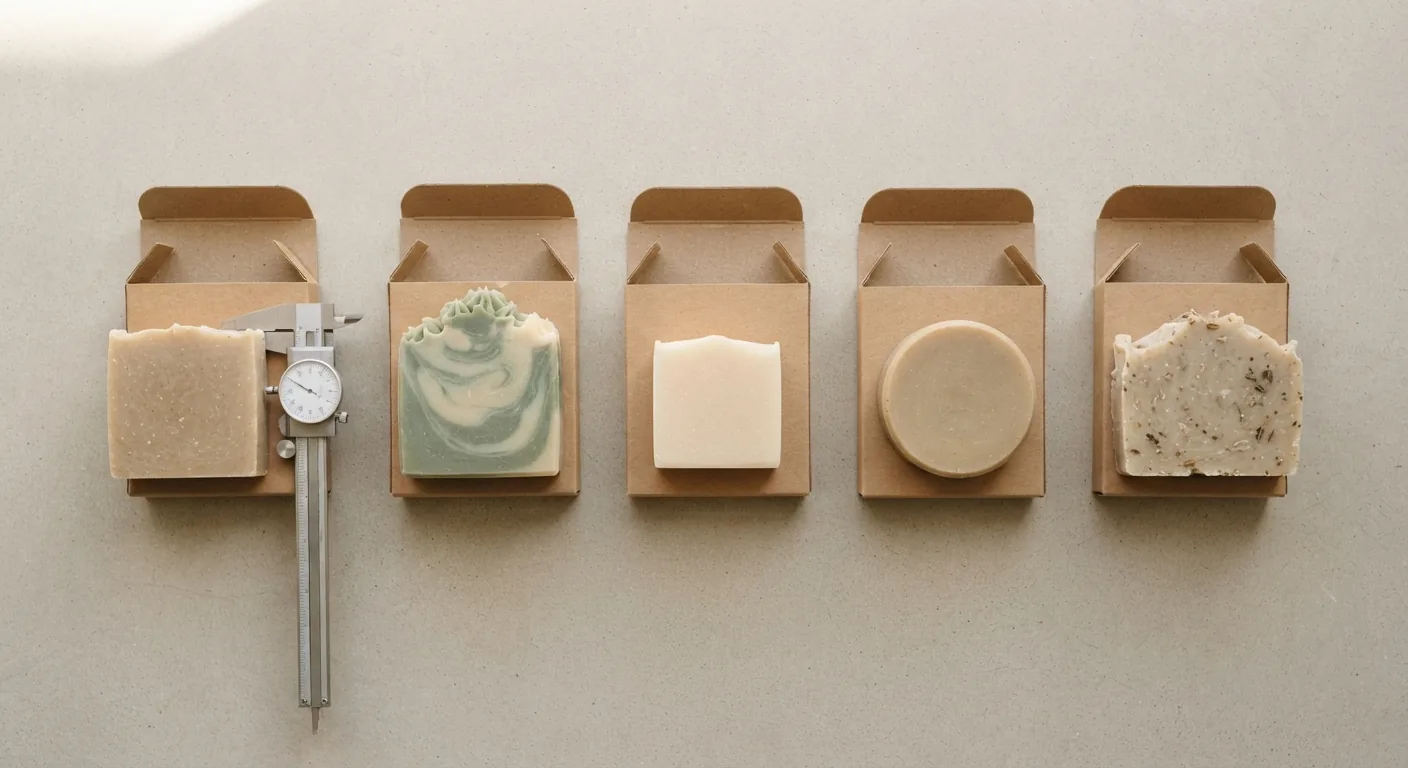
A standard 3.5 x 2.25 x 1 inch soap bar fits a box measuring 3.625 x 2.375 x 1.125 inches. Add 1/16 inch of clearance per dimension for a naked bar and 1/8 inch for a shrink-wrapped one. Oversize artisan bars need 4.125 x 2.875 x 1.375 inches, and a 3 inch round bar takes 3.25 x 3.25 x 1.125 inches.
Soap Packaging Size Chart
Every figure below is an internal dimension written length x width x depth. Suppliers quote tuck boxes and folding cartons by the inside of the carton, because the inside is what holds the bar.
| Bar Format | Typical Bar Size (in) | Box for Naked Bar (in) | Box for Shrink-Wrapped (in) |
|---|---|---|---|
| Standard rectangular | 3.5 x 2.25 x 1 | 3.625 x 2.375 x 1.125 | 3.75 x 2.5 x 1.25 |
| Oversize artisan | 4 x 2.75 x 1.25 | 4.125 x 2.875 x 1.375 | 4.25 x 3 x 1.5 |
| Guest / travel | 2 x 1.5 x 0.75 | 2.125 x 1.625 x 0.875 | 2.25 x 1.75 x 1 |
| Round bar | 3 dia. x 1 | 3.25 x 3.25 x 1.125 | 3.375 x 3.375 x 1.25 |
| Shampoo puck | 2.5 dia. x 1 | 2.75 x 2.75 x 1.125 | 2.875 x 2.875 x 1.25 |
| Loaf-cut slab | 3.5 x 2.5 x 1.25 | 3.625 x 2.625 x 1.5 | 3.75 x 2.75 x 1.625 |
How to Measure a Soap Bar Before Ordering Boxes
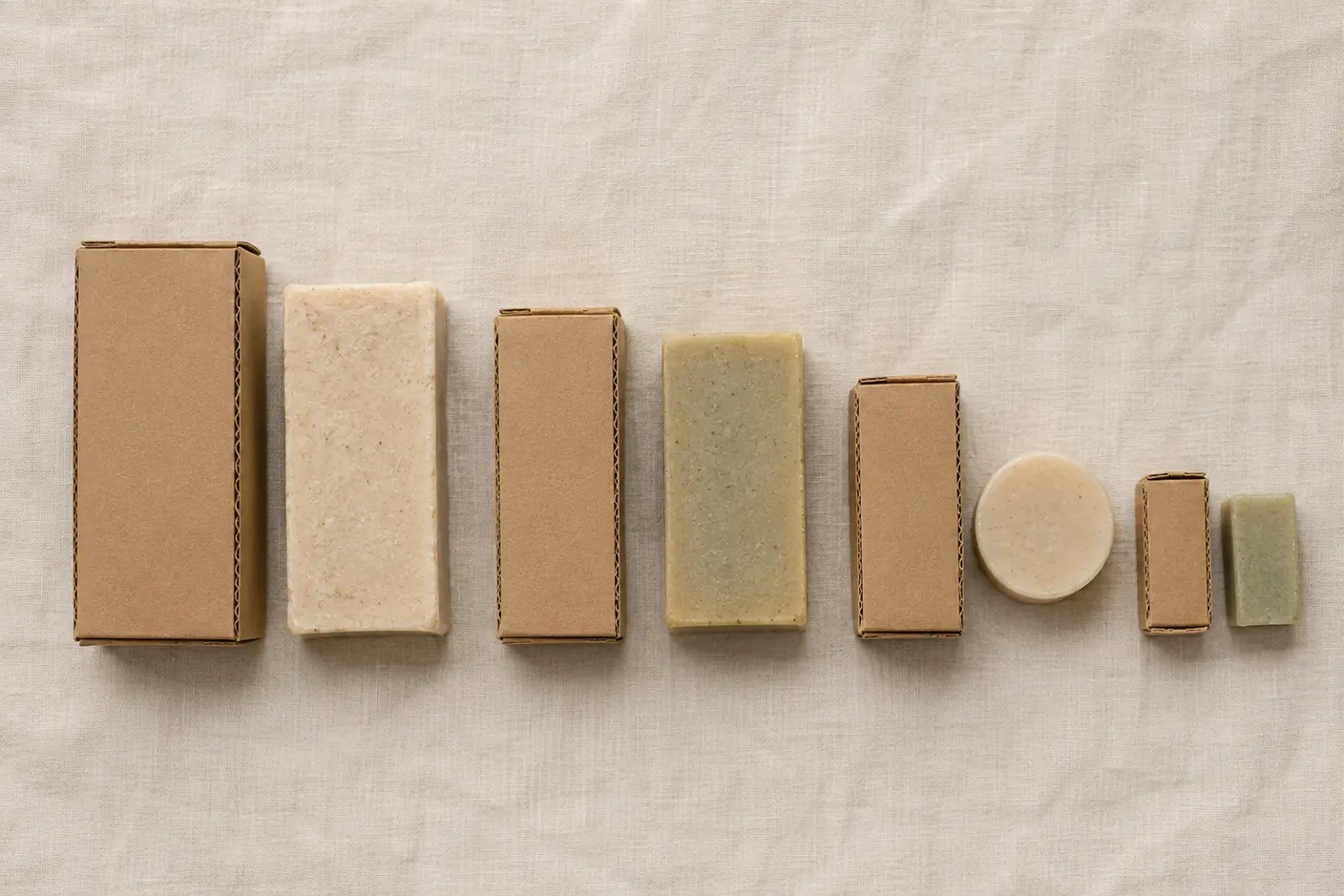
Measure a fully cured bar, never a fresh one out of the mold. Cold process soap loses water across a four to six week cure, and most makers find a bar contracts by roughly 5 percent on its largest face.
Measure the widest point, not the average. Cut bars taper: a loaf sliced on a wire cutter is often wider at the base than at the top face, because the soap pulled away from the mold walls unevenly. Run calipers across the bottom edge, the top edge, and the middle of one bar, and take the largest reading.
Sample five bars, not one. Hand-cut bars from a single loaf commonly differ by 1/16 inch in thickness. Measure five bars, take the largest figure in each dimension, and build the box from that. Sizing to an average guarantees that a portion of every run will not close.
Then round to the nearest 1/8 inch. Dies are cut in 1/16 inch increments, but holding your soap box dimensions to clean 1/8 inch steps keeps a single dieline reusable across scents and avoids a retooling charge on your second order.
Clearance Tolerances: Naked Bars vs Shrink-Wrapped Bars
Clearance is the gap between the bar and the inside wall. Get it wrong in either direction and the box fails. An unwrapped cold process bar needs the walls to grip lightly so it cannot slide and abrade its own edges in transit, while film adds material thickness plus a sealed seam that sits on one face, and that seam is what jams a tight box. Too little clearance and the packer creases the front panel forcing the bar in. Too much and the bar shifts, which reads as cheap the moment a customer lifts it off a shelf.
| Bar state | Clearance per dimension | Why |
|---|---|---|
| Naked bar | 1/16 in | Walls grip lightly so the bar cannot slide and abrade its edges |
| Paper-banded | 3/32 in | A cigar band adds one layer of stock on two faces only |
| Shrink-wrapped | 1/8 in | Film thickness plus a sealed seam ridge on one face |
| Bagged in poly | 3/16 in | Loose poly bunches at the corners and eats clearance unpredictably |
Standard Rectangular Bars
The standard soap bar size in the US handmade market is 3.5 x 2.25 x 1 inch, because that is what a 10 inch silicone loaf mold produces when sliced at one inch. It settles near 4.5 ounces after cure, which is the weight most makers price around. Box it at 3.625 x 2.375 x 1.125 inches naked.
A 4 ounce triple-milled or melt and pour bar runs thinner, close to 3.5 x 2.25 x 0.75 inches, and needs its own depth. Reusing a 1.125 inch deep box for a 0.75 inch bar leaves the bar floating and the front panel bowing.
Oversize and Artisan Bars
Oversize bars, typically 4 x 2.75 x 1.25 inches and 6 to 7 ounces, are the format market sellers use to justify a higher price point. The box runs 4.125 x 2.875 x 1.375 inches, and two structural rules apply at that size.
Front panels wider than 4 inches begin to bow inward on 14pt stock, so step up to 16pt or 18pt SBS. And a 7 ounce bar crosses the load point where a straight tuck end pops open during a drop, so specify a reverse tuck with a locking tab instead.
Guest, Travel, and Sample Bars
Guest bars run 2 x 1.5 x 0.75 inches at roughly 1 ounce, boxed at 2.125 x 1.625 x 0.875 inches. These carry the highest margin in most soap catalogs and drive sampler sets, so the box has to read as a scaled-down version of the full-size carton, not a cheaper cousin. Printing gets tight at this scale: a 2.125 inch front panel holds a logo and a scent name, nothing more.
Round Bars, Pucks, and Shampoo Bars
Round bars go into square boxes. A 3 inch diameter bar takes a 3.25 x 3.25 x 1.125 inch box and a 2.5 inch shampoo puck takes 2.75 x 2.75 x 1.125: the diameter sets both length and width, plus 1/16 inch clearance on each.
The four empty corners are the tradeoff, and the bar will rotate inside them. A die-cut paperboard collar pins the bar centrally. Holding depth to a true 1/16 inch clearance pinches the bar between the top and bottom panels so it cannot spin, and costs nothing.
Loaf-Cut Slabs and Textured Tops
Slab-poured soap cut on a multi-bar cutter produces the least consistent bars in the category. Thickness drifts across the slab and tops are frequently piped or swirled.
Size these boxes to the tallest point of the textured top, not to the flat body of the bar. A piped top adds up to 1/4 inch that a caliper reading across the plain face misses entirely. A 3.5 x 2.5 x 1.25 inch slab bar with texture takes a 3.625 x 2.625 x 1.5 inch box.
Soap Box Depth Is the Dimension That Ruins Orders
Length and width are easy to measure and hard to get wrong. Depth is where first orders fail. It is the smallest number, so a 1/8 inch error is a 12 percent error rather than a 3 percent one, and it carries the most variance because the cutter and the maker’s hand set it rather than the mold. A box 1/8 inch too shallow will not close at all.
Five Mistakes That Kill a First Soap Box Order
Sizing to a fresh uncured bar is the most common one. A bar measured on cutting day is the largest it will ever be, so take the order measurement in week five. Second, placing the shrink-wrap seam on a printed face: run the seam along the back panel so the raised ridge sits against the glue flap, where the box is already thickest.
Third, sending external dimensions. A supplier who receives outside figures will build a box one stock caliper too small on every wall. Fourth, rounding depth down; round depth up by 1/16 inch and add a paperboard insert instead, and round every other dimension down. Fifth, ordering boxes before the mold is final, because a new mold or cutter changes two dimensions at once and orphans the entire dieline.
How to Write Dimensions on a Quote Request
Suppliers read dimensions in a fixed order, and reversing them produces a box that is technically correct and completely wrong. Write length x width x depth, state that the figures are internal, name the unit, then name the bar state.
A complete line reads: “3.625 x 2.375 x 1.125 inches internal, reverse tuck end, 16pt SBS, for a naked cold process bar.” That removes every ambiguity that causes a reprint. Include it verbatim when you request a quote for custom soap packaging, and the sample you get back will match what you measured.
Once the single-bar box is locked, the same dieline scales into multi-bar gift sets, and the band versus sleeve versus full box question becomes the next decision.
Frequently Asked Questions
Our Packaging Products
Elevate Your Brand With Custom Packaging
Get packaging designed for your brand. Free shipping. No minimums.
Start TodayAuthor
Harper Quinn
Harper Quinn ran a cold process soap studio for six years, cutting roughly 400 bars a week across eighteen scents before moving into packaging sourcing full time. She now helps handmade personal care brands spec dielines and place first production runs, and she still keeps a set of dial calipers in her desk drawer.