

The Short Answer
Advent calendar box design is the structural engineering of a 24-cell countdown box: the die-cut door or drawer mechanism, the grain-aligned hinge that survives repeated openings, the grid arithmetic that sizes the chassis around the largest product, and the fill sequence that lands 24 correct items in 24 numbered positions. Structure sets cost and schedule long before print does.
The Four Structures Advent Calendars Actually Ship In
Every advent calendar on a retail shelf is one of four builds, and the choice sets tooling complexity, fill speed, and unit economics before a single Pantone is picked. Rigid builds use 1.5 mm to 2 mm greyboard wrapped in 128 gsm to 157 gsm litho paper. Folding carton builds run 350 gsm to 400 gsm SBS or FBB over a backer tray. Corrugated towers use E-flute or B-flute corrugated cardboard with litho-laminated faces. Unit cost between the cheapest carton and the most involved rigid drawer routinely varies fivefold at the same quantity. Our box styles guide compares these base structures outside the advent context.
| Structure | Opening action | Typical outer size | Best fit | Relative cost |
|---|---|---|---|---|
| Rigid door front | 24 hinged die-cut doors | 300 x 420 x 45 mm | Beauty, fragrance | High |
| Rigid drawer array | 24 sliding drawers | 320 x 400 x 60 mm | Jewelry, high-ticket minis | Highest |
| Folding carton front and tray | Die-cut doors over a backer tray | 280 x 380 x 30 mm | Chocolate, tea, candy | Lowest |
| Corrugated tower | Stacked pull-drawers | 200 x 200 x 600 mm | Toys, coffee, spirit minis | Middle |
Door Die-Cut Mechanics: Grain Direction Decides Everything
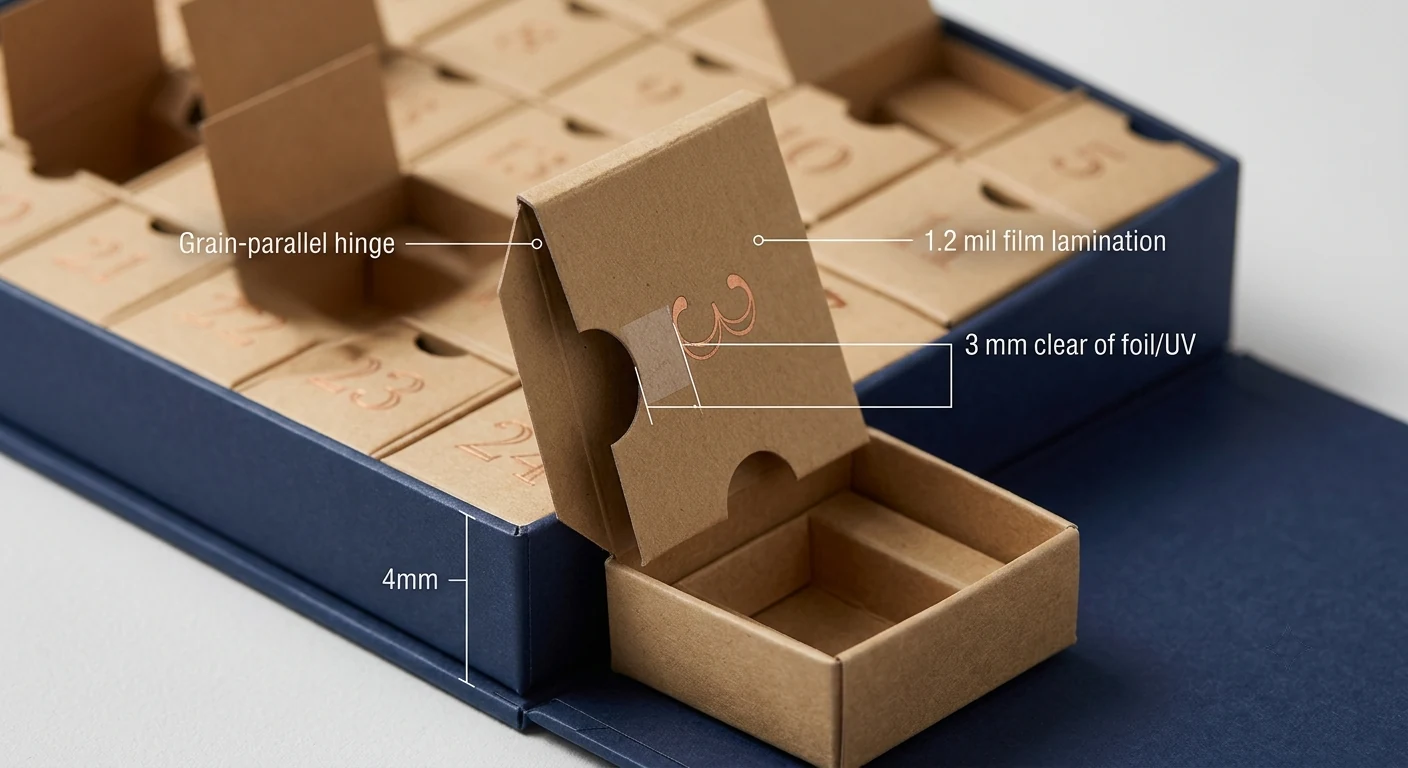
A door is a three-sided cut with an uncut fourth edge acting as the hinge. That uncut edge is where advent calendars fail, in a specific and preventable way. Paper fibres align during manufacture, and a hinge running perpendicular to grain cracks its coating on the first opening and tears loose by day nine. The hinge line must run parallel to the machine direction of the board, so the door layout is dictated by the sheet rather than by the arrangement a designer would prefer. If artwork forces cross-grain hinges, the fix is a 0.7 mm scored channel in the board face rather than a plain crease. The common failure here is a brand approving a flat printed proof, never opening a physical door, and discovering in December that customer photos show torn day-one doors. A flat proof cannot reveal grain direction, so always test hinges on a cut sample before you sign off.
Door Size, Lamination, and Registration
Three more door specifications decide how the calendar performs in a customer hand. On size and finger access, a door narrower than 35 mm gives an adult no purchase, so below that width add a die-cut thumb notch with a 7 mm to 8 mm radius. Doors at 45 mm x 45 mm and above open cleanly without one. Doors above 70 mm on rigid board need a magnetic closure dot or a friction tab, because a large unsupported flap sags open in transit and arrives looking pre-opened. On lamination, film at 1.2 mil holds fibre across the hinge for repeated openings and aqueous coating alone does not; aqueous-coated doors on a folding carton front crack white within a handful of cycles. Keep foil stamping and spot UV at least 3 mm clear of the hinge line, since both stiffen the board exactly where you need flexibility. On registration, door numbering prints on the front panel while the product sits in a tray behind it, so if that tray shifts 2 mm during assembly, door 14 opens onto cell 15. Lock the tray with two die-cut registration tabs seated in chassis slots and specify a die-cut tolerance of plus or minus 0.5 mm. The failure mode is a tray glued by eye that drifts one cell over the run, so that every door from unit 200 onward opens on the wrong product. Registration tabs cost nothing at the dieline stage and make that error physically impossible.
Drawer Formats: When Pull-Out Beats Push-Through
Drawer calendars replace hinged doors with 24 sliding trays in a honeycomb chassis. The format costs more and fills slower, and beauty and jewelry brands choose it anyway for three reasons. Drawers protect fragile contents: a glass 5 ml vial rattling behind a hinged door has no lateral support, while a drawer with 1.5 mm walls plus a pulp insert holds it immobile. Drawers survive repeat handling where hinged doors are effectively one-way. And a drawer delivers a fresh unboxing experience each morning, which is the core promise of luxury packaging in this category. A 6 mm grosgrain ribbon pull is the standard detail, glued under the base and protruding 12 mm to 15 mm; die-cut thumb notches cost less and do the same job. Ribbon adds one hand-assembly step per drawer, which at 24 drawers is 24 extra touches per unit in your labour quote.
Explore Our Packaging
Sizing a 24 Day Advent Box
Grid arithmetic sets the outer dimensions of any 24 day advent box. Twenty-four cells divide cleanly as 4 x 6 or 6 x 4, with a 5 x 5 grid plus one oversized cell when a single day carries a hero product. Add 3 mm clearance per side around the largest product, then add wall thickness: on a 1.5 mm greyboard chassis a 4 x 6 grid loses 7.5 mm horizontally and 4.5 mm vertically to internal walls alone. Size the grid around the largest single item, or the hero product will not seat. Depth is the tallest item plus 2 mm headroom. Mixed-height assortments waste volume, and volume is dimensional weight: splitting a deep calendar into two shallow stacked trays often lands in a lower shipping band than one deep box.
| Grid | Cell footprint | Cell area only | Suits |
|---|---|---|---|
| 4 x 6 | 50 x 50 mm | 200 x 300 mm | Beauty minis, sachets, sample vials |
| 6 x 4 | 45 x 60 mm | 270 x 240 mm | Lipsticks, tea tins, wrapped chocolate |
| 5 x 5 less one cell | 55 x 55 mm | 275 x 275 mm | One hero product at double width |
Fill-Line Logistics
Fill is where advent budgets break. A standard mailer is one product into one box; a 24-cell calendar is 24 separate picks into numbered positions with zero tolerance for error. Hand-fill rates run in the low tens of units per hour per operator on a mixed-content 24-cell calendar. Most co-packers quote advent fill as a separate line item, and fill labour commonly exceeds packaging cost on complex builds. On a 2,000-unit order at 20 units per operator-hour, that is roughly 100 operator-hours of fill before a single box ships, which is why structure choices that speed the line beat a cent saved on board. Three structural choices cut that cost directly. Number the tray floor and not just the door, because cell numbers under the product give the operator a visual check on every pick and remove the counting error behind the most costly rework. Group by product rather than by calendar, since filling all 400 units of cell 1 and then all of cell 2 is materially faster than completing one calendar at a time, provided the chassis holds shape while open and unstacked. And design a flat fill orientation, because trays that fill face-up and slide into a sleeve fill faster than any structure that requires the operator to work through the door apertures. Retention matters too, since loose items migrate between cells in transit and leave a door opening onto an empty cell. Moulded pulp, vacuum-formed PET, or friction-fit paperboard inserts all solve it, and paperboard keeps the build recyclable in one stream when the calendar is sold as sustainable packaging.
The Real Advent Calendar Box Design Deadline
Advent calendars carry the longest lead time of any seasonal packaging product, but most of that reputation belongs to one line item domestic production deletes entirely: the ocean crossing. Every guide telling you to commit by June assumes an overseas supplier and five to seven weeks of sea freight plus customs. Cut that out and the decision date moves back roughly ten weeks. Work backward from a mid-October delivery and the overseas schedule puts artwork approval in July and structural sign-off in June, while a USA-based schedule with digital die-cutting and no ocean leg supports a late-September commit for the same delivery. That gap is the biggest lever in advent planning, and it is why the standing advice to order your advent packaging in June is really advice about freight rather than about boxes.
| Stage | Overseas schedule | USA-based schedule |
|---|---|---|
| Structural design and dieline | Late June | Mid August |
| White sample and structural approval | Mid July | Early September |
| Artwork, proofing, print approval | End of July | Mid September |
| Production run | Through August | Late September (8 to 10 business days) |
| Sea freight and customs | September (5 to 7 weeks) | None |
| Co-packing and fill | Early October | Early October |
Reading This in August or September?
A late start narrows the menu rather than closing it, and three recovery paths keep the launch alive. The first is to use a stock structure: a standard 4 x 6 door dieline with custom print skips structural sampling and cuts two to three weeks from the front of the schedule. The second is to reduce the door count, because a 12-day format halves fill labour and insert complexity, and 12-day calendars now sell as their own category rather than as a compromise. The third is to downgrade drawers to doors, since a drawer chassis is the slowest structure to sample and to fill, and a hinged-door front on the same footprint saves both sampling time and per-unit assembly touches. Each of these buys back schedule at a defined cost, and taking two of them together is usually enough to recover a launch that started in September.
Choosing an Advent Calendar Box Manufacturer
Evaluate any advent calendar box manufacturer on four capabilities. In-house die-cutting with a documented tolerance matters because outsourced cutting adds a week and a registration risk. Physical white samples matter because a flat dieline proof says nothing about whether a hinge survives 24 openings. Insert manufacturing under the same roof matters because tray and chassis should cut on matched tooling. And drop-test data on the loaded assembly matters because the failure mode that counts, doors popping open under vibration, only appears with real product weight in the cells; custom rigid boxes behave differently loaded than empty, so ask for a filled sample that has been through a drop sequence. Packify builds advent calendars on that exact checklist, with rigid boxes, folding cartons, and corrugated structures die-cut and assembled in the USA, no minimums, no die charges, physical samples before production, an 8 to 10 business day turnaround, and free US shipping. A small test run and a 5,000-unit retail order follow the same process, so you can prove the structure before you scale it. Send your product dimensions and cell count and request a quote to get a dieline started.
Quick Decision Checklist
Lock these seven answers before requesting a dieline. Structure: doors, drawers, carton, or tower, chosen by product value and fragility. Grid: 4 x 6, 6 x 4, or 5 x 5 with a hero cell, sized to the largest item plus 3 mm. Hinge spec: grain-parallel hinges, film lamination, foil and UV held 3 mm off the hinge line. Registration: tray tabs on the dieline, plus or minus 0.5 mm die tolerance. Insert: pulp, PET, or paperboard, with paperboard the answer if single-stream recyclability matters. Fill plan: numbered tray floors, flat fill orientation, and a product-by-product sequence. Date: worked backward on the domestic column of the timeline table, not the overseas one. Seven answers is a short list, but every advent programme that goes wrong goes wrong on one of them.
Frequently Asked Questions
Our Packaging Products
Elevate Your Brand With Custom Packaging
Get packaging designed for your brand. Free shipping. No minimums.
Start TodayAuthor
Derek Ashworth
Derek Ashworth spent nine years as a structural packaging engineer specifying rigid board builds for beauty and confectionery clients, including four consecutive advent calendar programs that ran from dieline to co-packing floor. He is the person people call when a door hinge cracks on the third opening, and he keeps a drawer of failed white samples as teaching aids.