The Short Answer
Christmas packaging needs three decisions: the right box style for the product, an interior size with clearance, and proof approval 16 to 20 business days before boxes must be in hand. Packify produces most orders in 8 to 10 business days after proof approval.
What Christmas Packaging Covers
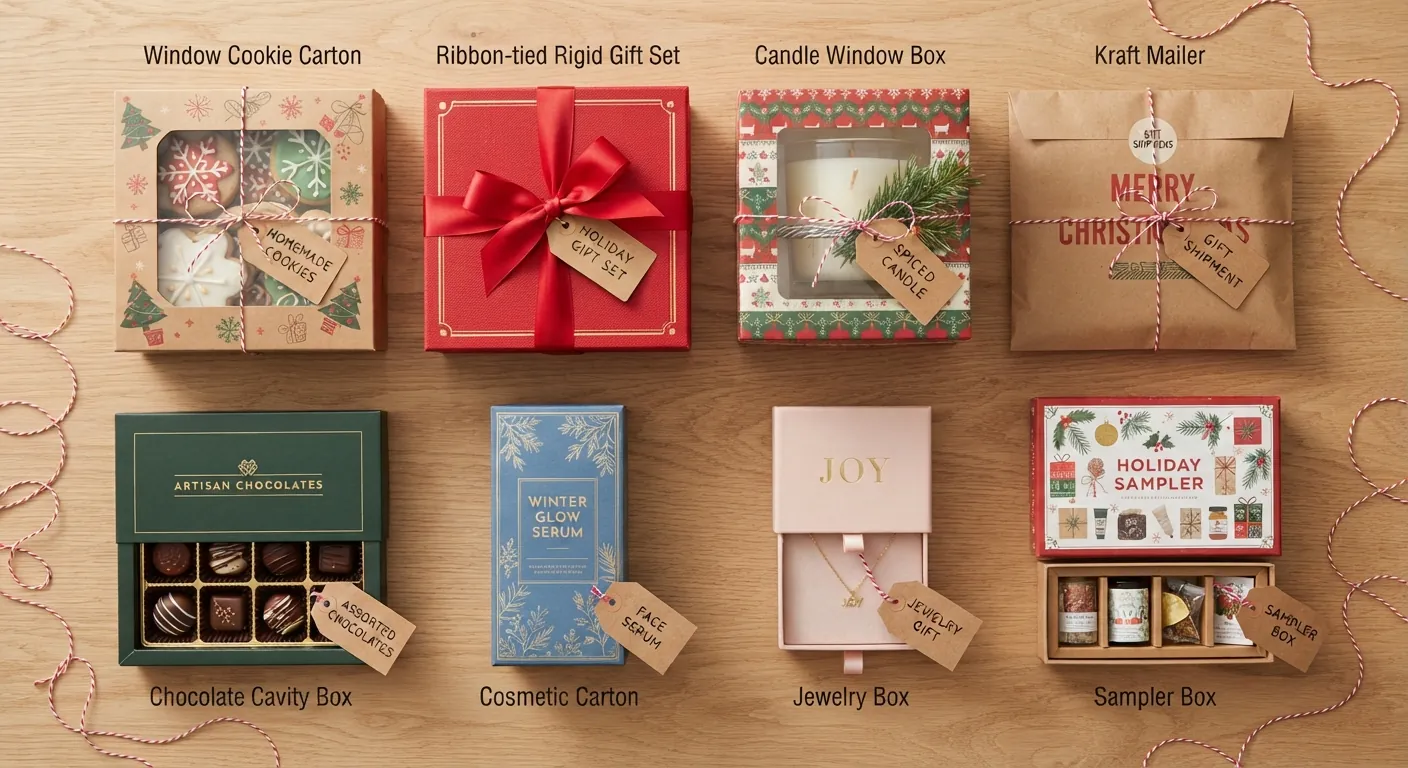
This holiday packaging guide is the hub for every Christmas format Packify produces. Christmas packaging for business buyers falls into eight formats in the custom Christmas packaging range: gift boxes, cookie boxes, cupcake boxes, mailer boxes, candy boxes, candle boxes, treat boxes, and stacking boxes. Every order of custom Christmas boxes carries no minimum, no die or plate charge, and free design support, so a 50-unit bakery test and a 5,000-unit retail program follow the same path from quote to proof to production.
Three decisions shape the season: style (structure and closure), size (interior dimensions plus insert allowance), and date (the day the proof must be approved). The sections below take each in turn, then walk through every product category.
Box Style by Product Type
Match the structure to the failure the product is most likely to suffer: crushed contents, grease, breakage, or a gift that looks cheap on opening.
| Product | Best style | Typical interior size (in) | Board and spec |
|---|---|---|---|
| Cookies, cupcakes | Window bakery boxes with insert | 9.5 x 6.5 x 2 (six 3-inch cookies) | 14 pt (300 GSM) food-safe coated paperboard |
| Chocolate, candy | Rigid base and lid with cavity insert | 6 x 6 x 1.5 (16 pieces) | 1,200 GSM greyboard, foil seal |
| Beauty, fragrance | Cosmetic boxes with molded insert | 1.75 x 1.75 x 4.5 (30 ml bottle) | 14 pt (300 GSM), soft-touch lamination |
| Candles | Rigid window box or tuck boxes with insert | 3.75 x 3.75 x 4 (8 oz jar) | 1,200 GSM rigid or 18 pt (350 GSM) carton |
| Jewelry, watches | Rigid boxes with magnetic closure | 2.5 x 2.5 x 1.75 (ring); 4.5 x 4.5 x 3 (watch) | 1,200 to 1,400 GSM greyboard |
| Apparel | Tuck-top mailer boxes | 12 x 9 x 2.5 (folded tee) | E-flute corrugated |
| Shipped orders | Corrugated mailer boxes | 12 x 9 x 4 = 432 cu in, billed at 4 lb | E-flute or B-flute, ECT 32 or ECT 44 by weight |
Note: add 0.125 in (3 mm) clearance per side for inserts. Packify makes every box to your exact dimensions.
Carriers bill dimensional weight at a divisor of 139 cubic inches per pound: 432 divided by 139 is 3.1, which rounds up to 4 lb. The shipping cost guide covers the math, and the Christmas gift box sizes guide carries full dimension charts.
Christmas Packaging by Product Category
Bakery and Treats
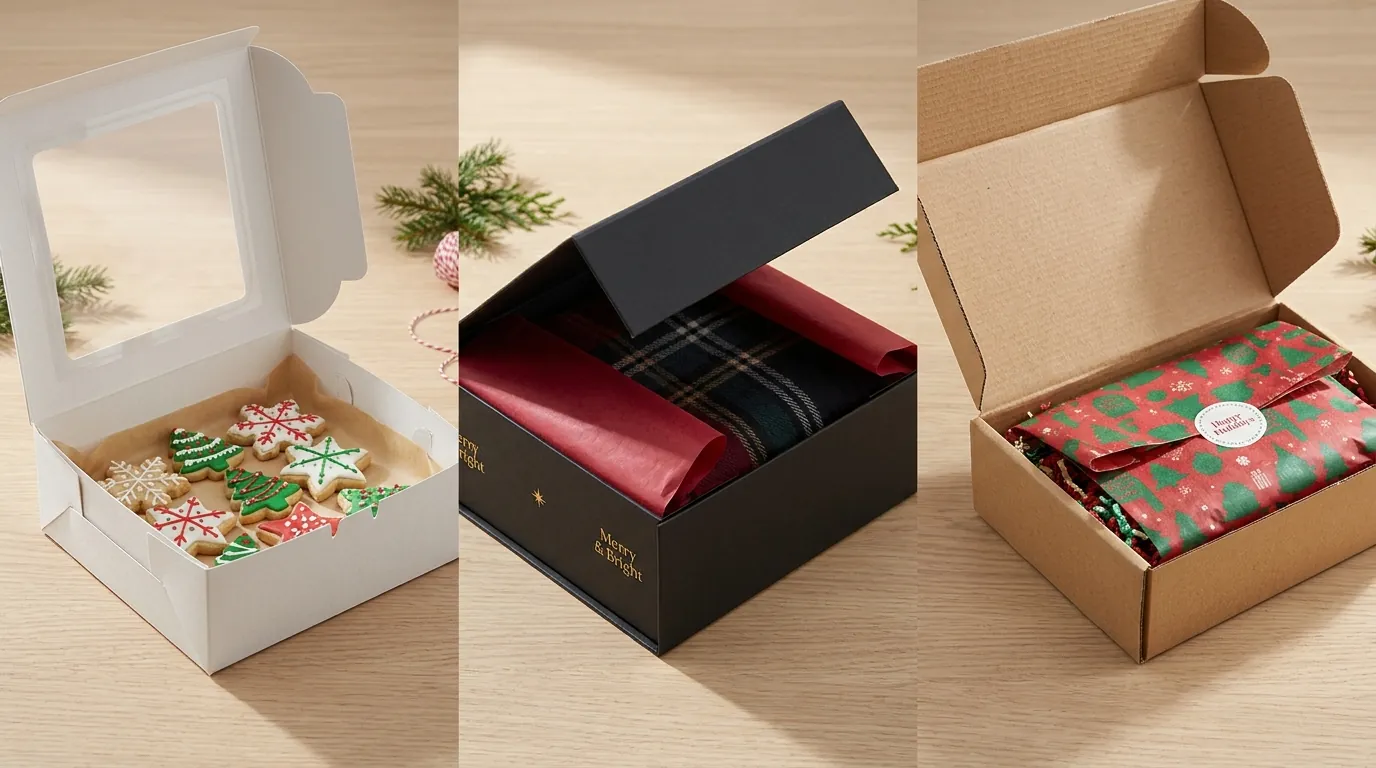
Cookie and cupcake sales concentrate in the final two weeks before December 25, so bakery boxes need grease-resistant coated paperboard and a window that keeps decorated tops clear of the film. A 9.5 x 6.5 x 2 inch box holds six 3-inch cookies, and the guide on how many cookies fit in a box shows counts per dimension. Packify prints metallic ink instead of loose glitter on food formats.
Chocolate and candy reverse the priority: a 16-piece box that shifts in transit arrives as loose fragments, so the cavity insert matters more than the lid. Bonbon sets run as rigid base-and-lid boxes or folding cartons at 18 pt (350 GSM), and stocking fillers under 4 inches suit small tuck boxes at any quantity.
Beauty, Candles and Fragrance
Beauty sets sell earliest, with Black Friday weekend opening the run. A 30 ml bottle fits a 1.75 x 1.75 x 4.5 inch carton, a three-product set needs a 9 x 6 x 2.5 inch rigid box with a molded insert, and single items suit cosmetic boxes at 14 pt (300 GSM). The lipstick tube dimensions guide lists carton sizes by tube.
Candles carry a different risk: an 8 oz jar weighs roughly 1 lb, and the glass vessel is what breaks in December carrier volume. The candle vessel weight guide lists weights by jar size, the ECT 32 versus ECT 44 choice for shipped sets sits in the weight limits guide, and shelf sets suit rigid window boxes.
Jewelry, Apparel and Corporate Gifts
Jewelry carries the highest value per cubic inch, and gift buyers expect a box that needs no wrapping. A ring fits 2.5 x 2.5 x 1.75 inches and a watch 4.5 x 4.5 x 3 inches inside rigid boxes with a magnetic closure or ribbon pull, on greyboard at 1,200 to 1,400 GSM.
Apparel brands move from polybags to boxes for the gifting window because a boxed garment ships flatter and presents better. A folded tee needs 12 x 9 x 2.5 inches interior, and tissue plus a seal sticker create a gift-ready opening without wrapping.
Corporate programs of 250 to 5,000 units with foil sit in the 20-business-day window, so proofs must be approved by the first week of November for a December 8 delivery. Rigid sets with ribbon closures at 1,400 GSM carry brand color best, and the corporate Christmas gift boxes guide covers executive and team gift tiers.
Food, Drink and Shipped Orders
Coffee and tea samplers sell as four- to six-compartment sets. A 9 x 6 x 2.5 inch box with an insert tray at 18 pt (350 GSM) holds six tea sachets plus a card, and sealed pouches stay inside the box to protect freshness through December shipping.
Anything that ships, from samplers to candle sets, belongs in corrugated mailer boxes in E-flute or B-flute. Size the box within 0.5 inch of the packed product: a 12 x 9 x 4 inch mailer bills at 4 lb, and every extra inch of height raises the billed weight.
Packify Delivery Tiers
Packify runs two delivery tiers, standard and paid rush, on one production cycle.
| Tier | Production | Transit | Shipping cost | Total window |
|---|---|---|---|---|
| Standard | 8 to 10 business days after proof approval | 3 to 6 business days, continental US | Free | 11 to 16 business days |
| Standard with foil or spot UV | 10 to 14 business days | 3 to 6 business days | Free | 13 to 20 business days |
| Mid-season reorder (retained die) | 8 to 10 business days, no new proof | 3 to 6 business days | Free | 11 to 16 business days |
| Paid rush shipping | 8 to 10 business days | 4 to 6 business days as listed | Quoted per order | Confirmed before you pay |
International orders ship in 7 to 15 business days, so approve the proof up to 25 business days out (29 with foil).
The Work-Backward Formula
Start at the date boxes must be in your hands, then subtract in this order:
- Subtract 6 business days for transit (worst case).
- Subtract 10 business days for production (worst case).
- Subtract 4 business days if the design uses foil or spot UV.
- The result is the proof approval deadline: 16 business days before delivery for plain print, 20 with foil.
- Subtract 3 more business days for your own artwork and proof turnaround to get the order date.
Example: foil cartons due in hand December 8. Subtract 20 business days: approve the proof by November 9 and place the order by November 4.
| In-hands date | Recommended approve-by (foil, 20 days) | Latest approve-by (plain, 16 days) |
|---|---|---|
| November 20 | October 23 | October 29 |
| December 1 | November 2 | November 6 |
| December 8 | November 9 | November 13 |
| December 15 | November 16 | November 20 |
Counts skip weekends and Thanksgiving Day (November 26).
Rush Orders
Rush at Packify is a paid shipping upgrade, listed at 4 to 6 business days within the USA, and each request is confirmed before ordering. Production holds at 8 to 10 business days, so four levers protect a tight deadline:
- Select "ASAP (within 2 weeks)" on the quote form, which flags the order as a rush run.
- Drop foil and spot UV to recover 2 to 4 business days.
- Approve the proof the day it arrives.
- Reorder from a retained die, which skips setup and a new proof cycle.
A proof approved on October 26 arrives between November 10 and November 17 on standard terms, and by November 23 with foil. Any date earlier than 11 business days after approval cannot be met on standard terms.
Common Mistakes
Five planning errors account for most late holiday boxes, and each has a simple fix.
| Mistake | What happens | Fix |
|---|---|---|
| Counting from the order date | The 8 to 10 day clock starts at proof approval, not payment | Track the approval date |
| Forgetting finishing time | Foil and spot UV add 2 to 4 business days | Add 4 days to the plan |
| Printing a year on the box | Unsold stock becomes waste on December 26 | Use undated artwork |
| Ignoring dimensional weight | A 12 x 9 x 4 in mailer bills at 4 lb, not its scale weight | Check size against divisor 139 |
| Planning through Thanksgiving | November 26 is not a production or transit day | Subtract it from every count |
Planning Inventory Between Seasons
Holiday stock occupies warehouse space for eleven months to sell in one, so storage footprint is a real cost. Graduated stacking sets nest inside one another, and flat-shipped blanks fold only when a bakery or packer needs them. Artwork built from snow, evergreen, ribbon, and brand color carries no year, which turns unsold boxes into next season’s opening stock instead of waste on December 26. Packify retains the die, so topping up an existing run costs 8 to 10 business days instead of a full reprint cycle.
More Christmas Guides
Each guide below goes deeper on one format or deadline. This list updates automatically as new Christmas guides publish.
- Hot Cocoa Bomb Box Sizes: Dimensions for 1, 2, 4, 6, and 12 BombsA 3 x 3 x 3 inch box fits a standard 2.5 inch cocoa bomb, but 12 bombs need 11.5 x 9 x 3 inches and a topped bomb needs more height. This guide gives the full size table, cavity spacing, and the dates to order before Christmas.
- Corporate Christmas Gift Box Ideas: Packaging That Represents Your BrandSeptember 20 is the order date, meaning purchase order signed and print-ready artwork supplied. This guide chains that date forward to a November 25 carrier handoff, sets three gift tiers sharing one foil die, and puts the foam insert on the same timeline as the box.
- Christmas Gift Box Sizes: A Dimensional Guide for Every Gift TypeA ring box and a sweater box are separated by 15 inches of length and two entirely different board specs. This chart gives interior dimensions for twelve gift categories, the 0.25 inch clearance rule that keeps lids seated, and the October 1 cutoff for December delivery.
- How to Order Holiday Packaging Before the Rush: Christmas Production DeadlinesSubmit artwork by September 15 and your holiday boxes are flat on the packing bench by November 15. Miss it and the choices are a 40 to 70 percent rush premium, air freight at three times ground, or stock boxes with printed tape. Here is the critical path, rung by rung, with the carrier cutoffs at the end of it.
- Advent Calendar Box Design: Structures, Door Mechanics, and Fill LogisticsTwenty-four doors is twenty-four chances for a hinge to crack or a cell to open empty. This guide covers die-cut hinge mechanics, drawer versus door economics, 24-cell grid arithmetic, and the fill-line decisions that quietly cost more than the box. It also shows why the famous June advent deadline is a freight assumption, not a packaging one.
Frequently Asked Questions
Our Packaging Products
Elevate Your Brand With Custom Packaging
Get packaging designed for your brand. Free shipping. No minimums.
Start TodayAuthor
Elena Vasquez
Elena Vasquez has run seasonal packaging calendars for gift and bakery brands for nine years. In her first holiday program she approved a foil-stamped proof on November 20 expecting cartons by December 5; foil stretched production to 14 business days, the boxes arrived December 18, and the launch lost its first week of sales. She now builds every schedule backward from the in-hands date and subtracts the finishing days first.