
The Short Answer
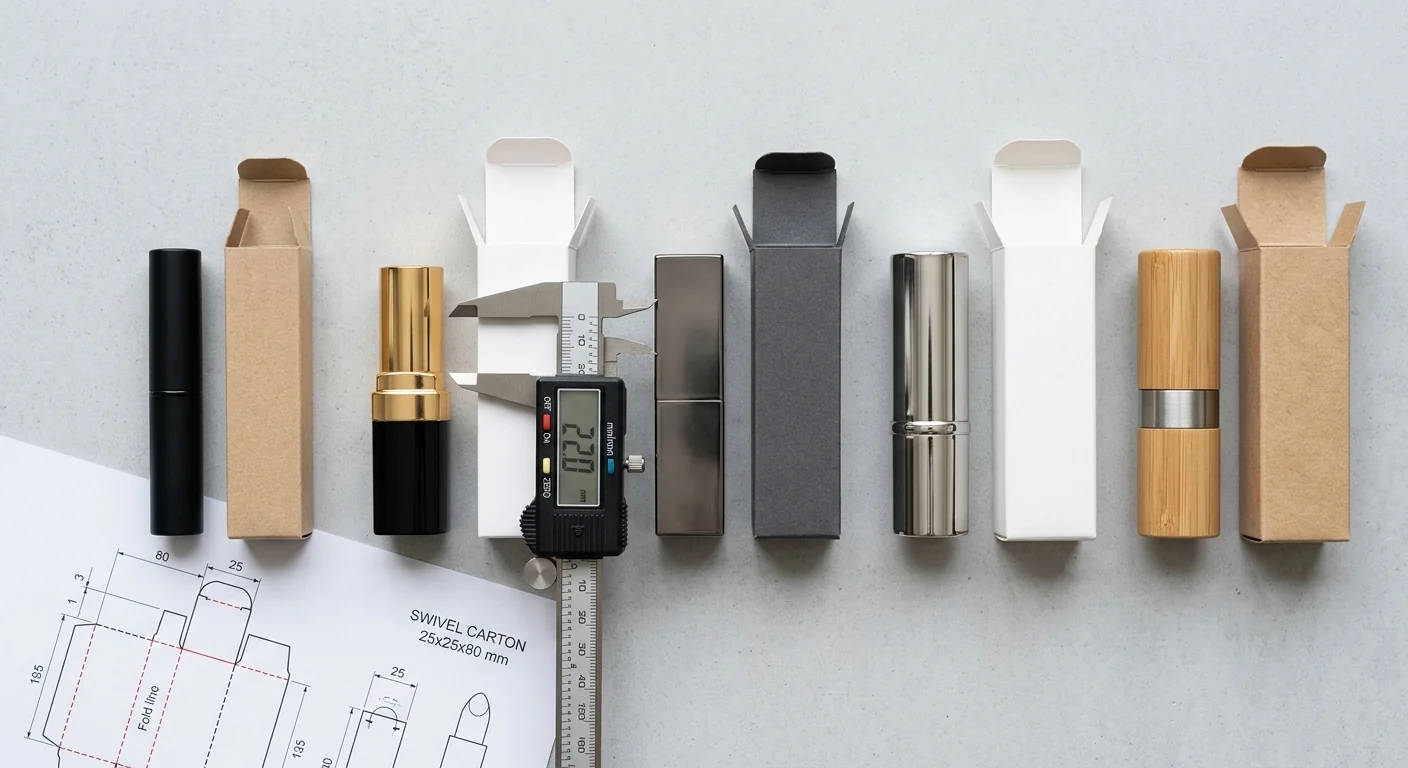
A standard lipstick tube stands 72 to 82 mm tall and measures 20 to 23 mm across, built around the 12.1 mm bullet cup that dominates global fill lines. The matching carton runs 24 x 24 x 83 mm internally, or 0.94 x 0.94 x 3.27 inches. Slim tubes narrow to 16 mm, oversize metal formats reach 30 mm, and every carton adds clearance on all three axes. The tables below pair each tube format with the carton internal dimensions it needs, in both millimeters and inches.
How to Measure Your Tube in Thirty Seconds
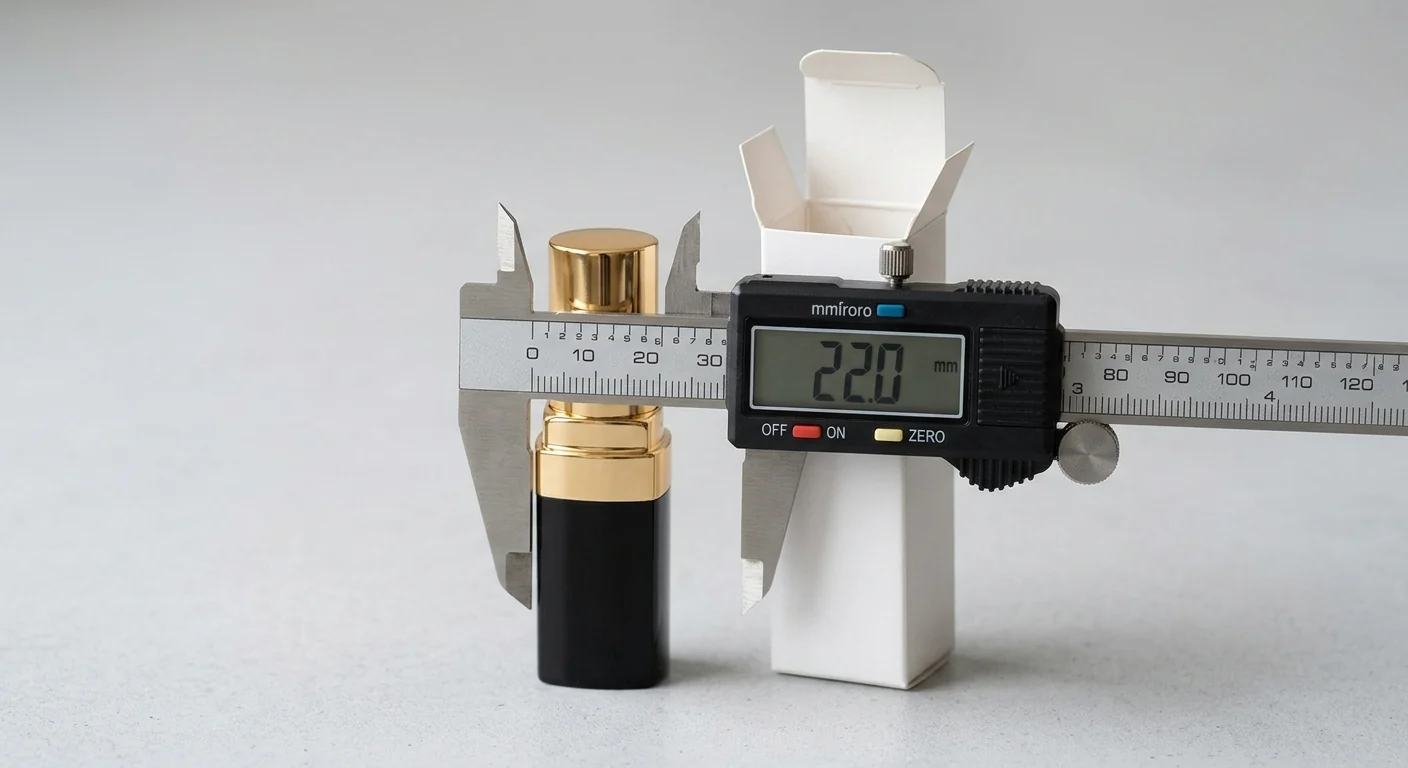
Before any table below is useful, take two caliper readings off the actual component rather than off the supplier spec sheet. For width, keep the cap on and the mechanism fully retracted, and measure across the widest point of the cap rather than the barrel. Caps run 0.3 to 0.8 mm wider than the body on most moulded tubes, and that is the figure the carton has to clear. For height, measure base to the crown of the cap with the cap fully seated; a cap sitting proud by half a millimeter because the mechanism is not fully retracted will read long and push your dieline oversize. Take both readings on three tubes from the same lot rather than one. Moulding variation of 0.2 to 0.4 mm across a cavity set is normal, and you want the largest of the three. If you are working from a component drawing instead of a physical sample, follow the same measuring guide as soon as the first samples land and confirm the drawing before the carton goes to plate.
Six Tube Formats, Six Sets of Numbers
Every set of lipstick tube dimensions in production today falls into one of six formats. Fillers, mechanism suppliers, and carton printers all work from the same short list, so identifying yours takes only the two caliper readings above. The classic swivel tube is the reference point for the whole category. It carries a 3.5 g (0.12 oz) bullet, the net weight printed on most full-size lipsticks sold in the US. Travel minis carry 1.8 g (0.06 oz) and shorten the tube to 55 to 62 mm, short enough that a carton built for the full-size SKU leaves the mini loose inside it. Refillable formats are the newest entry and the heaviest: a zamac outer shell with a magnetic collar pushes filled weight past 50 g, roughly double a plastic classic tube, and that weight changes both the board and the closure the carton needs.
| Format | Bullet cup | Closed footprint | Closed height | Filled weight |
|---|---|---|---|---|
| Slim precision | 3.5 to 6.5 mm | 13 to 16 mm round, 12 x 12 mm square | 70 to 80 mm | 12 to 20 g |
| Classic swivel | 12.1 mm | 20 to 23 mm round | 72 to 82 mm | 18 to 30 g |
| Square architectural | 12.1 mm | 18 x 18 to 22 x 22 mm | 74 to 86 mm | 25 to 45 g |
| Oversize statement | 12.7 mm | 24 to 30 mm round | 82 to 95 mm | 35 to 60 g |
| Refillable magnetic | 12.1 mm | 22 to 26 mm round | 80 to 90 mm | 45 to 70 g |
| Travel mini | 12.1 mm | 18 to 21 mm round | 55 to 62 mm | 10 to 16 g |
The 12.1 mm Cup Sets a Floor Under Lipstick Tube Diameter
The bullet cup is the internal cradle the wax sits in, and it is the one dimension you cannot design around. Three cup sizes cover nearly the entire market: 12.1 mm, the global default; 12.7 mm, common in US-filled prestige lines; and 11.8 mm, frequent in mechanisms tooled by Korean and Chinese suppliers. Work outward from the cup and the exterior follows. The mechanism sleeve adds roughly 1 mm per side, the outer shell adds 2.5 to 4 mm per side depending on wall material, and a 12.1 mm cup lands at a 20 to 23 mm finished tube. Anything under 20 mm on the outside is running a slim mechanism with a 3.5 to 6.5 mm bullet rather than a standard one. Get the cup size from your filler before you brief a dieline against our artwork guidelines, because two tubes with matching outer diameters can take different mechanisms, and the mechanism decides whether your 3.5 g fill claim survives the first production run.
Turning Tube Measurements Into Lipstick Carton Dimensions
A dieline is drawn to internal dimensions. Lipstick packaging dimensions are quoted that way on every drawing a printer sends you, so the numbers you approve describe the cavity, not the finished box. Internal equals tube plus clearance, and four rules cover the clearance. Hand-packed cartons holding tubes under 45 g take 1.5 to 2 mm on each footprint axis and 2 to 3 mm on the height. Hand-packed cartons holding tubes over 45 g take 3 mm on each footprint axis and 4 mm on the height, because a zamac or refillable tube drops into the cavity with real momentum rather than being lowered, and the extra millimeter on each axis is what stops the base of the tube scuffing the printed inside face on the way down. Automated cartoning above 60 units per minute takes 3 mm on every axis so the pusher does not drive a tight tube into the far panel. A tube shipping with a paper collar or shade card takes the collar thickness on the footprint first, then the clearance on top. Round tubes go into square cartons: take the diameter, add clearance, and use that single figure for both length and width. Round folding cartons exist, but they need a wrapped or cylindrical build that costs several times more per unit and cannot ship flat.
| Tube format | Tube size (mm) | Carton internal (mm) | Carton internal (in) |
|---|---|---|---|
| Slim precision | 16 x 16 x 78 | 18 x 18 x 81 | 0.71 x 0.71 x 3.19 |
| Classic swivel | 22 dia x 80 | 24 x 24 x 83 | 0.94 x 0.94 x 3.27 |
| Square architectural | 20 x 20 x 84 | 22 x 22 x 87 | 0.87 x 0.87 x 3.43 |
| Oversize statement | 27 dia x 90 | 30 x 30 x 93 | 1.18 x 1.18 x 3.66 |
| Refillable magnetic | 25 dia x 88 | 28 x 28 x 92 | 1.10 x 1.10 x 3.62 |
| Travel mini | 20 dia x 58 | 22 x 22 x 61 | 0.87 x 0.87 x 2.40 |
Expect a Tolerance Band, Not an Exact Number
Approving 24.0 mm does not mean every carton arrives at 24.0 mm. Folding carton converters work to roughly plus or minus 0.5 mm on internal dimensions, driven by board caliper variation, creasing pressure, and how tightly the glue flap pulls the carton square. A cavity that measures 23.6 mm on a sample is inside spec, not a defect. Two things follow from that. Spec your clearance off the largest tube in your sample set rather than the average, so a carton at the tight end of the band still accepts a tube at the loose end. And if you are running an automated line, say so before quoting, because tighter tolerances on a cartoning line are achievable but they are a specification you request, not a default you receive.
Explore Our Packaging
Board Caliper Changes the Outside of the Box
Every wall adds one caliper to the exterior, so an 18pt carton finishes about 0.9 mm wider and deeper than the internal spec you signed off. That gap decides whether twelve cartons still fit a retail tray sized to the old component. Three grades cover the category: 14pt (0.36 mm) for slim tubes and travel minis under 20 g; 18pt (0.46 mm) for classic and square plastic tubes between 20 and 45 g, which is the working default across US color cosmetics; and 22pt to 24pt (0.56 to 0.61 mm) for zamac, refillable, and oversize tubes above 45 g. SBS C1S is the stock behind most cosmetic boxes in this category: clay coated on the print face, uncoated inside, bright enough to hold a Pantone shade match against the bullet color. Kraft reads warmer and costs less, but it shifts every printed shade toward brown, which is a problem when the carton color is meant to signal the lipstick inside it. If you need to work out how the finished carton affects parcel weight, our cardboard box weight chart covers the board-grade math in detail.
Run the Shipper Math Before You Approve the Carton
The external figure, not the internal one, decides how the range packs out. An 18pt classic carton finishes at roughly 24.9 x 24.9 x 84 mm, so a twelve-count shelf tray needs about 300 mm of run length once you allow a millimeter of play between cartons, and a 6 x 4 arrangement in a master case needs an internal footprint near 150 x 100 mm before dunnage. Two failures show up here more often than anywhere else. A brand switches component supplier mid-range, gains 1 mm on the tube, and the twelve-count tray a retailer already tooled no longer closes. Or a refillable SKU moves to 24pt board, gains 1.6 mm on every external axis, and the master case count drops from 96 to 84, which changes freight and shipping costs per unit on every shipment after that. Confirm the tray and case counts against the external dimensions before the dieline goes to plate, not after the first pallet lands.
Tuck Style Tracks Tube Weight
A straight tuck end tuck box hinges both flaps from the back panel, leaving the front face unbroken for artwork. It is the right default for a plastic classic tube on a shelf. A reverse tuck end alternates the flaps, nests tighter on the press sheet, and trims board waste, which is why it wins on high-volume shade ranges where the front panel carries a window instead of a flat print. Our guide to box styles walks the same decision across the wider format range. Tubes above 45 g need a 1-2-3 bottom lock. In drop testing, a tuck flap will typically hold a 25 g plastic tube through a standard drop sequence and release a 55 g zamac tube on the second impact, dropping it out of the base of the carton. Refillable and prestige lines that outgrow tuck construction move to rigid boxes with a foam or paper cradle, at a unit cost several times higher. Three dieline figures stay constant across every version of custom lipstick boxes: a 12 to 15 mm glue flap, a tuck flap depth around 80 percent of the carton depth, and dust flaps cut 1 to 2 mm short of full depth so they clear the fold.
What Fits on a Panel 24 mm Wide
A 24 x 24 x 83 mm carton has about 14.1 square inches of total surface, but the figure the regulation cares about is smaller. Under 21 CFR 701.3, ingredient type must be no smaller than 1/16 inch (1.6 mm), dropping to 1/32 inch only where the total surface area available to bear labeling is under 12 square inches, and that measure excludes bottoms, flanges, shoulders and sculptured surfaces. Discount both tuck ends on a classic lipstick carton and the four printable side panels come in near 12.4 square inches. That is a margin of less than half a square inch. A classic carton clears the threshold and takes the larger type, but only just, and a tube 2 mm shorter or narrower flips the same SKU into the reduced-type allowance. The 18 x 18 x 81 mm slim carton sits around 9 square inches on the same basis and qualifies comfortably, so check the number against your own dieline rather than assuming your format behaves like the reference one. Two more zones are fixed before design starts. Net quantity of contents belongs in the bottom 30 percent of the principal display panel, which is the lowest 24.9 mm of an 83 mm front face. MoCRA requires a domestic address, phone number, or electronic contact for adverse event reports, and that block eats a further 8 to 10 mm of a side panel. What survives is a front face roughly 24 mm wide by 55 mm tall. Subtract a 3 mm safety margin from each fold and the live area narrows to 18 mm. Logos designed for a website header fail at that width. Brands that get custom packaging right at this scale set the wordmark vertically along the tall axis or reduce it to a monogram, then carry the full lockup on the shipper.
If You Are Selling Into the EU or UK
The panel math gets tighter outside the US. Regulation (EC) No 1223/2009 requires the responsible person name and EU address, country of origin for imported product, batch code, nominal content, and the period-after-opening symbol or durability date, all in the language of each member state where the product is sold. The UK operates a parallel regime requiring a UK responsible person address. On a 24 mm panel that is the difference between a carton that works and one that needs an outsert or a peel-back label. Plan for it at dieline stage rather than discovering it after plates are cut, and if you are shipping to both markets, decide early whether you are running one multilingual carton or two separate SKUs. This is guidance on how the space works, not regulatory advice; confirm the specific requirements for your markets with your responsible person.
Getting From These Numbers to a Dieline
Once you have your internal dimensions, the dieline itself should not be a cost or a delay. Every Packify order includes free dieline and design support, so you can send the three internal figures from the table above and get a drawing back to check against your component before anything goes to plate. There is no minimum order, which matters more on lipstick than on almost any other format. It means you can run a hundred cartons of one shade, put real tubes through them, confirm the clearance and the tuck flap against the actual filled weight, and only then commit the full shade range. Production runs 8 to 10 business days with free shipping across the continental US. Because a 2 mm clearance error is only visible once the tubes are in the boxes, testing one shade before printing twelve is the cheapest insurance available. Send us your tube dimensions and request a quote, and we will size the carton around them.
Frequently Asked Questions
Our Packaging Products
Elevate Your Brand With Custom Packaging
Get packaging designed for your brand. Free shipping. No minimums.
Start TodayAuthor
Alina Cho
Alina Cho spent six years sourcing primary and secondary packaging for indie color cosmetics brands, running tube trials with fillers in New Jersey and Guangdong and signing off on more than 200 lipstick carton dielines. She has rejected enough first runs over 2 mm clearance errors to write this from memory.