

Why Limited-Edition Halloween Drops Work for Indie Beauty Brands
Halloween beauty packaging means limited-edition cosmetic boxes printed digitally in runs of 250 to 1,000 units on 18pt to 24pt SBS board, finished with a dark base and one metallic accent. Brands order between July and September, six to eight weeks ahead of the two-week Halloween makeup sales peak in late October.
Halloween is the second-largest seasonal makeup event after the winter holidays, and indie brands treat it as a controlled test: a small run that proves demand before a bigger commitment. A limited-edition palette or lip set typically sells through in four to six weeks, so limited edition cosmetic boxes must earn their tooling and finish budget inside one run. This is why halloween makeup packaging is an engineering problem before a design one: dark stock, metallic foil, and a six-week sell-through leave no room to reprint a file built wrong.
Short-Run Digital Printing Economics for Limited Editions
Offset lithography wins on unit cost at volume, but its plate and makeready charges only pay off past a calculable crossover point. Below it, digital printing on 300gsm to 350gsm C1S (coated one side) SBS matches print quality with no plate cost and a 10-to-12-business-day turnaround versus 5 to 6 weeks for offset.
The Break-Even Formula: When Digital Stops Winning
Break-even units = Offset setup cost ÷ (Digital cost per unit − Offset cost per unit)
Worked example on a Halloween palette carton: offset setup at $300, digital at $1.15 per unit, offset at $0.65 per unit once running. 300 ÷ (1.15 − 0.65) = 600 units. Offset only wins on pure per-unit cost past that point.
The formula understates the real threshold. Offset presses need 300 to 400 press sheets minimum to justify makeready, and a carton this size yields 6 to 8 boxes per sheet, putting the practical offset floor at 2,000 to 2,500 units. Treat the cost inputs above as placeholders for your own quote; the formula is fixed, the numbers are not.
Prepress Specifications for a Halloween Carton
Dark, foil-accented cartons fail in prepress more often than on press. These are the tolerances a print-ready Halloween file must hit.
The rich black build is the highest-value line in the table below. A carton printed at 100% K alone reads charcoal next to a foil stamp, and brands routinely blame the printer for a file problem. C60 M40 Y40 K100 stays under the 300% ink limit while printing dense.
| Specification | Value | Why It Matters |
|---|---|---|
| Bleed beyond trim | 0.125 in (1/8 in) on all sides | Black panels show white slivers at trim without it |
| Safety margin (text, logos) | 0.125 in inside every trim and score line | Prevents copy falling into a fold |
| Die-cut tolerance | ±0.031 in (1/32 in) | Design cannot rely on tighter registration |
| Foil registration tolerance | ±0.031 in (1/32 in) | Keep foil 0.125 in off any trim edge |
| Minimum foil stroke weight | 0.5 pt (0.007 in) | Thinner lines break up or fill in |
| Minimum spot UV gap | 0.02 in between elements | Tighter gaps bridge and flood |
| Rich black build | C60 M40 Y40 K100 | 100K alone prints washed gray on large panels |
| Maximum total ink coverage | 300% | Above this, dark panels set off and scuff |
| Resolution at final size | 300 ppi minimum | 150 ppi visibly softens foil-adjacent detail |
| Board grain direction | Parallel to the primary score | Cross-grain scores crack through dark ink |
Dark and Metallic Finish Combinations, and the Order They Run In
Finish sequence is not interchangeable. Foil and spot UV both apply after lamination, never before, because neither adheres reliably to raw litho ink under a film layer. The correct production order is print, laminate, foil stamp, then spot UV.
Two rules govern all four combinations below. Keep the metallic accent under 15% of visible panel area, because foil cost scales with coverage area while everything else in the box is fixed. And never stack foil, emboss, and spot UV on the same panel: each finish pass adds a registration cycle at ±0.031 in, and three stacked passes compound to visible misalignment on a small carton face.
| Combination | Base Stock | Accent | Build Note |
|---|---|---|---|
| Classic seasonal | 18pt SBS, anti-scuff matte lam | Gold or copper foil, 280 to 320 °F stamp | Anti-scuff lamination, not standard matte, or dark panels mark in transit |
| Tonal spooky | 18pt SBS, matte lam, oxblood or deep purple | Spot UV pattern (cobwebs, drips) | Requires UV-receptive lamination; standard matte film rejects UV coating |
| Texture-forward | 24pt SBS, soft-touch lam | Foil plus 0.010 in deboss | Soft-touch shows fingerprints on dark panels; specify anti-fingerprint film |
| Budget-conscious | 18pt uncoated or kraft | Holographic foil under 15% panel coverage | Uncoated stock absorbs ink; expect a darker proof than screen |
Reusing One Outer Dieline Across a Seasonal Beauty Line
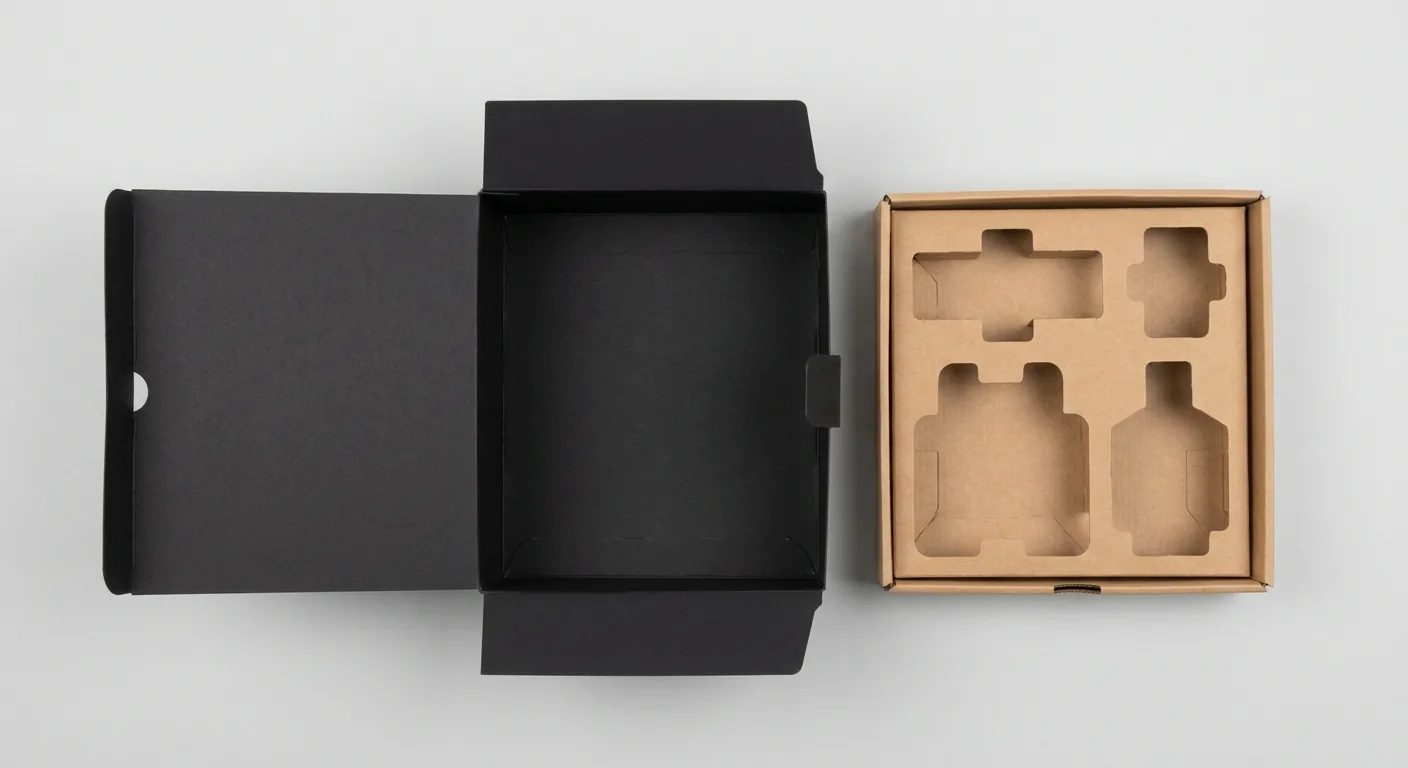
Separate the outer shell dieline from the product-specific insert. One shell carries an entire Halloween line when every SKU's insert tray fits inside it.
Insert cavity dimension = Product dimension + 0.0625 in clearance per side
The shell needs a 0.5 in to 0.75 in glue tab and dust flaps sized to depth minus 0.0625 in. A full structural die runs several hundred dollars; a flat insert die costs a fraction of it, since inserts are single-layer cuts with no glue pattern or fold sequence. One shell die plus four inserts, rather than four structural dies, is where a seasonal beauty collection boxes line recovers its tooling cost.
Reference dieline: one outer shell, four Halloween SKUs.
| SKU | Product Footprint (in) | Insert Cavity (in) | Fits 5.25 x 3.75 x 1.5 in Shell |
|---|---|---|---|
| Eyeshadow palette | 4.5 x 3.25 x 0.75 | 4.625 x 3.375 x 0.875 | Yes |
| Lip trio (3 tubes) | 3.75 x 1.5 x 1.25 | 3.875 x 1.625 x 1.375 | Yes |
| Highlighter compact | 2.75 x 2.75 x 0.6 | 2.875 x 2.875 x 0.725 | Yes |
| Mini gift set | 5.0 x 3.5 x 1.375 | 5.125 x 3.625 x 1.5 | Yes, at maximum fit |
Common Mistakes Brands Make With Limited-Edition Halloween Packaging
Each of these is a file or spec decision made before the order ever reaches press.
| Mistake | What Happens | Correct Spec |
|---|---|---|
| Building black as 100% K | Panels print gray next to foil | C60 M40 Y40 K100, under 300% total ink |
| Placing foil at the trim edge | ±0.031 in drift cuts the stamp | Hold foil 0.125 in inside every trim line |
| Scoring cross-grain | Dark ink cracks along the fold | Run grain parallel to the primary score |
| Specifying standard matte lam | Dark panels scuff before they reach the shelf | Anti-scuff matte lamination |
| Requesting spot UV over standard film | Coating beads and rejects | Specify UV-receptive lamination at quote stage |
| Ordering offset below 1,000 units | Makeready cost never amortizes | Run the break-even formula; digital under 2,000 units |
Ordering Timeline for a Halloween Beauty Drop
Halloween makeup sales concentrate in the two weeks before October 31, but the file has to be locked months earlier. Working backward from an October 15 in-hands date: artwork final by roughly September 1, a physical proof approved within 3 to 5 business days of that, a 10-to-12-business-day digital run, and ground transit. An offset order needs artwork locked by early August to clear a 5-to-6-week production window plus shipping.
Approve a physical proof, not a PDF, on any dark custom packaging with foil. Screen simulation cannot show how a C60 M40 Y40 K100 panel reads against a warm gold stamp under retail lighting.
Frequently Asked Questions
Our Packaging Products
Elevate Your Brand With Custom Packaging
Get packaging designed for your brand. Free shipping. No minimums.
Start TodayAuthor
Alina Cho
Alina Cho spent six years sourcing packaging for two indie beauty brands before joining Packify. Her first Halloween drop taught her the hard way: she locked a 3,000-unit offset run for a mascara set that sold 820 units, then paid warehouse storage on the rest through February. She now builds every seasonal brief around the digital print threshold first.