
The Short Answer
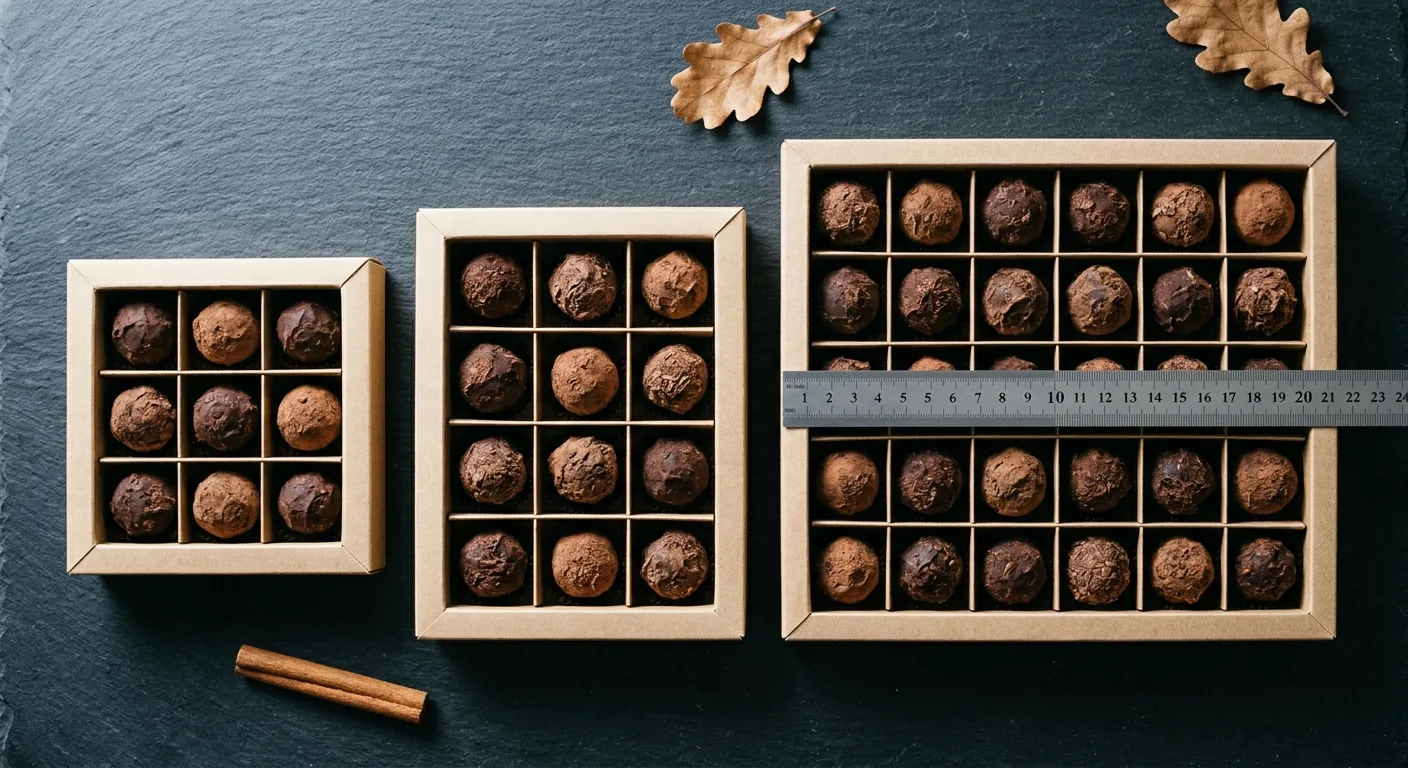
Halloween candy box sizes resolve to three formats: 4.5 x 3.25 x 1.25 inches for 6 pieces, 6 x 4.5 x 1.25 for 12, and 8.75 x 6 x 1.25 for 24. All three run a 1.375 inch cavity pitch and hold pieces up to 1 inch tall.
The Three Standard Halloween Candy Box Sizes
Confectionery packaging is built around cavity pitch, the center-to-center distance between insert cavities. In North American truffle and bonbon production, 1.375 inches dominates.
One rule generates the whole table: outer equals cavity span plus 0.375 inches, 0.1875 per side, rounded up to the nearest 0.25 inch because dielines are drawn in quarter inches.
Depth holds at 1.25 inches on every flat build, clearing a 1 inch piece with double the 0.125 minimum headroom. Tiered builds are the exception: the two-tier 24 count is 2.75 inches, two 1.25 tiers plus a 0.25 shelf. Board grade for each of these is set later, by gross weight rather than by count.
| Piece Count | Outer Dimensions (L x W x D) | Insert Grid | Cavity Span | Confection Weight |
|---|---|---|---|---|
| 6 count | 4.5 x 3.25 x 1.25 in | 3 x 2 | 4.125 x 2.75 in | 3 to 3.6 oz |
| 12 count | 6 x 4.5 x 1.25 in | 4 x 3 | 5.5 x 4.125 in | 6 to 7.2 oz |
| 24 count (flat) | 8.75 x 6 x 1.25 in | 6 x 4 | 8.25 x 5.5 in | 12 to 14.4 oz |
| 24 count (two-tier) | 6 x 4.5 x 2.75 in | 4 x 3, two tiers | 5.5 x 4.125 in | 12 to 14.4 oz |
Piece Footprint Sets the Grid
Count is half the equation. Truffles and fun-size bars at the same count produce different Halloween treat box dimensions. Pitch follows one rule: footprint plus 0.125 inches, calculated on both axes for rectangular pieces.
Fun-size bars show why. A 12 count runs 3 x 4 at 2.625 by 1.525 inch pitch: a 7.875 x 6.1 span, an 8.25 x 6.5 x 1.25 box. Pretzel rods at 9 inches long and 0.5 thick run four across on 0.625 pitch, a 9.375 x 2.5 span rounding to 9.5 x 3 x 1.25.
The rule that prevents most complaints is vertical: leave at least 0.125 inches of headroom above the tallest piece. Fill to the exact height of the confection and the lid drives stacking pressure into the ganache, which is how 200 boxes arrive with flattened tops inside intact cartons.
| Confection Type | Footprint | Height | Cavity Pitch (L x W) |
|---|---|---|---|
| Square caramel | 1 x 1 in | 0.75 in | 1.125 x 1.125 in |
| Round truffle | 1.25 in diameter | 1 in | 1.375 x 1.375 in |
| Bonbon | 1.25 x 1.25 in | 0.875 in | 1.375 x 1.375 in |
| Fun-size bar | 2.5 x 1.4 in | 0.4 in | 2.625 x 1.525 in |
| Bark shard | Varies | 0.375 in | None, fill by weight |
Insert Layouts That Hold the Assortment Still
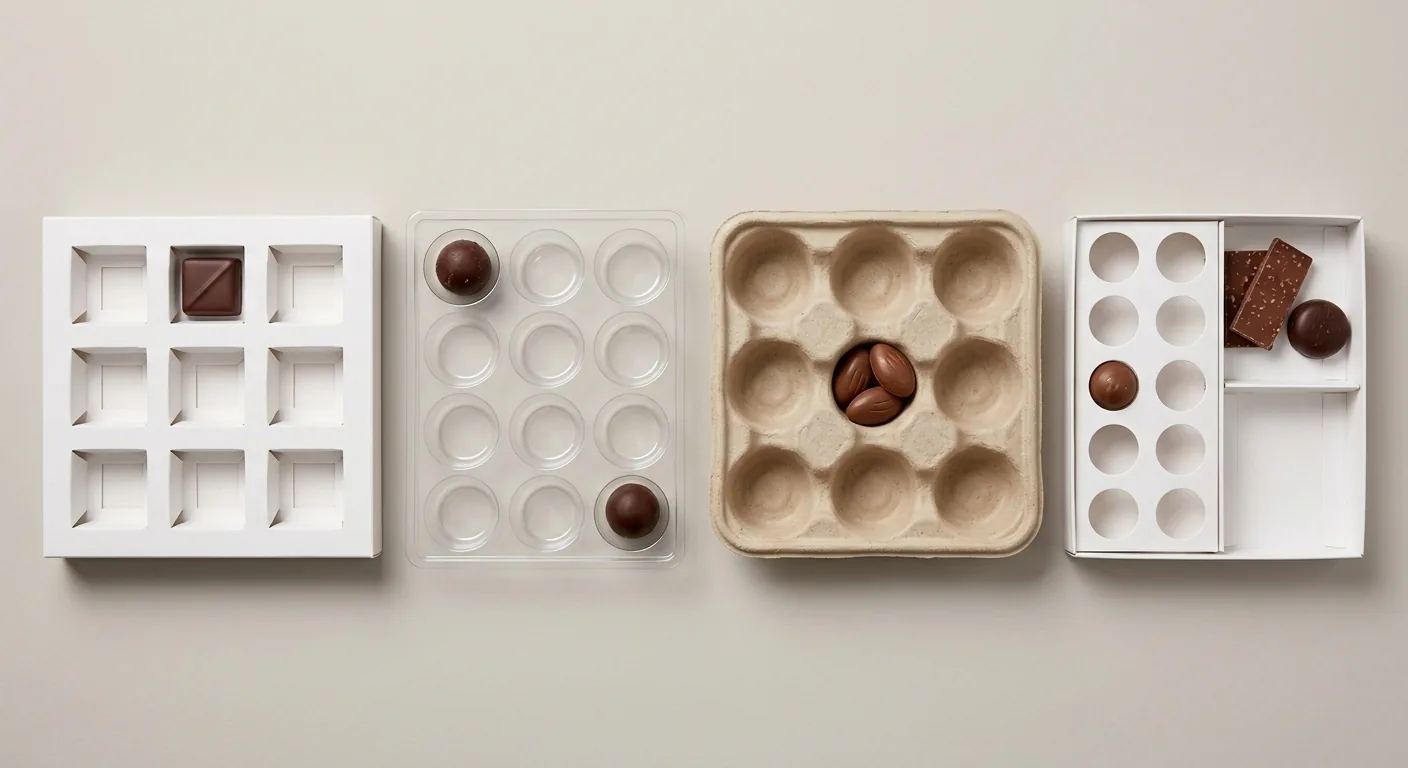
A candy box insert layout comes down to three formats, each with a food-contact consequence.
Paperboard platform inserts run 18pt stock, add roughly 0.5 ounces at the 12 count and 1 at the 24, and tolerate 0.0625 inches of variance.
Vacuum-formed PET trays hold a 0.75 inch cavity depth and grip irregular shapes. They add 20 to 30 percent to insert cost, and buyers comparing candy gift box sizes at the premium end land on PET.
Molded fiber trays accept 0.125 inches of variance. Thicker walls add about 0.25 inches to length and width, not to depth, since the tray sits inside the existing 1.25. Weight runs approximately 1.5 to 2 ounces at the 24 count.
Mixed assortments are where layouts fail. When one box holds truffles, caramels, and bark, build a two-zone insert rather than three cavity types: fixed cavities for uniform pieces, a divided compartment for irregular ones. One dieline then serves the whole range.
Food Contact, Grease, and Heat
Chocolate is roughly 30 percent fat, the hardest case for material migration. In the US, FDA 21 CFR 176.170 governs components of paper and paperboard contacting aqueous and fatty foods, and it is what your supplier should certify against.
Mineral oil migration is a separate issue with a separate evidence base. Recycled fiber can carry mineral oil hydrocarbons from inks in the recovered stream, documented mainly through European work including the German BfR. That is not what 176.170 addresses, and it is why you specify virgin fiber for any surface the chocolate touches.
That applies to the insert as much as the carton. Molded fiber comes in recycled and virgin food-grade stock, so a pulp tray is contact-safe only when specified virgin. Otherwise keep a glassine liner under the candy, which is also what lets you run a recycled kraft outer carton.
Butter-based caramels stain uncoated board within days. Clay coating solves it, but specify the chemistry, because PFAS-based grease resistance is now restricted in a growing list of states. Heat is the October risk nobody plans for: cocoa butter softens near 85F and fat bloom sets in well before the piece melts. Warm-climate parcels need an insulated liner and a Monday to Wednesday dispatch. The board does not change, the shipper does.
Weight Tolerance and Board Grade
Treat box weight capacity is set by gross weight, never by piece count. Work in ounces, insert included.
A truffle averages 0.5 ounces and a fun-size bar 0.6, so a 24 count holds 12 to 14.4 ounces: 15.4 with a paperboard insert, about 16.4 with molded fiber, which crosses a pound into E-flute. The 12 count straddles 8 ounces the same way, 7.7 with paperboard and roughly 8.7 with fiber.
An 18pt tuck box holding 1.5 pounds bows at the side panels within two days. Past 2 pounds, folding cartons stop working and rigid boxes take over, because wrapped chipboard carries load through the wall, not the seam.
For parcels, dimensional weight matters more than actual weight. The flat 24 count is 66 cubic inches and the two-tier 74, so against the 139 DIM divisor both bill at the 1 pound minimum. Identical cost, but the two-tier drops the footprint from 52.5 to 27 square inches. Rows above 1 pound in the table below assume a virgin liner between board and confection.
| Gross Weight With Insert | Standard Specification | Alternative for Parcel Shipping |
|---|---|---|
| Up to 8 oz | 18pt virgin SBS, roughly 350 GSM | Same, with corner tape |
| 8 oz to 1 lb | 24pt virgin SBS, roughly 450 GSM | E-flute laminated carton |
| 1 lb to 2 lb | E-flute corrugated, 32 ECT | B-flute corrugated, 44 ECT |
| Over 2 lb | Rigid box, 2mm greyboard | Rigid box with foam insert |
What Most Candy Makers Get Wrong
Five mistakes account for most of the seasonal runs that arrive crushed, stained, or misprinted, and every one of them is decided before the candy is made.
The mistake underneath these is deciding your Halloween goodie box size after the candy is finished. Pitch, headroom, insert weight, and board grade are production inputs, not afterthoughts.
| Mistake | What Happens | Fix |
|---|---|---|
| Sizing the box to the candy exactly | Lids crush decorated tops in transit | Leave at least 0.125 in headroom above the tallest piece |
| Ordering a different depth for every count | Small counts rattle, large counts jam | Standardize depth at 1.25 in, vary footprint |
| Choosing board by piece count | Board fails at gross weight, not at count | Specify from gross weight including insert |
| Recycled fiber against the chocolate | Mineral oil can migrate into fat over shelf life | Virgin stock for contact, or a glassine liner |
| Approving artwork before the dieline | Print lands across a fold or a glue seam | Approve the dieline first, then place artwork |
Standardizing the Range and Ordering It
Digital short-run printing turns 250 to 500 units in 10 to 15 business days with no plate tooling, the realistic route for anyone specifying in September or October. Standard offset runs 6 to 10 weeks from artwork approval, putting the October cutoff in early August. Our guide to Halloween packaging deadlines carries dates for both paths.
Standardizing depth at 1.25 inches means one insert depth, one shipper size, one stack height. Our custom treat boxes in standard sizes follow that principle.
Frequently Asked Questions
Our Packaging Products
Elevate Your Brand With Custom Packaging
Get packaging designed for your brand. Free shipping. No minimums.
Start TodayAuthor
Jamie Holloway
Jamie Holloway ran production for a confectionery and bakery operation that shipped seasonal assortment boxes for nine years, and now writes about packaging structure and dimensional specification. She learned cavity pitch the hard way after approving a 12-count insert built to the exact diameter of a truffle, then watching roughly 400 boxes come back from a wholesale account with pieces wedged so tightly that customers tore the ganache apart getting them out. She has specified 0.0625 inches of lateral clearance on every insert since.