The Short Answer
Halloween restaurant packaging is themed takeout packaging printed for a limited menu running October 1 through October 31. Most operators order 6 to 8 weeks ahead, absorb a print premium of a few cents per unit, and recover it inside the first 200 to 700 promotional orders. Burgers and pizza carry seasonal print best.
The Three Tiers of Seasonal Menu Packaging
Seasonal menu packaging splits into three tiers, and the difference that matters is tooling. Tier 1 wraps a one color flexo band around stock you already buy. Tier 2 reuses a cutting die you own. Tier 3 buys a new one, which is where the low hundreds of dollars and 3 to 5 extra business days come from.
Ghost kitchens should default to Tier 1. Virtual brands launch and retire concepts on 30 to 60 day cycles, exactly the length of a Halloween menu, so one blank box serves October and everything after. A 40 location chain themeing a burger in every store is where Tier 2 earns its cost, since the premium spreads over tens of thousands of units.
| Tier | What it is | Minimum | Tooling | Best for |
|---|---|---|---|---|
| 1 | Band or sticker over blank stock | 1,000 | None | Ghost kitchens, single sites |
| 2 | Print on an existing dieline | 2,500 | None | Multi unit rollouts |
| 3 | New custom structure | 5,000 | Low hundreds, 3 to 5 days | Chains, licensed tie ins |
Themed Burger Boxes and Pizza Boxes: What Changes, What Cannot
Print changes. Structure and board grade do not.
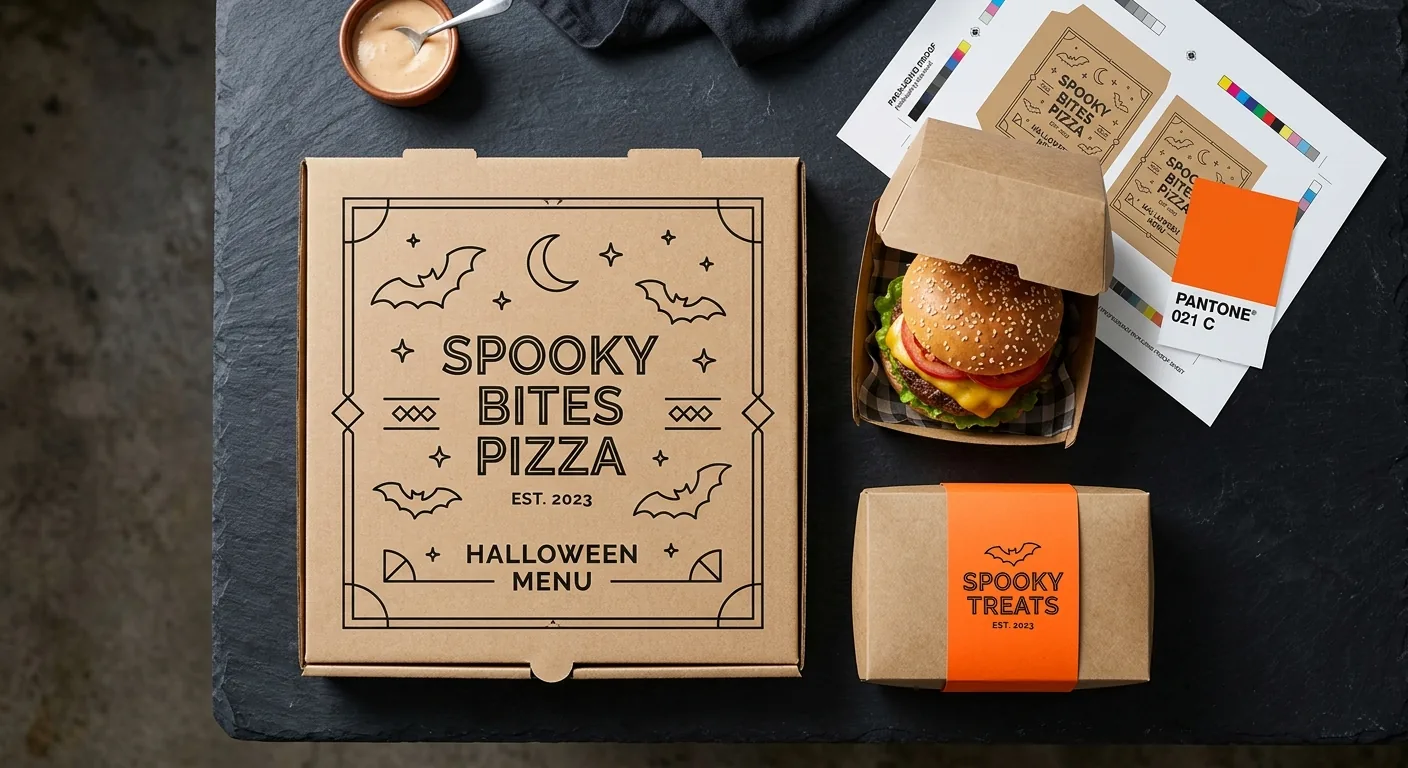
A single patty burger box runs 4.5 x 4.5 x 3.25 inches, in either 350 GSM clay coated SBS at roughly 0.4mm caliper or E flute corrugated cardboard at roughly 1.5mm. A double stack needs 4 inches of interior height. Themed burger boxes reuse that dieline: print the top panel, not a new box.
Pizza is stricter. A 14 inch pizza box measures 14 x 14 x 1.75 inches in B flute rated at 32 ECT, the Edge Crush Test, which measures edgewise compression resistance and predicts stacking strength. It stops a five box tower from crushing the bottom pie. Seasonal artwork touches neither flute profile nor ECT rating. Order themed custom pizza boxes on the same 32 ECT spec you already run.
Three rules hold on every themed food box. Keep ink off the food contact face, printing the outside and leaving the interior clay coated white. Expect heavy flood coverage to scuff, because a solid black panel on kraft shows wear across a delivery run while line art on kraft survives the trip on less ink. Keep vent holes clear, since pizza ventilation releases steam and a band across the vents softens crust before the order reaches the door.
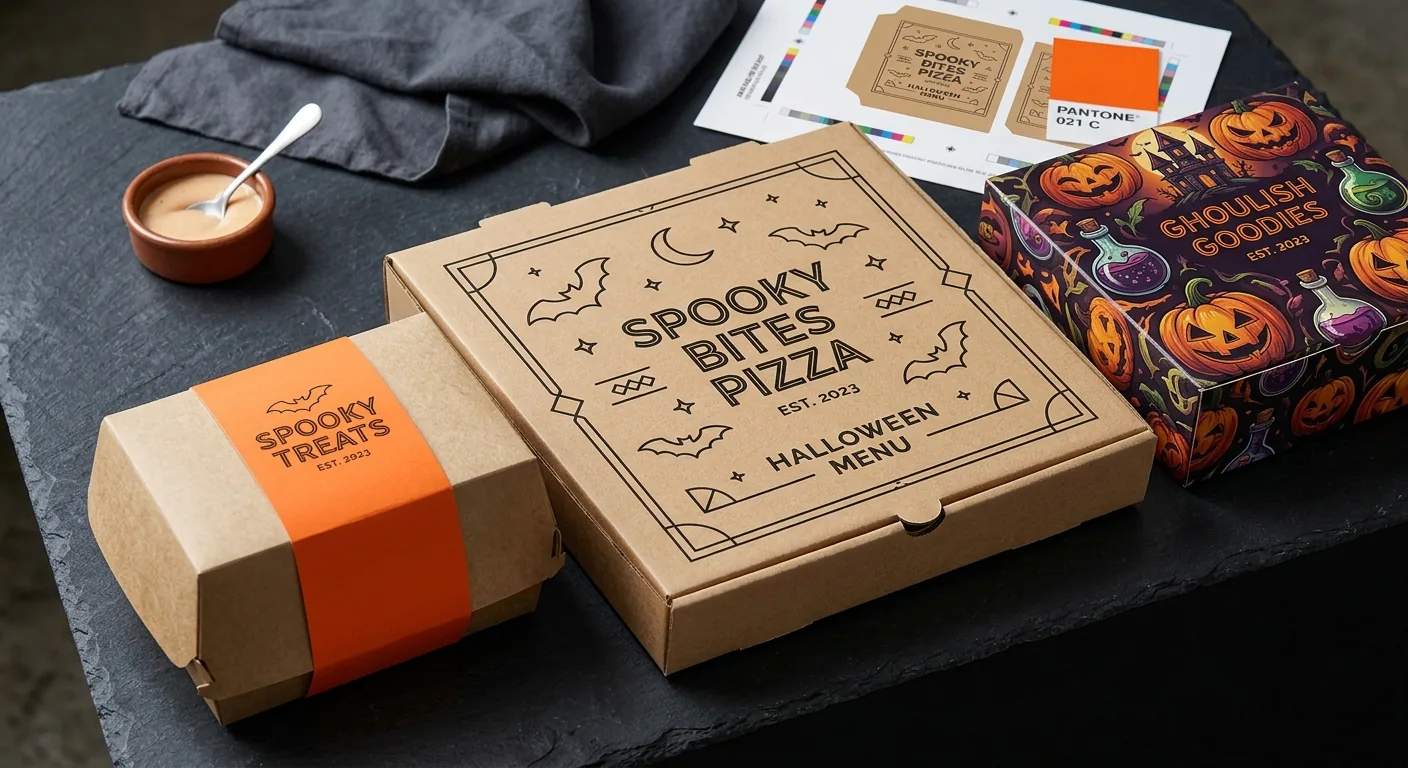
Pantone Orange 021 C over natural kraft prints in a single pass and reads as Halloween without a second color. A second color opens purple and acid green, away from the orange wall competitors print.
When a Seasonal Print Run Pays Back vs Standard Stock
A seasonal print run pays back when the promotional margin it drives exceeds the print premium across your October order count. The premium is a few cents per unit over blank stock on an existing dieline, plus flexo plates that run $100 to $250 per color on large format corrugated. The box does not sell the burger, the menu does. What it buys is the photograph, and reach costs nothing per ticket.
The table assumes roughly $1.50 of incremental contribution per promotional order. Substitute your own. Break even orders rise with volume even as per unit cost falls, because plates are a fixed cost amortized across the run.
| Promo units | Route | Total seasonal cost | Break even orders | Verdict |
|---|---|---|---|---|
| 600 | Below the 2,500 print minimum | Bands, near $80 | Roughly 55 | Tier 1 bands |
| 2,500 | Short run, no plates | Near $350 | Roughly 235 | Print it |
| 12,000 | Flexo, two plates | Near $1,000 | Roughly 680 | Print it |
Order Timing Against October Volume
Below roughly 2,500 units, short runs beat flexo because there are no plates to amortize. Above 5,000, flexo or litho lamination wins on unit cost. Between the two, plate count decides: one color goes flexo, two or more hold off until 5,000. Skip a dedicated run under roughly 800 units, because you cannot amortize a 2,500 unit minimum across it.
Work backward from October 1, not October 31. A menu launching on the 31st sells for one day. Live October 1, it sells for 31. Find the row matching today’s date: no start date closes the season, it narrows the tier.
| If you are starting | Path still open | Production plus freight | On the shelf |
|---|---|---|---|
| Before August 5 | Any tier, new dieline included | 15 plus 7 business days | September 15 |
| August 5 to September 5 | Standard run, existing dieline | 10 to 15 plus 5 to 7 days | September 20 to 29 |
| September 5 to 15 | Rush plus expedited freight, 25 to 40 percent over | 7 plus 2 to 3 days | September 29 |
| After September 15 | Tier 1 bands or stickers on blank stock | 1,000 unit minimum, standard | Before October 1 |
Proof Rounds Are the Real Deadline
Every row above lands stock before October 1, so every row delivers the full 31 day window. A September 15 start closes because 7 business days of rush production plus 3 days of expedited freight reaches September 29. What slips is tier and unit cost, so a late start argues for bands, not for skipping October.
The pressure point is proof approval, not production. One extra proof round adds 2 to 4 business days, and two rounds push a comfortable schedule into rush pricing. Lock artwork before you request a quote, and confirm the Halloween packaging deadlines.
Halloween is routinely cited among Domino’s busiest delivery days, alongside Super Bowl Sunday, Thanksgiving Eve, and New Year’s, and the spike sharpens when October 31 lands on a Friday or Saturday. Stock to October 31, not the monthly average, at 15 to 20 percent above projection. Leftover stock is a write off, but running dry on the biggest delivery night costs more.
What Most Restaurant Operators Get Wrong
Four mistakes account for most of the themed October runs that miss the shelf date or lose the margin that justified them, and all four are decided before the press runs.
| Mistake | What it costs | The fix |
|---|---|---|
| New dieline in September | Tooling time you no longer have | Drop to Tier 1 bands |
| Boxes arriving October 12 | 11 of the menu’s 31 selling days | Shelf date September 29 |
| Printing a year on the box | Unused stock is scrap November 1 | Seasonal art, no dates |
| Themed box, unthemed menu | Photographed once, never reordered | Tie print to a named LTO |
Halloween Food Packaging Ideas That Cost Almost Nothing
Three halloween food packaging ideas ship on standard stock into the third week of September.
Die cut stickers come first. A 2 inch seal on plain stock in 1,000 unit lots is the cheapest branded touch there is, and one color black on kraft reads as autumn without orange ink. Insert cards are the second: a 3 x 5 card with a QR code to your November menu turns October traffic into repeat orders.
The third is single material stock. Uncoated corrugated boxes with no plastic window stay curbside recyclable. AF&PA puts community access to programs accepting pizza boxes at 82 percent of Americans, up from 73 percent in 2020, with mills at 94 percent of recovered cardboard consumption accepting them. Food must be removed first, so sustainable packaging claims on themed takeout boxes hold only if customers empty the box.
Frequently Asked Questions
Our Packaging Products
Elevate Your Brand With Custom Packaging
Get packaging designed for your brand. Free shipping. No minimums.
Start TodayAuthor
Marcus Delgado
Marcus Delgado writes on restaurant packaging operations for Packify, with a background in multi unit food service supply. His hardest seasonal lesson came from a themed October run that arrived mid month after a second round of proof revisions, on artwork that carried a printed year and so could not be reused. He now builds every seasonal calendar backward from the menu launch date, never the holiday.