
The Short Answer
Halloween candle packaging is a limited-edition printed carton built to survive a glass vessel in transit. Order by August 1 for an October 1 drop, because printing runs 10 to 15 business days after proof approval. Most fall seasonal runs land between 250 and 2,000 units per scent.
The Fall Drop Calendar Runs on August Dates
Candle brands move more volume between September 15 and October 31 than in any six-week stretch outside December. Cartons must sit in the warehouse before the launch email sends, and a printed carton is a four to seven week commitment from artwork lock to pallet.
The runway has four components, and together they total 18 to 33 business days. Multi-scent collections add a week, since every extra SKU adds a proof round and a press setup.
| Stage | Business days |
|---|---|
| Artwork and dieline setup | 3 to 5 |
| Digital proof or physical sample approval | 2 to 7 |
| Print, die-cut, and gluing | 10 to 15 |
| Ground freight to your fulfillment location | 3 to 6 |
Limited-Edition Carton Strategy: One Dieline, Many Skins
The cheapest limited edition changes the print, never the structure. Lock a single dieline across the entire fall line and treat each scent as a different skin on identical tooling.
Digital printing carries no plate charge, which makes short seasonal runs viable at 250 units per scent. Offset litho overtakes it on per-unit cost somewhere between 2,000 and 3,000 units, once plate and setup costs spread thin. Most fall limited editions never reach that crossover, which is why digital is the default for seasonal candle packaging and why limited edition candle packaging costs less per SKU than founders expect.
Apply a 70/30 split to the artwork. Hold 70 percent constant across every scent: logo position, burn-time copy, wick and safety text, barcode zone, and net weight. Vary the remaining 30 percent: the color field, the seasonal illustration, and the scent name.
Autumn Candle Box Design: Dark Palettes on Soft-Touch Stock
Dark palettes are the fall signature and the hardest thing to print cleanly. A flood coat of 100 percent black or deep oxblood shows every handling mark from the gluing line to the fulfillment table.
Two fixes work: soft-touch lamination with a scuff-resistant additive, or artwork built at 92 percent black with a low-contrast pattern so marks disperse rather than streak. The second costs nothing. Earthy fall scents that skip the dark palette entirely run cleaner as kraft candle boxes, where the unbleached stock is the finish and scuffing never registers.
Halloween SKUs need a tighter palette than the rest of the fall line. Orange on black is the recognizable pairing, but 100 percent orange against a black flood coat reads costume-shop rather than premium. Drop it to burnt amber and hold the motif to one element: a moth, a wax seal, a crescent. Because the 70/30 split changes only the color field and illustration, a Halloween scent and a Thanksgiving scent share one dieline and press setup.
Board weight matters more than finish on tall vessels. Specify 16pt to 18pt SBS, roughly 350 to 400 GSM, for candle folding cartons. Below 14pt, a carton holding a 12 oz glass vessel bows at the side panel within a week on a retail shelf, which is the line between premium packaging and a carton that looks tired before the drop sells through.
The finish decides how far the palette survives handling, and every option fails somewhere.
| Finish | What it does well | Where it fails | Best fall use |
|---|---|---|---|
| Soft-touch matte lamination | Velvet feel, deepens blacks and oxblood | Fingerprints and scuffs on flood-coat darks | Flagship limited edition |
| Gloss lamination | Scuff resistant, saturates orange and gold | Reads cheap against a dark palette | Value tier, mass retail |
| Uncoated kraft, 18pt | Warm tone, supports sustainable claims | Dark inks dry muted and blotchy | Earthy scents, light palettes |
| Soft-touch plus spot UV | Matte field against glossy detail | Adds 2 to 4 days to production | Foil-free premium look |
Sizing Fall Candle Boxes to the Vessel
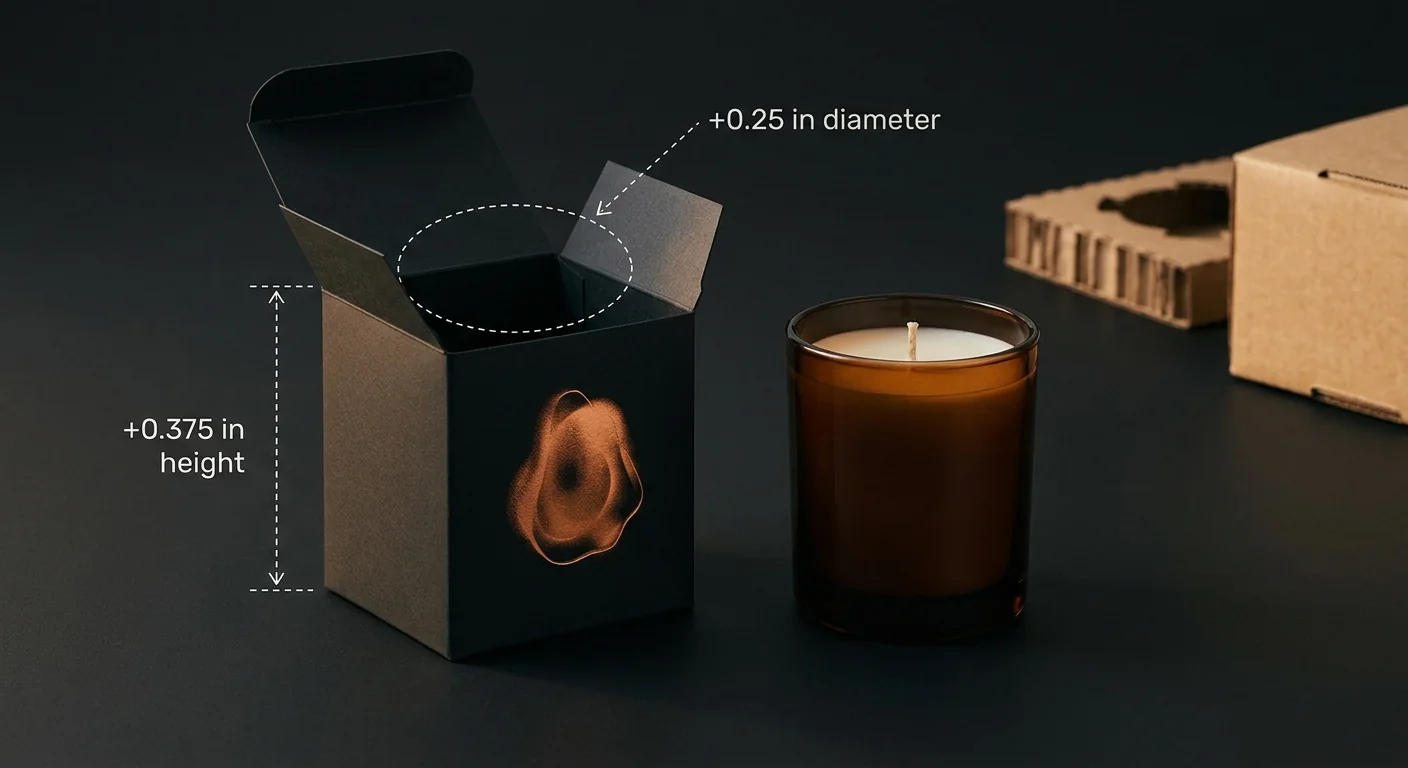
Add 0.25 inch to vessel diameter and 0.375 inch to vessel height when specifying fall candle boxes, then round up to the nearest 1/8 inch, which is how dielines are cut anyway. Tighter tolerances bind lidded jars during hand-packing. Looser tolerances let the vessel rattle, which breaks glass in transit.
Structure follows the vessel more than the price point. Votives and travel tins sit in slim candle tin boxes cut to the tin diameter, tumblers and lidded jars run as straight or reverse tuck cartons, and a 16 oz three-wick earns two-piece candle boxes with a lift-off lid. Multi-scent fall sets ship as candle gift box packaging with a tray insert that seats each vessel on its own.
| Vessel | Typical vessel size | Recommended carton (L x W x H) | Structure |
|---|---|---|---|
| 4 oz votive or tin | 2.6 in dia x 1.9 in tall | 2.875 x 2.875 x 2.25 in | Straight tuck |
| 8 oz tumbler | 3.0 in dia x 3.5 in tall | 3.25 x 3.25 x 3.875 in | Straight tuck |
| 9 oz lidded jar | 3.1 in dia x 4.0 in tall | 3.375 x 3.375 x 4.375 in | Reverse tuck |
| 12 oz vessel | 3.5 in dia x 4.25 in tall | 3.75 x 3.75 x 4.625 in | Reverse tuck or rigid |
| 16 oz three-wick | 4.0 in dia x 4.5 in tall | 4.25 x 4.25 x 4.875 in | Rigid, lift-off lid |
| Three-candle set, 8 oz | 3 across | 10.25 x 3.5 x 4.0 in | Rigid, tray insert |
Shipping Protection for Glass Vessels During the Fall Surge
The printed carton is never the shipper. Candle shipping boxes do another job: a printed folding carton nests inside a corrugated shipper with 1 to 1.5 inches of crush space on all six sides, held off the walls by a die-cut insert.
Specify 32 ECT single wall corrugated cardboard for single candles under 3 lb, and 44 ECT or double wall for three-candle sets over 5 lb. Board grade follows candle vessel weight, not carton size. Die-cut corrugated or molded pulp inserts beat loose fill, which migrates during the fall carrier surge and leaves the vessel against a wall.
Right-sizing the shipper pays for the insert. Major carriers bill dimensional weight using a divisor of 139 for domestic parcels. A 12 oz carton at 3.75 x 3.75 x 4.625 inches shipped in a 9 x 9 x 9 box calculates to 729 divided by 139, which rounds up to 6 billable pounds. Drop to a 6 x 6 x 7 shipper, which still clears the carton by over an inch on every side, and it bills at 2 pounds. On a 1,500-unit drop, four billable pounds per parcel separates a profitable scent from a break-even one. That is why e-commerce packaging decisions belong in the design phase.
Retail-bound units differ. A 16 oz three-wick in a rigid box with a lift-off lid survives shelf handling and reads as luxury packaging, while the same candle in a tuck box sells at a lower price point. Shelf programs that need the wax color visible run candle boxes with window instead. Subscription and DTC drops get the strongest unboxing experience from custom mailer boxes printed on the interior, and a monthly fall program repeats that exact specification as candle subscription boxes without a new setup.
What Most Candle Brands Get Wrong
Four mistakes account for most of the fall drops that miss their launch date or lose their margin, and all four are decided before the press runs.
| Mistake | What it costs | The fix |
|---|---|---|
| Ordering cartons before the vessel ships | Cartons bind or rattle; glass drifts 1 to 3 mm per pour | Measure a production vessel, then add 0.25 in and 0.375 in |
| Flood-coating 100 percent black with standard film | Scuffing on some received units | Specify scuff-resistant soft-touch, or design at 92 percent black |
| Shipping in the printed carton alone | Broken glass and scuffed cartons on arrival | Nest in a 32 ECT shipper with 1 to 1.5 in clearance |
| Under-ordering the hero scent | A four to six week reorder, past October 31 | Order 20 to 30 percent over forecast on the top scent |
Recommended vs Latest Possible Order Dates
Every recommended lock date below sits 61 days ahead of its drop date. The rush column is what a brand can still hit, not what it should plan against.
Rush production carries a 15 to 25 percent surcharge and removes the physical proof step, the riskiest cut on a dark-palette job. Brands that want candle packaging built for seasonal drops without the rush premium work from the recommended column, and the same seasonal packaging deadlines govern the rest of a Q4 range.
| Drop date | Recommended artwork lock | Latest possible lock (rush) | Risk at the latest date |
|---|---|---|---|
| September 15 | July 16 | August 8 | Digital proof only |
| October 1 | August 1 | August 25 | Rush surcharge, one proof |
| October 15 | August 15 | September 8 | Freight delay eats launch week |
| October 25 | August 25 | September 18 | No margin for any reprint |
Frequently Asked Questions
Our Packaging Products
Elevate Your Brand With Custom Packaging
Get packaging designed for your brand. Free shipping. No minimums.
Start TodayAuthor
Noah Fischer
Noah Fischer has specified packaging for candle brands for nine years, running fall drops that range from 300-unit indie pours to 40,000-unit retail programs. He once approved a PDF proof instead of a printed sample on a matte black limited edition and watched 4,000 cartons arrive scuffed along every fold, which cost the client its October launch date. He has required a physical proof on every dark-stock job since.