The Short Answer
Halloween subscription box packaging works best when the exterior stays plain and the theme lives inside: an interior print reveal plus one glow-ink or foil accent adds $0.20 to $0.53 per unit, versus $1.10 to $1.85 for a full redesign. Most operators overspend outside and underspend on the reveal that gets filmed.
| Quick reference | The number |
|---|---|
| Interior reveal plus one accent | $0.20 to $0.53 per unit |
| Full seasonal redesign | $1.10 to $1.85 per unit, plus $400 to $900 tooling |
| Where the crossover sits | Sleeve wins below 5,000 units; redesign pays off above 8,000 to 10,000 |
| Standard lead time | Digital print 5 to 7 business days; offset 10 to 15 business days |
| Rush lead time | Digital rush 2 to 3 business days at a 25 to 40 percent surcharge |
Why October Rewards a Different Halloween Subscription Box Packaging Strategy
October is the single highest-engagement month on the subscription box calendar. Unboxing content posted in the first two weeks of October carries a seasonal hook a January or June box cannot manufacture on its own, and subscribers who churn in Q4 disproportionately cite "the box felt the same as always" in exit surveys most operators run. Picking the right october subscription box theme comes down to the reveal, not a new structural die. Brands that treat Halloween as a full retool spend 3 to 5 times more per unit than brands that treat it as a print and insert refresh, for a difference often smaller than the cost gap suggests.
None of that requires a bigger budget. It requires spending on the four seconds that actually get recorded.
Interior Print Reveal Design: What Actually Gets Filmed
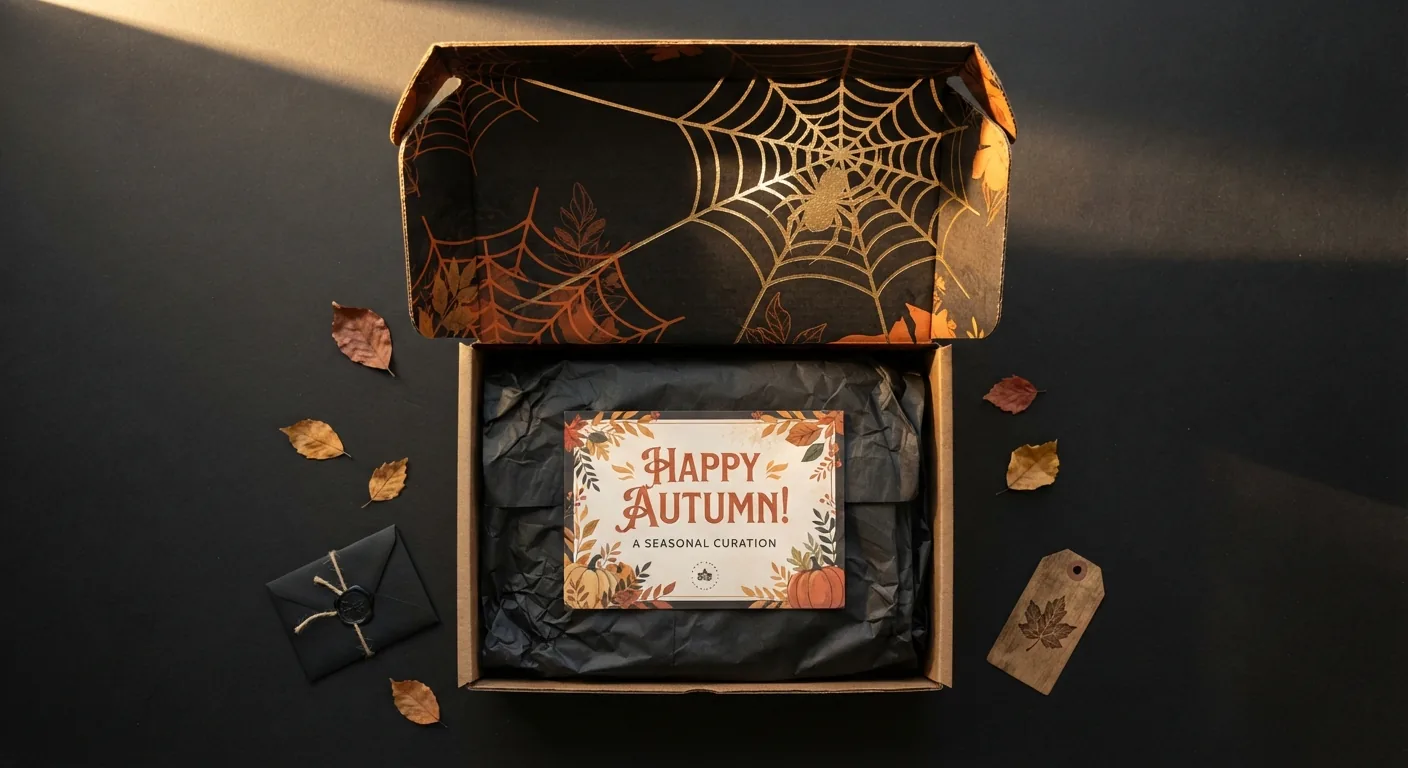
The reveal happens in a 2 to 4 second window between lid removal and the first item coming into view. Three elements do the work: a full-bleed interior lid print, a single printed tissue or wrap layer, and one insert card carrying a seasonal message. Interior lid printing on a standard mailer box adds one print pass and runs on the inside face of an 18pt to 24pt C1S or SBS board, since anything lighter shows ghosting from the reverse-side print. A single spot color, usually black or deep purple on an orange or kraft base, is enough to build a spooky unboxing experience without four-color art. Full four-color interior printing roughly doubles cost per unit compared to one or two spot colors, and most brands do not need it to make the reveal read as intentional.
The Real Cost Math: Glow-in-the-Dark Ink and Foil Accents Per Unit
Glow-in-the-dark ink is a UV-reactive phosphorescent spot varnish applied as an extra screen print pass, not a substitute for standard ink. At 2,500 to 10,000 units, it adds an informed-estimate $0.15 to $0.35 per unit, with the low end covering a small glow logo and the high end a full illustration across 30 percent or more of a panel. Foil stamping is a separate structure: a one-time die charge of $150 to $350 depending on complexity, plus $0.12 to $0.30 per unit for the stamping pass. Stacking glow ink and foil on one panel is the line item most operators regret at scale, since both rarely survive phone-camera compression as well as they read in hand.
Picking the accent is the easy part. The bigger decision is whether to touch the box itself.
| Accent type | Setup cost | Per-unit cost (2,500 to 10,000 run) | Best use |
|---|---|---|---|
| Glow-in-dark spot ink | None (screen ready) | $0.15 to $0.35 | Small icon or logo element |
| Single foil stamp | $150 to $350 die charge | $0.12 to $0.30 | Sharp edge details, text, borders |
| Interior lid print (1-2 color) | Existing plate reuse | $0.08 to $0.18 | Reveal moment, message |
| Interior lid print (4-color) | New plate set | $0.20 to $0.40 | Full-illustration reveal |
Sleeve-Over-Standard-Box vs Full Seasonal Redesign: The Actual Price Difference
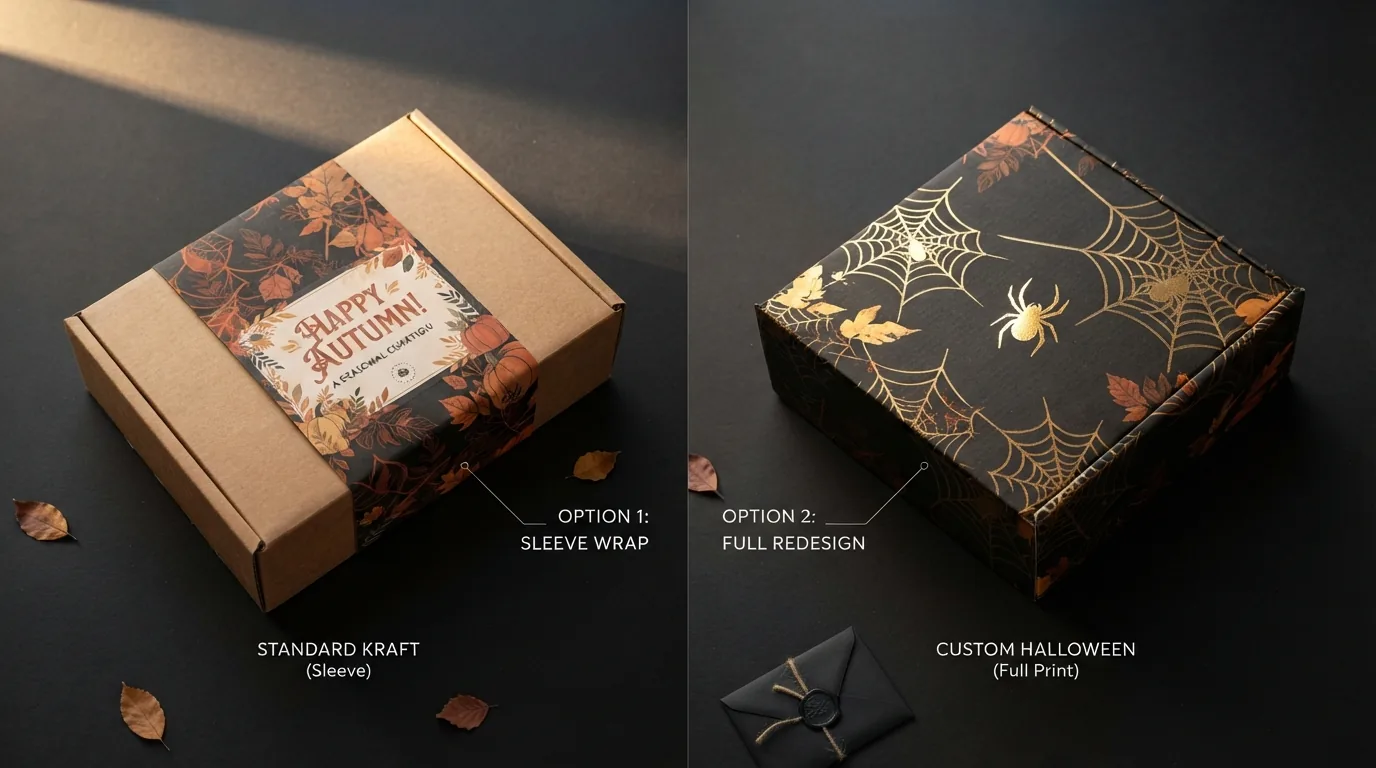
Every seasonal subscription box design decision comes down to one question: reuse the existing die or cut a new one. A printed sleeve wrapped over an existing standard mailer box reuses the current die line entirely, which is the main reason it costs less. Sleeve production adds $0.35 to $0.60 per unit at 2,500 to 10,000 volume with no new tooling charge. A full seasonal redesign requires a new die line cut, $400 to $900 as a one-time charge, plus $1.10 to $1.85 per unit in added print and structural cost, because the entire exterior carries seasonal art. Operators shipping fewer than 5,000 units rarely recover that tooling cost within a season, which is why the sleeve wins below that volume. Above roughly 8,000 to 10,000 units, the gap narrows enough that the reusable die justifies itself.
| Option | Tooling cost | Added cost per unit | Turnaround impact | Reusable next season |
|---|---|---|---|---|
| Sleeve over standard box | $0 (existing die) | $0.35 to $0.60 | None, runs with standard schedule | No, sleeve art is seasonal |
| Full seasonal redesign | $400 to $900 | $1.10 to $1.85 | Adds 3 to 5 business days for die cutting | Die is reusable, seasonal art is not |
Halloween Subscription Box Lead Times, by Production Type
Lead time depends on production method, not the calendar, which is why this formula holds whether it is read in July or the week before a ship date. Digital print, the standard method under roughly 5,000 units, runs 5 to 7 business days from final art approval to finished cartons, because it skips plate-making entirely. Offset lithography, used above 5,000 to 8,000 units for lower per-unit cost, runs 10 to 15 business days from approval, since plates must be burned and the press calibrated first. Add 2 to 4 business days for freight, and 1 to 2 days for a physical proof instead of a digital PDF. A full redesign on offset should budget 15 to 21 business days end to end, die-cutting included.
None of that helps once the calendar has already run out, which is where rush production earns its keep.
Rush Production for Late-Season Orders
A missed lead-time window does not automatically mean a canceled seasonal run. Digital rush compresses the standard 5 to 7 business day window to 2 to 3 business days under roughly 5,000 units, and most print partners charge a 25 to 40 percent rush surcharge on the print portion. That surcharge applies only to print and finishing, so the effective increase on a full order lands closer to 10 to 15 percent. Offset rush is far less flexible: plate-making cannot compress below 3 to 4 business days even under rush terms, so an offset rush order bottoms out around 7 business days, and only when the brand reuses an existing die. The highest-value rush move is dropping the accent, not the print: cutting the foil stamp or glow ink pass saves a full step and 1 to 2 business days without touching the interior reveal that drives the unboxing experience. Ask the print partner two questions first: does the die already exist, and can the accent be dropped without the box reading unfinished on camera.
Common Mistakes Operators Make with October Packaging
Most operators get this backward: spend on the panel seen for half a second, cut cost on the panel filmed for four.
| Mistake | Why it costs money | Better approach |
|---|---|---|
| Adding both glow ink and foil on the same panel | Cameras rarely capture both effects clearly, so one cost is wasted | Pick one accent and put the budget into the interior reveal |
| Requesting a full redesign under 5,000 units | Tooling cost per unit at low volume erases the retention gain | Use a sleeve over the standard mailer boxes instead |
| Approving a 4-color interior print by default | Doubles interior cost without a proportional lift in impact | Default to 1-2 spot colors unless the art requires full color |
| Waiting past the offset window before checking rush options | Assumes the order is dead when digital rush is often still available | Call the print partner first; ask about existing dies and digital rush |
Frequently Asked Questions
Our Packaging Products
Elevate Your Brand With Custom Packaging
Get packaging designed for your brand. Free shipping. No minimums.
Start TodayAuthor
Zoe Bennett
Zoe Bennett spent six years running packaging procurement for a beauty subscription brand before joining Packify’s content team. She once approved a full seasonal box redesign three weeks out from an October ship date, missed the offset press window, and had to ship 4,000 boxes late in a plain backup carton, which is why every lead-time figure she writes now assumes the reader is already behind.