The Short Answer
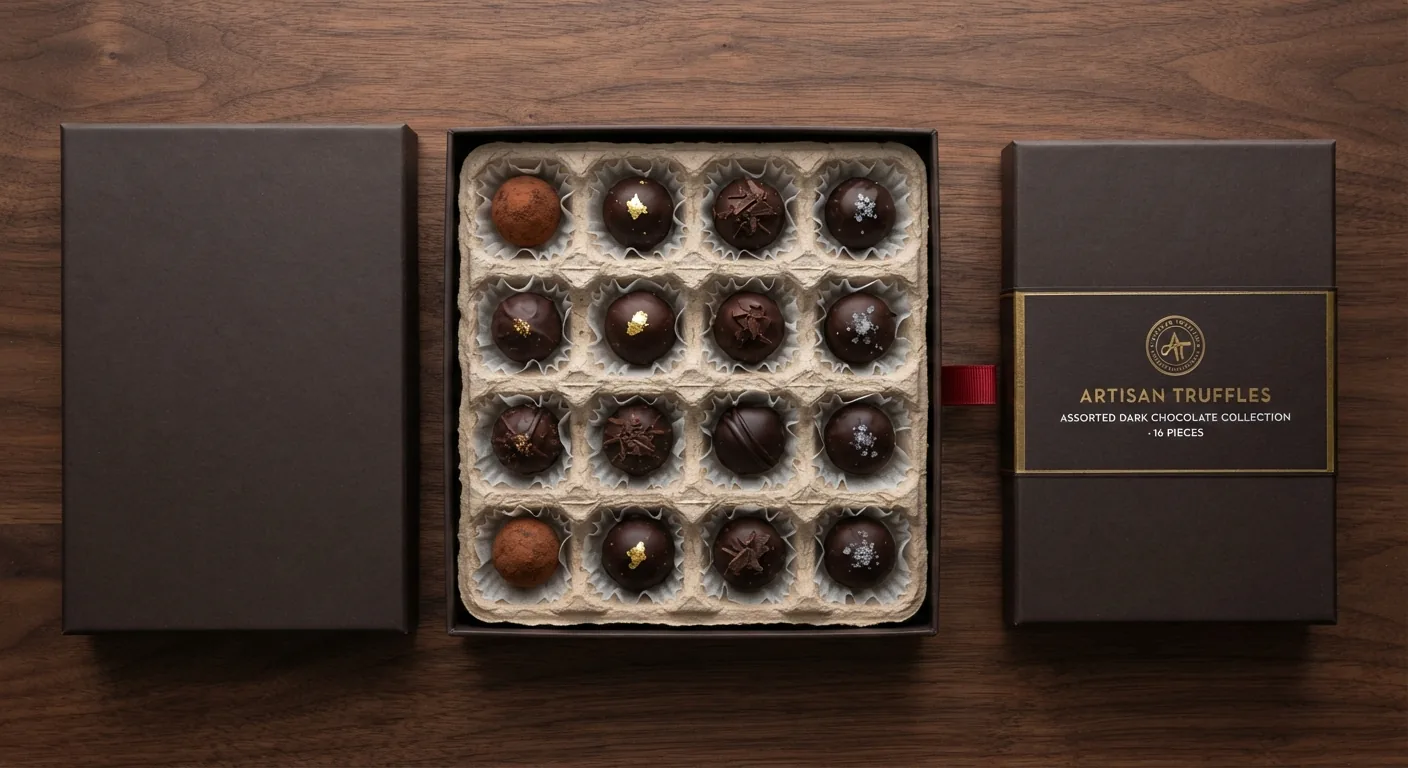
The best Christmas chocolate packaging is a cavity-tray box with a food-safe insert, a grease-resistant liner, and a closed lid for shipped gifts. Size each cavity within 2 mm of the piece, keep contents below 21°C (70°F) in transit, and approve artwork by October 30 to have boxes in hand before the December 10 final fill.
Part of our Christmas Packaging Guide
For box styles, sizes, and proof deadlines across every holiday product, start with the Christmas Packaging Guide: Box Sizes, Styles, and Deadlines for Every Product.
Which Format Fits Which Christmas Chocolate and Price Tier
Match the format to the product first and the gift price tier second, because the product sets the insert and the tier sets the structure.
| Format | Typical contents | Gift tier | Structure and insert |
|---|---|---|---|
| Cavity tray boxes | 4, 9, or 16 truffles (12 to 15 g each) | $15 to $60 | Folding cartons or rigid boxes with a thermoformed PET or molded pulp tray |
| Bonbon boxes | 12 to 24 filled bonbons (10 to 12 g each) | $40 to $120 | Two-piece rigid base and lid with a glossy tray and an optional magnetic closure |
| Bar boxes and sleeves | 1 to 4 bars (70 to 100 g) | $6 to $25 | 300 to 350 gsm sleeve over foil-wrapped bars; custom tuck boxes for 3-bar sets |
| Candy boxes by weight | 4 oz, 8 oz, 1 lb, or 2 lb of caramels, brittle, or clusters | $10 to $45 | Glassine-lined folding cartons, no dividers, optional window |
| Cocoa bomb boxes | 1 to 6 bombs (40 to 50 g each) | $5 to $40 | Windowed carton with a 3 mm pulp ring per bomb |
| Gift sets | Bar, bonbons, and a cocoa bomb together | $60 to $200 | Two-piece rigid box with a die-cut greyboard insert and ribbon pull; the premium packaging tier |
Box dimensions for every format live in the Christmas gift box sizes and candy gift box sizes guides, so this post stays on structure and protection. Gift sets sit in the chocolate gift boxes range, cavity formats in chocolate cavity boxes, and weight-based assortments in Christmas candy boxes.
The strongest chocolate gift box ideas follow a price ladder: a 3-bar sleeve set at $18 converts impulse buyers, a 16-piece cavity carton at $48 serves family gifting, and a $120 rigid set serves corporate buyers. Reusing one cavity pattern across the 9-piece and 16-piece boxes keeps tooling to a single tray die.
Print spend should follow the tier as well. Plain kraft with a one-color stamp suits the $6 to $25 bar tier, where unit cost must stay under roughly 8 to 10 percent of retail. Foil stamping, soft-touch lamination, and spot UV belong on the $60-plus gift sets, where the box is part of the gift and the extra $0.60 to $1.50 per unit disappears into the margin.
Cavity Insert Materials: PET, Molded Pulp, Greyboard, or Corrugated
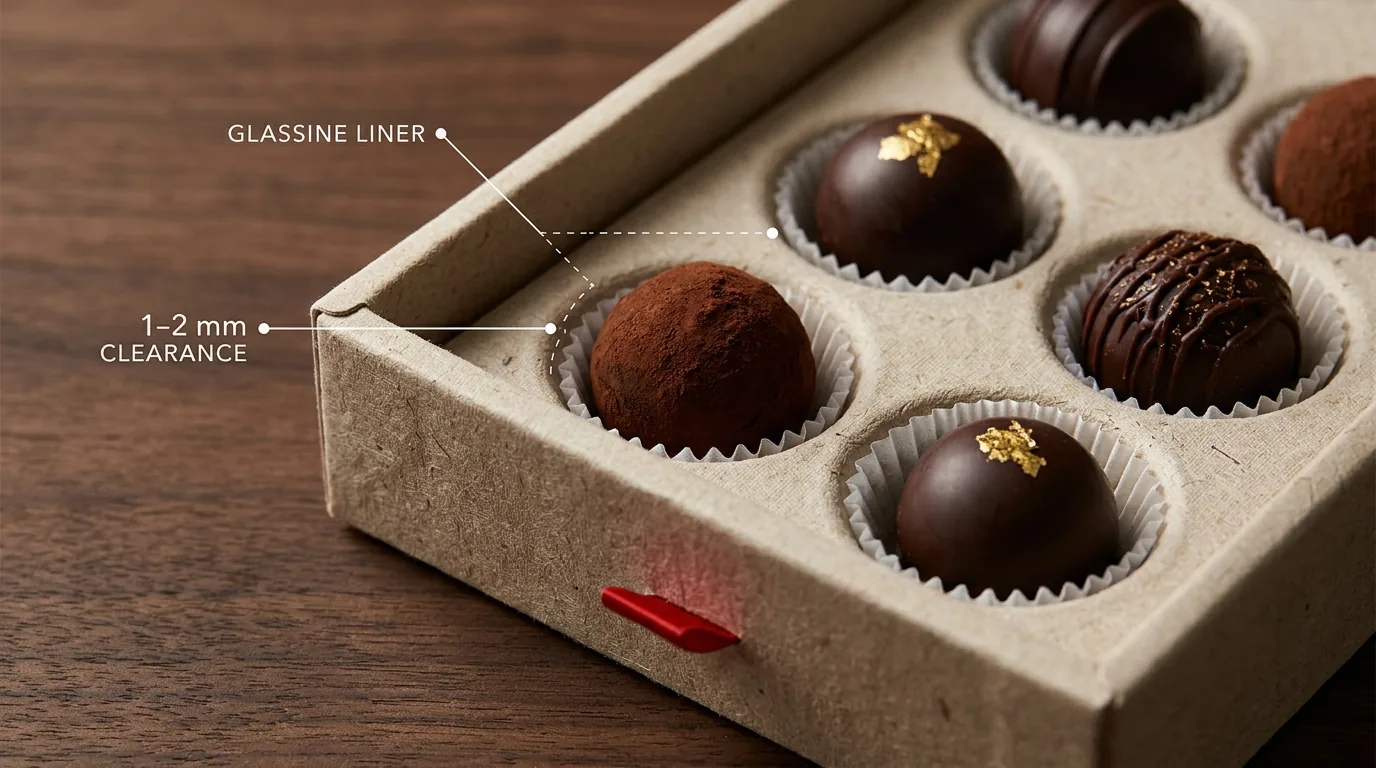
Thermoformed PET holds the tightest fit, molded pulp supports sustainable packaging claims, and die-cut greyboard carries the premium look. Whatever the material, a cavity should clear the piece by 1 to 2 mm per side and run 3 mm deeper than the piece height.
| Insert material | Best for | Food-contact note | Weakness |
|---|---|---|---|
| Thermoformed PET (0.3 to 0.5 mm) | Truffles and shiny bonbons | Use food-grade resin compliant with FDA 21 CFR | Plastic perception |
| Molded pulp | Truffles, cocoa bombs | Needs a glassine liner because cocoa butter wicks into fiber | Looser fit, about 1 to 2 mm more play |
| Die-cut greyboard (1.5 to 2 mm) | Gift sets, flat pieces | Wrap in food-safe paper | Flat cavities only |
| E-flute corrugated boxes dividers (1.5 mm) | Brittle, clusters, shipping outers | Line before contact | Visible fluting on shelf |
Cocoa butter migrates into uncoated fiber and leaves dark grease spots within one to two weeks in warm storage. Line every pulp or paperboard cavity with a 35 to 40 gsm glassine or greaseproof sheet.
How to Prevent Bloom and Scuffing in Holiday Chocolate Boxes
Bloom is a temperature and moisture problem and scuffing is a movement problem, so holiday chocolate boxes must insulate the pieces and lock them in place. Fat bloom shows as grey-white streaks when stored chocolate cycles above roughly 26°C (79°F) and cocoa butter recrystallizes on the surface. Sugar bloom appears when condensation dissolves surface sugar, which happens when a box stored near 4°C (39°F) opens in a 21°C room.
Scuffing starts with vibration. A parcel in a delivery van experiences continuous vibration for 8 to 10 hours, and a piece with 4 mm of lateral play rubs its glaze against the tray thousands of times. Cut that play to 1 to 2 mm and the glaze survives. Transfer-sheet designs and hand-painted shells need the tightest fit and a glassine interleaf between layers in any box holding more than one tier.
- Pack at 18°C (64°F) and about 50 percent relative humidity to keep moisture out of the sealed box.
- Overwrap bars in foil, which blocks light and moisture, before they enter the sleeve.
- Seat truffles in 22 to 28 mm paper cups and add a 3 mm pulp or foam lid pad so nothing lifts.
- Validate the finished pack with an ISTA 3A parcel test before the first December shipment.
Explore Our Packaging
Window Boxes or Closed Boxes for Christmas Candy Packaging
Use a closed box for shipped gifts and a windowed box for shelf sales, because a window sells in the store and a closed lid protects in the carton. Keep any window under roughly one third of the panel so the carton keeps its stacking strength, and wrap milk and white chocolate in foil behind it because they show light damage faster than dark.
Cocoa bomb cartons are the exception: buyers choose them by decoration, so give every one a 60 mm round window. In a closed rigid set, an inner-lid print and a ribbon pull build the unboxing experience that a window would otherwise advertise. Christmas candy packaging by weight, such as 8 oz brittle, sells best with a window and a glassine liner behind it.
Heat and Holiday Shipping: Keeping Chocolate Below 21°C
Chocolate ships safely when the box interior stays below 21°C (70°F) for the whole transit, which takes insulation, a cold barrier, and a short route. Most operators find that a 1 lb box on a 2-day route holds temperature with a 12 mm paper or EPS liner and one frozen 8 oz gel pack separated from the product by a corrugated layer.
Ship Monday to Wednesday so no parcel sits in a depot over a weekend. Price the outer carton against the carrier divisor of 139: a 12 x 12 x 6 inch shipper (864 cubic inches) bills as 7 lb, whatever the product weighs. A sealed e-commerce packaging outer also stops cold-room condensation, so tell recipients in northern states to let the box reach room temperature, about 2 hours, before opening.
Warm destinations need a different spec from cold ones. Shipments to Florida, Texas, Arizona, and southern California in December can meet parcel-van interiors above 30°C (86°F), so add a second gel pack and cap the route at 2 days. Shipments to northern states rarely melt but regularly freeze, which is why the sealed outer and the 2-hour rest rule matter more there.
Common Mistakes Chocolatiers Make With Holiday Packaging
| Mistake | What happens | Fix |
|---|---|---|
| Uncoated pulp tray with no liner | Grease spots within 1 to 2 weeks | 35 to 40 gsm glassine sheet |
| Cavity 4 mm oversized per side | Pieces slide and shells scuff | 1 to 2 mm clearance per side |
| No thermal plan for warm regions | Fat bloom on arrival | 21°C ceiling, insulated liner, Monday to Wednesday ship |
| Window on milk chocolate with no barrier | Dull, faded surface | Foil overwrap or tinted film |
| Approving artwork after October 30 | Boxes land after the December 10 final fill | Switch to the rush path below |
Rush Orders: What Is Still Possible Before December 10
A late order still works if you commit to an existing dieline and digital print, because custom tooling adds approximately 5 to 7 business days that a late schedule cannot absorb. See the full Christmas packaging deadlines timeline for carrier dates.
Rush also means fewer choices. Keep the cavity pattern, board, and finish already in the catalog, supply print-ready artwork at 300 dpi with 3 mm bleed, and approve the digital proof within 24 hours, because every day of delay on proof approval moves the delivery date by a day. Choose one box size over a three-tier range if December volume forces a trade, since one size reorders and replenishes faster.
| Milestone | Recommended | Latest possible |
|---|---|---|
| Artwork approved | August 15 | October 30 |
| Proof approved | September 1 | November 3 |
| Digital rush production | Complete by September 30 | Complete by about November 20 |
| Boxes in hand | October 15 | November 30 |
| Final fill and pack | November 15 to December 5 | December 10 |
| Last ground ship date | About December 12 | About December 15 to 18 |
Frequently Asked Questions
Our Packaging Products
Elevate Your Brand With Custom Packaging
Get packaging designed for your brand. Free shipping. No minimums.
Start TodayAuthor
Marguerite Hale
Marguerite Hale ran production and fulfilment for a bean-to-bar chocolate maker in Chicago for nine years, packing roughly 18,000 holiday gift boxes each December.