The Short Answer
The most common Halloween cupcake box sizes are 6.25 x 6.25 inches for 4 cupcakes, 9.5 x 6.5 inches for 6, and 12.5 x 9.5 inches for 12. Frosted cupcakes need 4 inches of internal height; tall Halloween toppers usually need 5. Exact sizes vary by insert, liner, and board thickness.
For Halloween donut box sizes, the common starting points are 10 x 7 inches for 6, 14 x 10 inches for 12, and 20 x 13.5 inches for 24, at 2.5 inches tall for flat glazes and 3 to 3.5 inches for topped donuts. All figures are internal dimensions.
The Height Rule for Cupcake and Donut Boxes
Footprint comes from count and spacing. Height comes from one formula for both product lines:
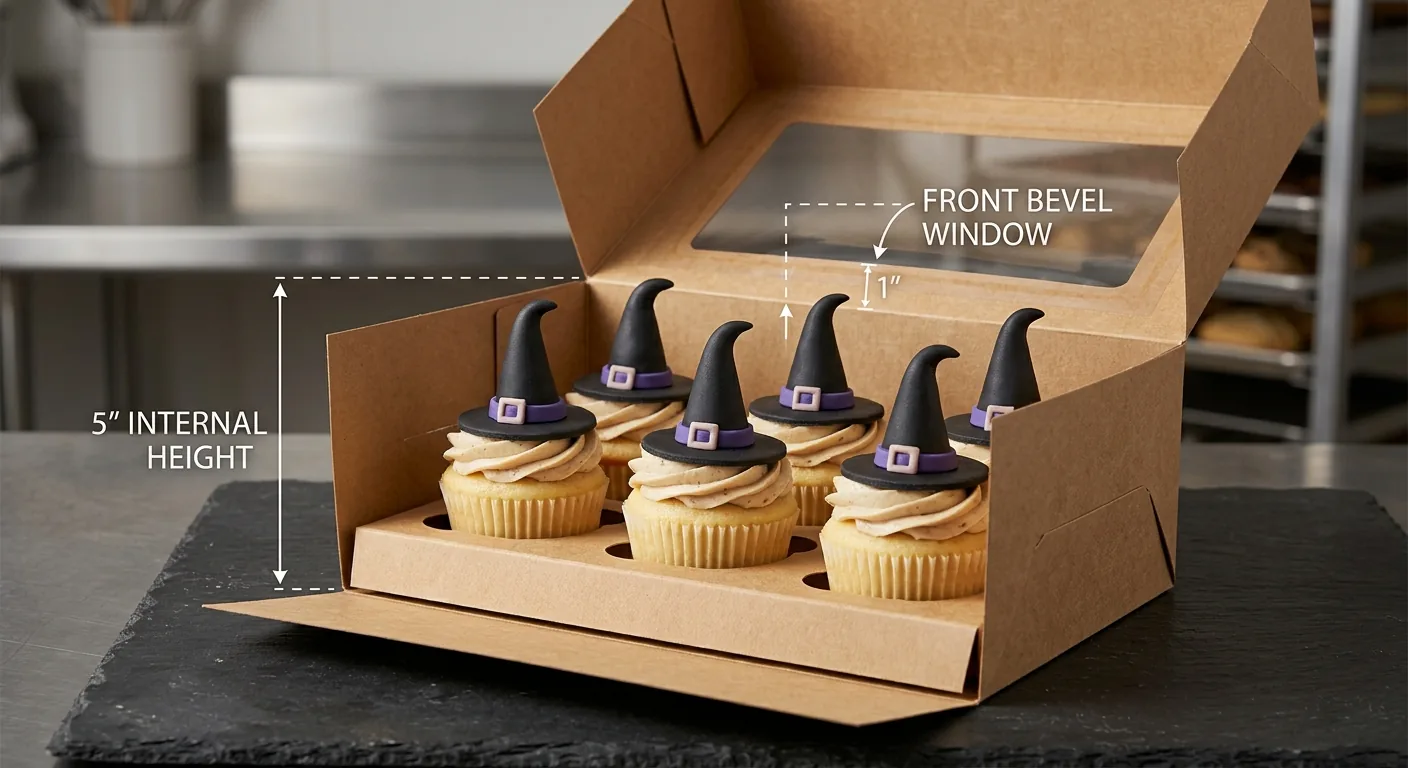
Required internal height = treat height + insert elevation + 0.5 inch clearance
Treat height runs from the liner base (or donut base) to the highest point of decoration. Insert elevation is how far the insert surface sits above the box floor: 0.25 to 0.5 inch for a raised platform, 0 for a recessed cell.
Round up to the next available stock height. Moving from 4 to 5 inches is the common practical choice once a topper sits on the frosting.
| Treat | Treat height | Insert elevation | Required height | Box height |
|---|---|---|---|---|
| Frosted swirl cupcake | 3.25 in | 0.25 in | 4.0 in | 4 in |
| Cupcake with fondant witch hat | 4.25 in | 0.25 in | 5.0 in | 5 in |
| Flat-glazed donut | 1.5 in | 0 in | 2.0 in | 2.5 in |
| Eyeball or spider-leg donut | 2.25 in | 0 in | 2.75 in | 3 to 3.5 in |
Halloween Cupcake Box Sizes by Count
Every footprint starts with the cupcake box insert. A standard liner has a 2-inch base and a 2.75-inch crown, so insert holes are commonly cut at 2.125 inches on 3-inch centers. Spacing varies by manufacturer, so two 6-count boxes from different suppliers rarely match.
Jumbo cupcakes need 2.75-inch holes on 3.75-inch centers (about 11.5 x 7.75 inches for 6). For liner-by-liner capacity beyond Halloween counts, see our cupcake box capacity guide by liner size and count.
| Count | Insert layout | Frosted (L x W x H) | Tall-topper (L x W x H) |
|---|---|---|---|
| 4 | 2 x 2 | 6.25 x 6.25 x 4 in | 6.25 x 6.25 x 5 in |
| 6 | 3 x 2 | 9.5 x 6.5 x 4 in | 9.5 x 6.5 x 5 in |
| 12 | 4 x 3 | 12.5 x 9.5 x 4 in | 12.5 x 9.5 x 5 in |
Halloween Donut Box Sizes: 6, 12, and 24 Count
Donut footprints assume a 3.25-inch ring laid flat. Candy eyeballs, pretzel spider legs, and piped mummy stripes push a Halloween donut from 1.5 inches tall to 2.25 inches or more. Everyday counts are in our donut box size chart for single, half-dozen, and dozen orders.
The 24-count row is where these Halloween bakery box dimensions diverge from everyday ones. A 20-inch span is where paperboard starts to bow, and whether it holds comes down to board caliper, corner construction, donut weight, and stack height. For filled or heavily topped two-dozen orders, E-flute corrugated boxes or reinforced corners are the safer default.
Packify builds bakery boxes to the internal dimensions you measure, so any row in the cupcake and donut size tables can be adjusted to your liner, insert, and topper height instead of forced into a stock size.
| Count | Grid | Flat glaze (L x W x H) | Halloween topped height | Typical board |
|---|---|---|---|---|
| 6 | 3 x 2 | 10 x 7 x 2.5 in | 3 to 3.5 in | 18pt SBS |
| 12 | 4 x 3 | 14 x 10 x 2.5 in | 3 to 3.5 in | 20 to 24pt SBS |
| 24 | 6 x 4 | 20 x 13.5 x 2.5 in | 3 to 3.5 in | E-flute or reinforced SBS |
Window Placement for Decorated Halloween Treats
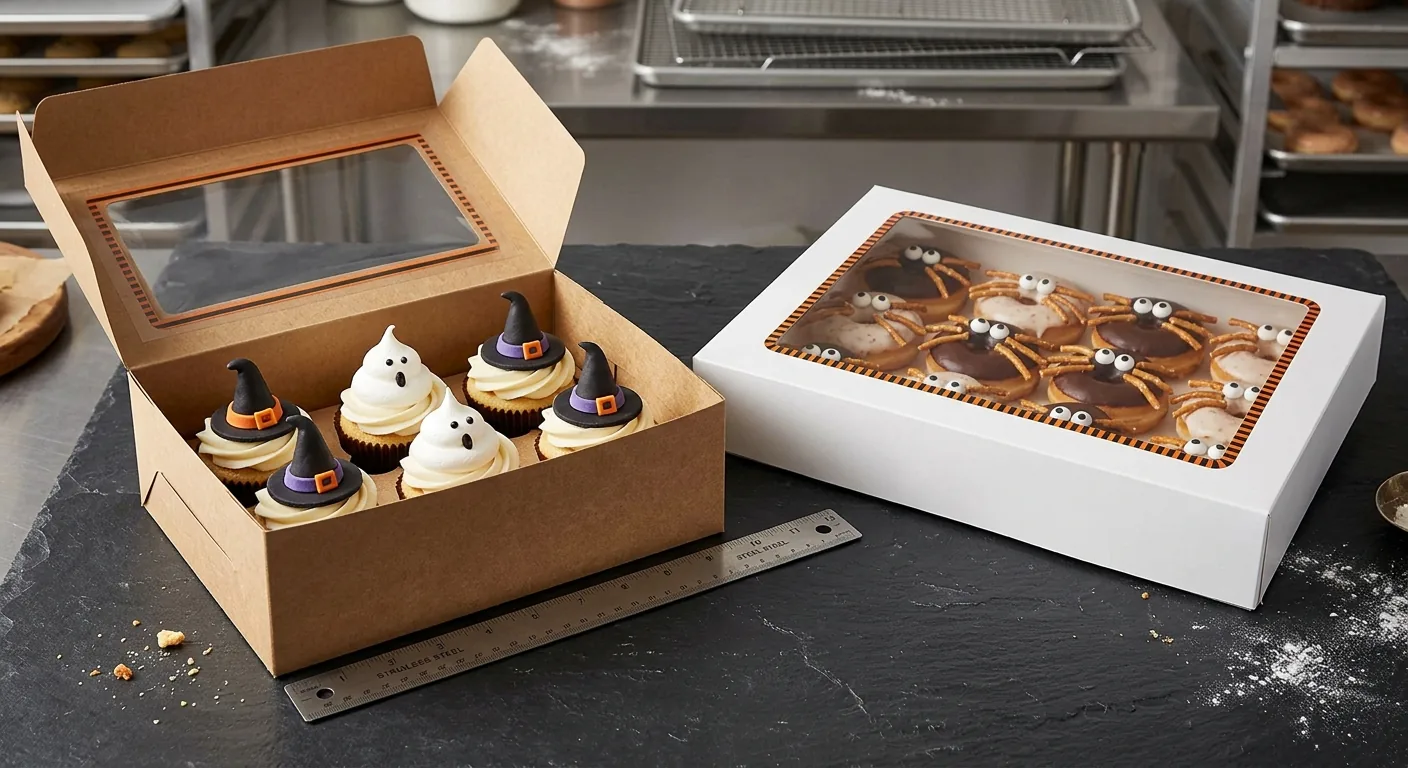
A donut box window or cupcake window sells only if it shows the decoration from the angle it was built for. Piped spiderwebs read from above. Witch hats, ghost meringues, and candy-melt bat wings read from the side.
Three guidelines hold across all spooky treat box sizes. Keep at least 0.75 inch of solid board between the window and any fold, because a closer cut weakens the corner that flexes on every opening. Start front windows 1 inch above the insert line to hide liners. Keep the 0.5-inch clearance, because black cocoa frosting transfers on contact and shows through the film as a grey smear.
Use 1.5-mil PET film, or PLA film for eco-friendly packaging. Warm donuts fog standard film; anti-fog PET prevents it.
| Treat | Decoration reads from | Window position | Window size (example box) |
|---|---|---|---|
| Spiderweb cupcakes | Above | Top panel, centered | 8 x 5 in on a 9.5 x 6.5 lid |
| Witch hat or ghost cupcakes | Side | Front bevel, starting 1 in above insert | 8.5 x 2.5 in front panel |
| Glazed eyeball donuts | Above | Top panel, centered | 10 x 6 in on a 14 x 10 lid |
| Spider-leg or stacked donuts | Above and side | Top plus wraparound front | Top 10 x 6 in, front 12 x 1.5 in |
Production-Day Lead Time Formulas
Count backward from your first Halloween sale day, which for most bakeries lands 7 to 10 days before October 31, not from the holiday itself.
Order-by day = first sale day minus (proof days + production days + transit days + buffer days)
Window patching adds a separate machine pass after die-cutting, so windowed folding cartons typically run 1 to 2 production days longer than solid-lid versions. For the full backward schedule, see our Halloween packaging deadline math.
| Stage | Standard order | Rush order |
|---|---|---|
| Artwork proof and approval | 2 to 3 business days | Same day to 1 business day |
| Production (printed, windowed) | 10 to 12 business days | 4 to 6 business days |
| Transit | 3 to 5 business days (ground) | 1 to 2 business days (expedited) |
| Buffer for reprints or carrier delay | 3 business days | 1 business day |
| Total before first sale day | 18 to 23 business days | 6 to 10 business days |
Ordering Close to Halloween: The Rush Math
Packify’s rush production runs 4 to 6 business days after proof approval, and that is the number to plug into the formula when the calendar is tight. Worked scenario: a bakery needs 500 six-count cupcake boxes and 300 dozen donut boxes, and its first Halloween sale day is 10 business days away. Standard math needs 19 business days (2 proof, 10 production, 4 transit, 3 buffer) and misses by 9. Rush math needs 9 business days (1 proof, 5 production, 2 transit, 1 buffer) and lands with 1 day to spare.
Rush pricing typically carries a premium of roughly 20 to 40 percent over standard unit pricing, and expedited freight on 800 flat-packed boxes (approximately 200 to 250 pounds) runs several times the ground rate. To cut both:
Rush one SKU, not two. The 6-count cupcake box carries most walk-in volume; the donut box can ship plain.
Drop the window on the rushed SKU. A solid lid skips the patching pass and recovers 1 to 2 production days.
Approve the proof within 2 hours. Every overnight wait costs a full business day.
When fewer business days remain than the formula needs, ask about short-run digital production first. The backup is stock windowed boxes finished with printed 3-inch stickers or sleeves in orange and black.
What Most Bakeries Get Wrong
Four mistakes account for most of the crushed toppers, hidden decorations, and late boxes that come up every Halloween.
| Mistake | What happens | Fix |
|---|---|---|
| Sizing the box to the cupcake, not the topper | Lid presses into fondant hats and meringue ghosts | Apply the height rule to the tallest treat |
| Top window on side-reading decorations | Customer sees only the frosting base | Front bevel window 1 in above insert |
| Light board on a heavy 24-count | Base bows and donuts slide to the center | E-flute, reinforced corners, or two 12-count boxes |
| Counting lead time back from October 31 | Boxes arrive after the first sale weekend | Count back from first sale day |
Frequently Asked Questions
Our Packaging Products
Elevate Your Brand With Custom Packaging
Get packaging designed for your brand. Free shipping. No minimums.
Start TodayAuthor
Jamie Holloway
Jamie Holloway writes Packify’s bakery packaging guides and works with bakeries on seasonal box specifications for cupcakes, donuts, and cookies. The lesson Jamie repeats most came from an early Halloween order: a batch of 4-inch cupcake boxes was approved for a fondant-topper line without measuring a finished, decorated cupcake on its insert, and the lids pressed into the toppers on the first test pack. Every seasonal spec since starts with measuring the tallest finished treat in place.